 VIPSolutions
give answer in 2 step with explanation at the end of each step and final answer at the end:Question # 3 (Quantum Numbers and Drawing Orbitals) Draw reasonable representations, indicating their three- dimensional nature as best you can, of the following orbitals [specify the direction of the axes used and include sign of the phase (+ or -) of each lobe] 3dz2 (i) 2p, (ii) 4d,, (iii) Question #4 (Energy Level Diagrams and the Bohr Equation) Use the Bohr equation (ignore the correction for effective nuclear charge) to construct an energy level diagram for boron. Determine the energies for the first 4 shells and for n= w, label all subshells and don’t forget to include .the electrons
Question:
give answer in 2 step with explanation at the end of each step and final answer at the end: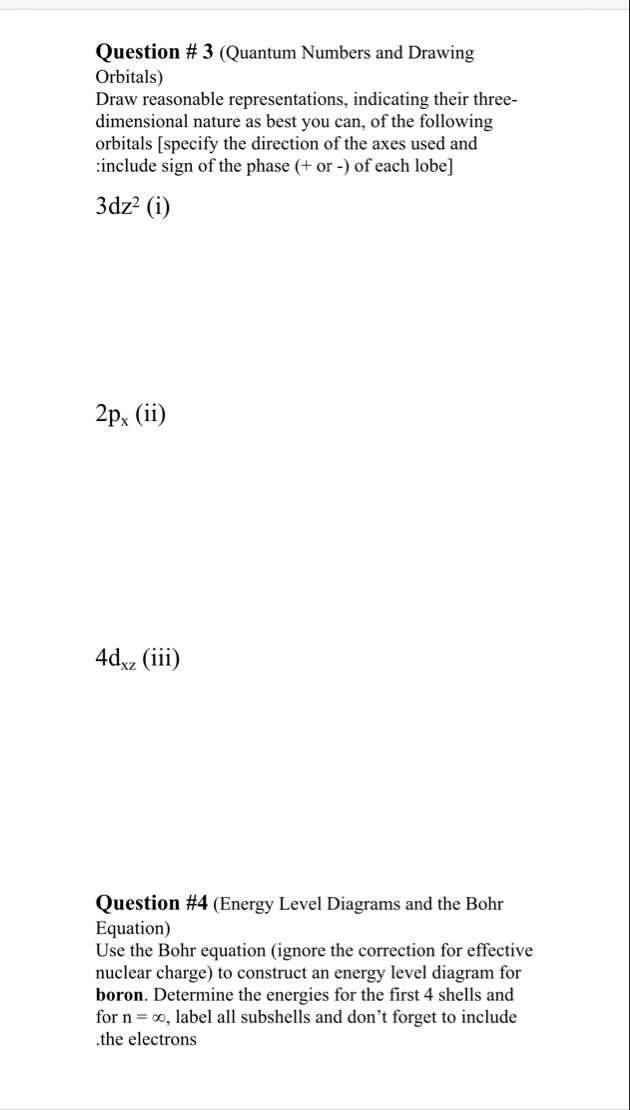 Question # 3 (Quantum Numbers and Drawing
Orbitals)
Draw reasonable representations, indicating their three-
dimensional nature as best you can, of the following
orbitals [specify the direction of the axes used and
include sign of the phase (+ or -) of each lobe]
3dz2 (i)
2p, (ii)
4d,, (iii)
Question #4 (Energy Level Diagrams and the Bohr
Equation)
Use the Bohr equation (ignore the correction for effective
nuclear charge) to construct an energy level diagram for
boron. Determine the energies for the first 4 shells and
for n= w, label all subshells and don’t forget to include
.the electrons
Question # 3 (Quantum Numbers and Drawing
Orbitals)
Draw reasonable representations, indicating their three-
dimensional nature as best you can, of the following
orbitals [specify the direction of the axes used and
include sign of the phase (+ or -) of each lobe]
3dz2 (i)
2p, (ii)
4d,, (iii)
Question #4 (Energy Level Diagrams and the Bohr
Equation)
Use the Bohr equation (ignore the correction for effective
nuclear charge) to construct an energy level diagram for
boron. Determine the energies for the first 4 shells and
for n= w, label all subshells and don’t forget to include
.the electrons
This is AI generated Response.
Asked by: Rahul
Created at: 2025-11-11 14:19:09
Asked by: Rahul
Created at: 2025-11-11 14:19:09
Final Answer:
Rendered
Raw Text
Did you like this answer?
## **Question 3: Drawing Orbitals**
### **Step 1: Draw and explain the orbitals’ shapes and axes**
#### (i) **3d<sub>z²</sub>**
- **Shape:** This orbital has a "doughnut" or "dumbbell with a donut" shape. There are two lobes along the z-axis and a torus (donut) of electron density in the xy-plane.
- **Axes:** Align the vertical axis as z.
- **Phases:** The two lobes along the z-axis have one phase (e.g., +), and the torus in the xy-plane has the opposite phase (−).
**Explanation:**
The 3d<sub>z²</sub> orbital is unique among d orbitals, featuring a donut-shaped electron cloud in the xy-plane and two elongated lobes along the z-axis.
---
#### (ii) **2p<sub>x</sub>**
- **Shape:** This orbital looks like two elongated lobes on either side of the nucleus along the x-axis.
- **Axes:** Horizontal axis is x.
- **Phases:** One lobe is +, the other is −.
**Explanation:**
The 2p<sub>x</sub> orbital is a simple dumbbell shape aligned along the x-axis, with one lobe having a positive phase and the other a negative phase.
---
#### (iii) **4d<sub>xz</sub>**
- **Shape:** Four lobes oriented between the x and z axes (in the xz-plane, at 45° to both).
- **Axes:** x and z axes.
- **Phases:** Opposite lobes have the same phase; adjacent lobes have opposite phases (+ and − alternately).
**Explanation:**
The 4d<sub>xz</sub> orbital consists of four lobes, lying between the x and z axes, characteristic of d-type orbitals, with alternating phases.
---
### **Step 2: Final Answer and Diagram Summary**
- **3d<sub>z²</sub>:** Two elongated lobes along z (both +), donut in xy-plane (−).
- **2p<sub>x</sub>:** Two lobes along x-axis (left lobe +, right lobe −).
- **4d<sub>xz</sub>:** Four lobes in xz-plane, alternating + and −.
**Final Answer:**
These are the correct three-dimensional representations of the requested orbitals, with axes and phases indicated as per quantum mechanical convention.
---
## **Question #4: Bohr Energy Levels for Boron**
### **Step 1: Bohr Equation and Energy Calculation**
The Bohr equation for energy levels:
\[
E_n = -\frac{13.6\,\text{eV}}{n^2} Z^2
\]
For boron, Z = 5.
So,
\[
E_n = -13.6 \frac{5^2}{n^2} = -340 \frac{1}{n^2} \text{ eV}
\]
Calculate for n = 1, 2, 3, 4, ∞:
- n = 1: \( E_1 = -340\, \text{eV} \)
- n = 2: \( E_2 = -85\, \text{eV} \)
- n = 3: \( E_3 = -37.8\, \text{eV} \)
- n = 4: \( E_4 = -21.25\, \text{eV} \)
- n = ∞: \( E_\infty = \, \text{eV} \)
**Explanation:**
These are the energy levels for a hydrogen-like boron atom (single electron, ignoring electron-electron interactions).
---
### **Step 2: Energy Level Diagram and Electron Configuration**
Boron has 5 electrons. Fill orbitals using the aufbau principle:
- 1s² (2 electrons)
- 2s² (2 electrons)
- 2p¹ (1 electron)
**Diagram Layout:**
- n=1: 1s (2 electrons)
- n=2: 2s (2 electrons), 2p (1 electron)
- n=3: 3s, 3p, 3d (empty)
- n=4: 4s, 4p, 4d, 4f (empty)
- n=∞: Ionization limit
**Final Answer:**
The energy level diagram for boron, using the Bohr equation, shows electrons filling up to 2p. Energy levels for n = 1 (−340 eV), n = 2 (−85 eV), n = 3 (−37.8 eV), n = 4 (−21.25 eV), and n = ∞ ( eV). Each shell and subshell is labeled, and electrons are placed as per boron’s electron configuration.
---
If you need actual orbital diagrams or a sketched energy level diagram, let me know!
Question:
Please correct answer solved
This is AI generated Response.
Asked by: Rahul
Created at: 2025-11-11 14:21:22
Asked by: Rahul
Created at: 2025-11-11 14:21:22
Final Answer:
Rendered
Raw Text
Did you like this answer?
## **Question 3: Drawing Orbitals**
### **Step 1: Draw and explain the orbitals’ shapes and axes**
#### (i) **3d<sub>z²</sub>**
- **Shape:** This orbital has a "doughnut" shape with two lobes along the z-axis and a torus in the xy-plane.
- **Axes:** The vertical axis is z.
- **Phases:** The two lobes along the z-axis are positive (+) and the torus in the xy-plane is negative (−).
**Explanation:**
The 3d<sub>z²</sub> orbital features a unique shape with a toroidal electron density in the xy-plane and two lobes extending along the z-axis, where one phase is positive and the other is negative.
---
#### (ii) **2p<sub>x</sub>**
- **Shape:** This orbital resembles two lobes positioned on either side of the nucleus along the x-axis.
- **Axes:** The horizontal axis is x.
- **Phases:** One lobe is positive (+) and the other is negative (−).
**Explanation:**
The 2p<sub>x</sub> orbital is a dumbbell shape oriented along the x-axis, indicating the different phases of the lobes.
---
#### (iii) **4d<sub>xy</sub>**
- **Shape:** This orbital has four lobes oriented in the xy-plane, between the x and y axes.
- **Axes:** The x and y axes.
- **Phases:** Opposite lobes have the same phase (+), and adjacent lobes have opposite phases (−).
**Explanation:**
The 4d<sub>xy</sub> orbital consists of four lobes positioned in the xy-plane, characteristic of d-type orbitals, with alternating phases indicated.
---
### **Step 2: Final Answer and Diagram Summary**
- **3d<sub>z²</sub>:** Two elongated lobes along z (both +), donut in the xy-plane (−).
- **2p<sub>x</sub>:** Two lobes along the x-axis (left lobe +, right lobe −).
- **4d<sub>xy</sub>:** Four lobes in the xy-plane, alternating + and −.
**Final Answer:**
These representations of the specified orbitals are accurate, with the axes and phases clearly defined according to quantum mechanical conventions.
---
## **Question #4: Bohr Energy Levels for Boron**
### **Step 1: Bohr Equation and Energy Calculation**
The Bohr equation for energy levels is given by:
\[
E_n = -\frac{13.6\,\text{eV}}{n^2} Z^2
\]
For boron (Z = 5), the equation becomes:
\[
E_n = -\frac{13.6 \cdot 5^2}{n^2} = -\frac{340}{n^2} \text{ eV}
\]
Calculate for n = 1, 2, 3, 4, and ∞:
- \( E_1 = -340\, \text{eV} \)
- \( E_2 = -85\, \text{eV} \)
- \( E_3 = -37.78\, \text{eV} \)
- \( E_4 = -21.25\, \text{eV} \)
- \( E_{\infty} = 0\, \text{eV} \)
**Explanation:**
These calculations yield the energy levels for a hydrogen-like boron atom, assuming a single electron, neglecting electron-electron interactions.
---
### **Step 2: Energy Level Diagram and Electron Configuration**
Boron has 5 electrons, filled following the Aufbau principle:
- 1s² (2 electrons)
- 2s² (2 electrons)
- 2p¹ (1 electron)
**Diagram Layout:**
- n=1: 1s (2 electrons)
- n=2: 2s (2 electrons), 2p (1 electron)
- n=3: 3s, 3p, 3d (empty)
- n=4: 4s, 4p, 4d, 4f (empty)
**Final Answer:**
The energy level diagram for boron illustrates the electrons filling up to the 2p subshell, with energy levels calculated for n = 1 (−340 eV), n = 2 (−85 eV), n = 3 (−37.78 eV), n = 4 (−21.25 eV), and n = ∞ (0 eV). Each shell and subshell is labeled, and electrons are placed according to boron’s electron configuration.
📢 Instructions:
- Ask anything relatd to above question only.
- For new Question goto :