 VIPSolutions
give answer in 2 step with explanation at the end of each step and final answer at the end:5. For the allowing general reaction: 9 1) Draw fre energy digram that depicts the formation of both the kinetic and thermodyamic enolate (4 points) 6 nol nd ket forms are tautomers of th carbo group that ifr the position of 3 double bond and a proton. Explain why i Cate A the major tame fort 1 he Ket form. whit h Cae B the majo tautomer form i the enol form. (8 points] cut 9 o caso2 0 0 ono iit - JT 20% ren
Question:
give answer in 2 step with explanation at the end of each step and final answer at the end: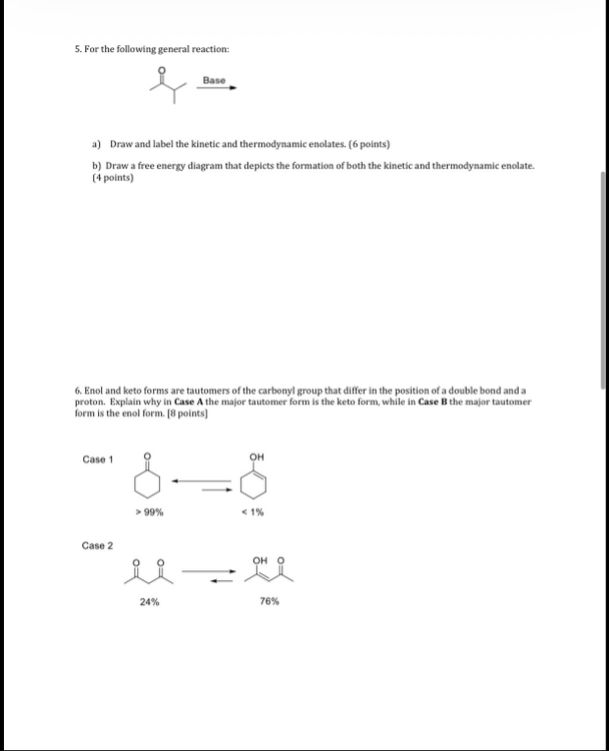 5. For the allowing general reaction:
9
1) Draw fre energy digram that depicts the formation of both the kinetic and thermodyamic enolate
(4 points)
6 nol nd ket forms are tautomers of th carbo group that ifr the position of 3 double bond and a
proton. Explain why i Cate A the major tame fort 1 he Ket form. whit h Cae B the majo tautomer
form i the enol form. (8 points]
cut 9 o
caso2
0 0 ono
iit - JT
20% ren
5. For the allowing general reaction:
9
1) Draw fre energy digram that depicts the formation of both the kinetic and thermodyamic enolate
(4 points)
6 nol nd ket forms are tautomers of th carbo group that ifr the position of 3 double bond and a
proton. Explain why i Cate A the major tame fort 1 he Ket form. whit h Cae B the majo tautomer
form i the enol form. (8 points]
cut 9 o
caso2
0 0 ono
iit - JT
20% ren
This is AI generated Response.
Asked by: Rahul
Created at: 2025-11-12 13:58:32
Asked by: Rahul
Created at: 2025-11-12 13:58:32
Final Answer:
Rendered
Raw Text
Did you like this answer?
## 5. Enolate Formation
### Step 1: Draw and Label the Kinetic and Thermodynamic Enolates
**Kinetic Enolate:**
- Formed fastest, typically at lower temperature, with a bulky base.
- Formed by removing the proton from the less substituted (more accessible) α-carbon.
**Thermodynamic Enolate:**
- More stable, formed at higher temperature, with a smaller/less hindered base.
- Formed by removing the proton from the more substituted (more stable) α-carbon.
**Structures:**
- **Kinetic enolate:**

(Double bond at less substituted position)
- **Thermodynamic enolate:**

(Double bond at more substituted position)
**Explanation:**
The kinetic enolate forms faster due to easier base access to the less hindered proton, while the thermodynamic enolate is more stable due to greater alkyl substitution.
---
### Step 2: Draw a Free Energy Diagram
- Y-axis: Free Energy
- X-axis: Reaction Coordinate
- The reactant (starting ketone) is at a higher energy level.
- The kinetic enolate forms via a lower activation energy pathway but results in a less stable (higher energy) product.
- The thermodynamic enolate requires a higher activation energy (slower to form) but results in a more stable (lower energy) product.
**Sketch:**

**Explanation:**
The diagram shows that the kinetic enolate forms faster (lower activation barrier) but is less stable, while the thermodynamic enolate is slower to form but is more stable in the long run.
---
## Final Answer (5):
- **Kinetic enolate**: Formed faster, less substituted, less stable.
- **Thermodynamic enolate**: Formed slower, more substituted, more stable.
- **Free energy diagram**: Shows lower activation energy for kinetic, but lower final energy (more stable) for thermodynamic enolate.
---
## 6. Keto-Enol Tautomerism
### Step 1: Case A — Predominance of Keto Form
- **Cyclohexanone** vs. cyclohexenol
- **Observation:** >99% keto, <1% enol
**Explanation:**
The keto form is highly favored because it has a strong carbonyl double bond (C=O), which is much more stable than the C=C and O–H in the enol. There are no special stabilizations (such as conjugation or hydrogen bonding) in the enol form.
---
### Step 2: Case B — Predominance of Enol Form
- **1,3-diketone** vs. enol form
- **Observation:** 24% keto, 76% enol
**Explanation:**
The enol form is favored because it is stabilized by intramolecular hydrogen bonding and conjugation (resonance) between the alkene and carbonyl groups. This stabilization makes the enol form more favorable than in simple ketones.
---
## Final Answer (6):
- **Case A:** Keto form dominates due to the inherent stability of the C=O bond with no special stabilization for the enol.
- **Case B:** Enol form dominates because it is stabilized by intramolecular hydrogen bonding and resonance, making it more stable than the keto form in this case.
📢 Instructions:
- Ask anything relatd to above question only.
- For new Question goto :