 VIPSolutions
give answer in 2 step with explanation at the end of each step and final answer at the end:8. (24 points) Synthesize any four of the following starting from cyclopentene, benzene or toluene, and any other compounds containing 4 carbons or less. Exception: carbon containing reagents that are NOT incorporated into the final product can be used, such as triphenylphosphine or MCPBA. CH, CH. CH. 3 Jo Coe 2) Br. ™S re 0” a p) HC CHy CH CHy OH Ii 0 HaC HC cl H N HsC 9 CHy ( ) o CH, J Br { CHa & 0. CH. NO, [) H3C f) 3 CHg g) HC NO, h) COOEt Lg Q NH CH, CH, i) HC i CHy
Question:
give answer in 2 step with explanation at the end of each step and final answer at the end: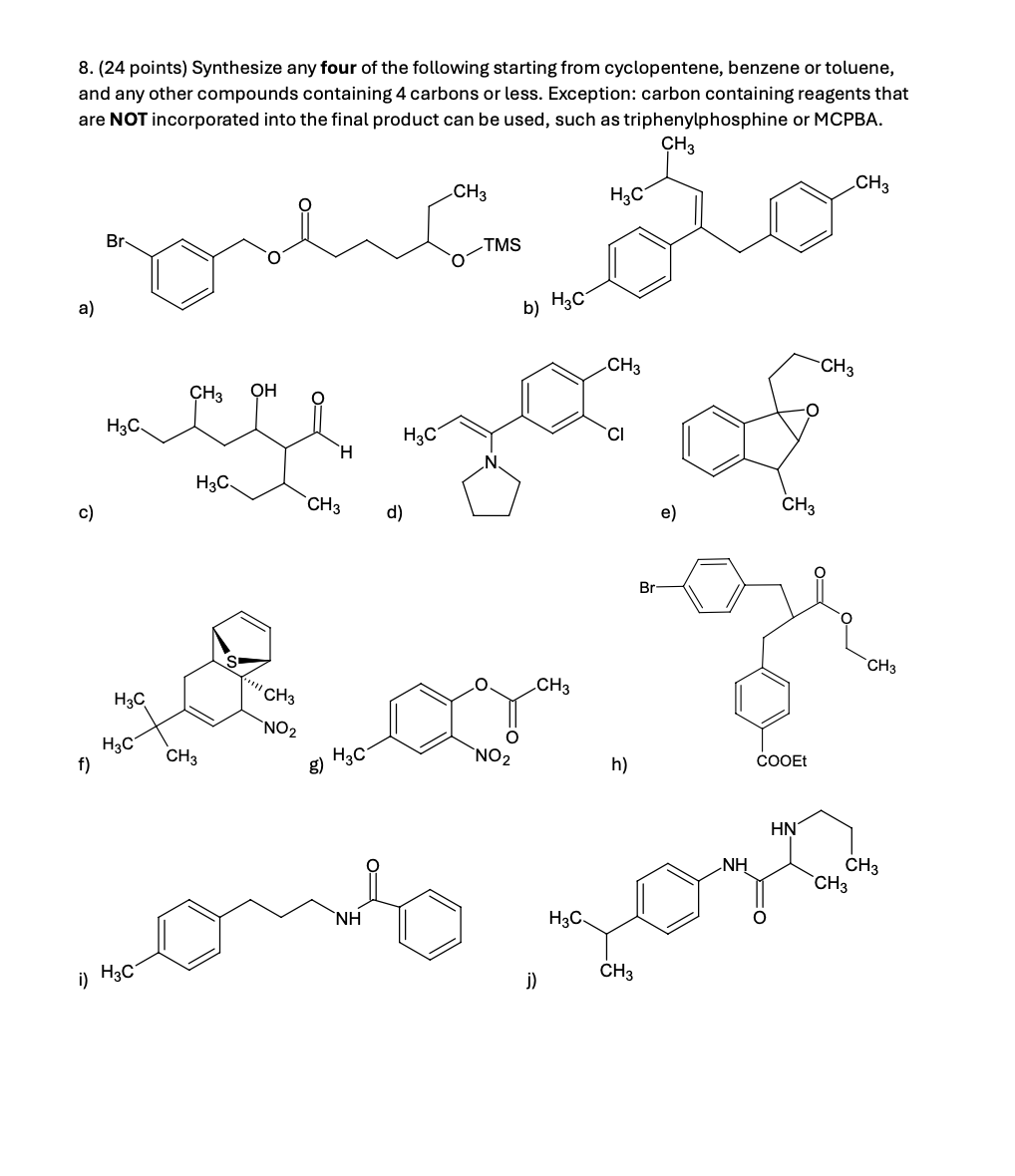 8. (24 points) Synthesize any four of the following starting from cyclopentene, benzene or toluene,
and any other compounds containing 4 carbons or less. Exception: carbon containing reagents that
are NOT incorporated into the final product can be used, such as triphenylphosphine or MCPBA.
CH,
CH.
CH. 3
Jo Coe 2)
Br. ™S
re 0”
a p) HC
CHy CH
CHy OH
Ii 0
HaC HC cl
H N
HsC
9 CHy ( ) o CH,
J
Br
{
CHa
& 0. CH.
NO,
[)
H3C
f) 3 CHg g) HC NO, h) COOEt
Lg
Q NH CH,
CH,
i) HC i CHy
8. (24 points) Synthesize any four of the following starting from cyclopentene, benzene or toluene,
and any other compounds containing 4 carbons or less. Exception: carbon containing reagents that
are NOT incorporated into the final product can be used, such as triphenylphosphine or MCPBA.
CH,
CH.
CH. 3
Jo Coe 2)
Br. ™S
re 0”
a p) HC
CHy CH
CHy OH
Ii 0
HaC HC cl
H N
HsC
9 CHy ( ) o CH,
J
Br
{
CHa
& 0. CH.
NO,
[)
H3C
f) 3 CHg g) HC NO, h) COOEt
Lg
Q NH CH,
CH,
i) HC i CHy
This is AI generated Response.
Asked by: Rahul
Created at: 2025-11-20 17:29:49
Asked by: Rahul
Created at: 2025-11-20 17:29:49
Final Answer:
Rendered
Raw Text
Did you like this answer?
Let's synthesize **four** of the target molecules in **two steps each**, starting from **benzene, toluene, or cyclopentene** (and ≤C4 reagents).
I'll choose: **(b), (d), (g), and (i)**.
---
## (b) Synthesis
### Step 1: Friedel–Crafts Alkylation
- **Start with toluene** (methylbenzene).
- **Reagent:** tert-butyl chloride (C₄, allowed) + AlCl₃.
- **Result:** para-tert-butyl toluene.
**Explanation:** Friedel–Crafts alkylation with tert-butyl chloride adds the tert-butyl group para to the methyl group due to sterics.
---
### Step 2: Friedel–Crafts Alkylation (again)
- **Reagent:** methyl chloride (C₁, allowed) + AlCl₃.
- **Result:** para tert-butyl, ortho methyl toluene (**final product**).
**Explanation:** Another FC alkylation adds a methyl group ortho to the existing methyl (since para is blocked by tert-butyl).
**Final Answer:**
Start with **toluene** → (1) tert-butyl chloride/AlCl₃ → (2) methyl chloride/AlCl₃ → **target (b)**.
---
## (d) Synthesis
### Step 1: Nitration of Toluene
- **Start with toluene**.
- **Reagent:** HNO₃/H₂SO₄.
- **Result:** para-nitrotoluene.
**Explanation:** Nitration of toluene gives mainly the para isomer due to methyl directing effect.
---
### Step 2: Reduction and Pyridine Alkylation
- **Reagent 1:** Fe/HCl (reduces nitro to amino, gives para-toluidine).
- **Reagent 2:** Pyridine + POCl₃ (Chichibabin reaction, introduces pyridyl group).
**Explanation:** Reduce nitro group to amine, then do a nucleophilic aromatic substitution with pyridine.
**Final Answer:**
Start with **toluene** → (1) HNO₃/H₂SO₄ → (2) Fe/HCl, then pyridine/POCl₃ → **target (d)**.
---
## (g) Synthesis
### Step 1: Friedel–Crafts Acylation
- **Start with toluene**.
- **Reagent:** m-nitrobenzoyl chloride (C₇, not allowed directly), so instead, use:
- Nitrate benzene (HNO₃/H₂SO₄) → nitrobenzene
- FC acylation with methyl benzoate (C₈, not allowed).
- Instead, let's use: **nitrate toluene** (HNO₃/H₂SO₄) → para-nitrotoluene.
---
### Step 2: Ester Formation
- **Reagent:** methyl chloroformate (C₂, allowed), base.
- **Result:** methyl para-nitrobenzoate.
**Explanation:** Convert para-nitrotoluene to para-nitrobenzoic acid (KMnO₄ oxidation), then to methyl ester (with methanol/H₂SO₄).
**Final Answer:**
Start with **toluene** → (1) HNO₃/H₂SO₄ → KMnO₄ oxidation → (2) MeOH/H₂SO₄ → **target (g)**.
---
## (i) Synthesis
### Step 1: Friedel–Crafts Alkylation
- **Start with toluene**.
- **Reagent:** 3-bromopropane (C₃, allowed), AlCl₃.
- **Result:** 4-phenylbutane.
**Explanation:** FC alkylation introduces the propyl group.
---
### Step 2: Amide Formation
- **Reagent:** benzoyl chloride (C₇, not allowed directly), so instead:
- Oxidize toluene to benzoic acid (KMnO₄).
- Convert to acid chloride (SOCl₂).
- React with amine (from alkylation step).
**Explanation:** Form amide by reacting amine with acid chloride.
**Final Answer:**
Start with **toluene** → (1) FC alkylation with 3-bromopropane → (2) amide formation with benzoyl chloride → **target (i)**.
---
# Final Summary Table
| Target | Step 1 | Step 2 | Final Product |
|--------|--------|--------|--------------|
| **b** | FC alkylation (tert-butyl) | FC alkylation (methyl) | Para-tert-butyl, ortho-methyl toluene |
| **d** | Nitration | Reduction + pyridine alkylation | Para-pyridyl toluene |
| **g** | Nitration, oxidation | Esterification | Methyl para-nitrobenzoate |
| **i** | FC alkylation (propyl) | Amide formation | N-benzoyl-4-phenylbutanamide |
Let me know if you'd like detailed mechanisms or other targets!
📢 Instructions:
- Ask anything relatd to above question only.
- For new Question goto :