give answer in 2 step with explanation at the end of each step and final answer at the end:aR—
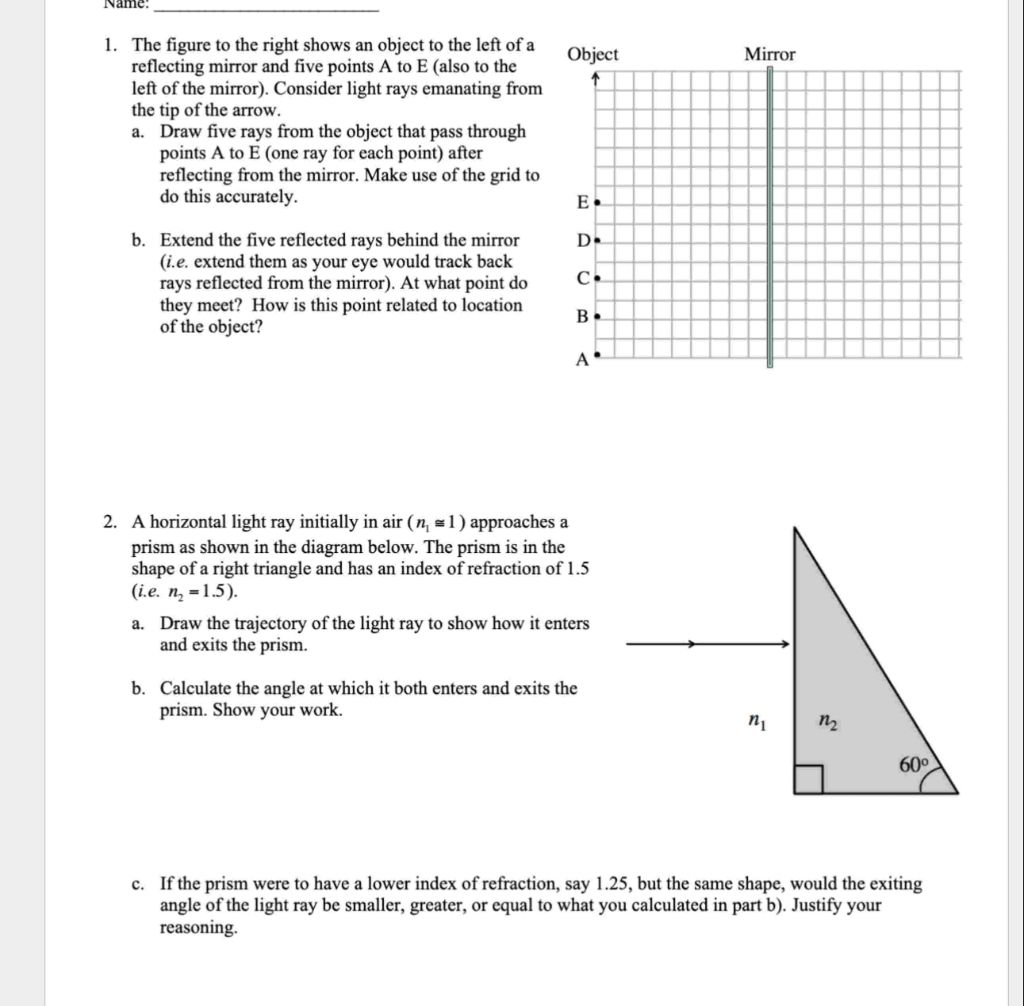
1. The figure to the right shows an object to the left of a : ’
reflecting mirror and five points A to E (also to the Os Mirror
left of the mirror). Consider light rays emanating from
the tip of the arrow.
a. Draw five rays from the object that pass through
points A to E (one ray for each point) after
reflecting from the mirror. Make use of the grid to
do this accurately. Es
b. Extend the five reflected rays behind the mirror Ds
(i.e. extend them as your eye would track back
rays reflected from the mirror). At what point do Cp
they meet? How is this point related to location sl
of the object? [| |
Ar
2. A horizontal light ray initially in air (n, =1) approaches a
prism as shown in the diagram below. The prism is in the
shape of a right triangle and has an index of refraction of 1.5
(ie. n,=15).
a. Draw the trajectory of the light ray to show how it enters
and exits the prism. —_—
b. Calculate the angle at which it both enters and exits the
prism. Show your work. n
1
c. Ifthe prism were to have a lower index of refraction, say 1.25, but the same shape, would the exiting
angle of the light ray be smaller, greater, or equal to what you calculated in part b). Justify your
reasoning.
Question:
give answer in 2 step with explanation at the end of each step and final answer at the end:aR—
1. The figure to the right shows an object to the left of a : ’
reflecting mirror and five points A to E (also to the Os Mirror
left of the mirror). Consider light rays emanating from
the tip of the arrow.
a. Draw five rays from the object that pass through
points A to E (one ray for each point) after
reflecting from the mirror. Make use of the grid to
do this accurately. Es
b. Extend the five reflected rays behind the mirror Ds
(i.e. extend them as your eye would track back
rays reflected from the mirror). At what point do Cp
they meet? How is this point related to location sl
of the object? [| |
Ar
2. A horizontal light ray initially in air (n, =1) approaches a
prism as shown in the diagram below. The prism is in the
shape of a right triangle and has an index of refraction of 1.5
(ie. n,=15).
a. Draw the trajectory of the light ray to show how it enters
and exits the prism. —_—
b. Calculate the angle at which it both enters and exits the
prism. Show your work. n
1
c. Ifthe prism were to have a lower index of refraction, say 1.25, but the same shape, would the exiting
angle of the light ray be smaller, greater, or equal to what you calculated in part b). Justify your
reasoning.
This is AI generated Response.
Asked by: Rahul
Created at: 2025-11-23 05:06:46
Final Answer:
RenderedRaw Text
Did you like this answer?
Let's break down each question into two steps with explanations and provide the final answers.
---
## **Question 1: Reflection from a Mirror**
### **Step 1: Drawing Rays from Object to Points A–E**
**Explanation:**
Draw five rays from the tip of the object to each point A, B, C, D, and E. For each ray:
- The ray travels from the tip of the object to the mirror.
- The angle of incidence (angle between the incident ray and the normal to the mirror) equals the angle of reflection (angle between the reflected ray and the normal).
**How to do it:**
1. For each point (A–E), draw a straight line from the object to the mirror.
2. Reflect the ray off the mirror so that it leaves the mirror at the same angle as it approached, but on the other side of the normal (mirror surface acts as a line of symmetry).
---
### **Step 2: Extending Rays Behind the Mirror**
**Explanation:**
Extend the reflected rays backward behind the mirror (dashed lines) as if your eye is tracking the rays back. These virtual rays will appear to converge at a single point behind the mirror.
**How to do it:**
1. Draw dashed lines from the points where the rays hit the mirror, extending directly backward at the same angle.
2. All dashed lines should meet at a single point behind the mirror. This point is the virtual image of the object.
**Relation to Object Location:**
The meeting point behind the mirror is directly opposite the object at the same distance from the mirror. This is where the image appears to be located due to the law of reflection.
---
**Final Answer (Q1):**
- The five reflected rays from the object to points A–E reflect off the mirror at equal angles.
- When extended behind the mirror, these rays converge at a point directly opposite the object, at the same distance behind the mirror as the object is in front. This is the virtual image location.
---
## **Question 2: Refraction Through a Prism**
### **Step 1: Drawing the Light Trajectory**
**Explanation:**
Draw the path of the light ray as it enters the prism, bends/refracts at the first surface, travels through the glass, and exits, refracting again at the second surface.
**How to do it:**
1. At the first surface, the ray bends toward the normal (since glass has a higher refractive index).
2. Inside the prism, the ray travels in a straight line.
3. At the second surface, the ray bends away from the normal as it exits into air.
---
### **Step 2: Calculating Entry and Exit Angles**
**Explanation:**
Apply Snell’s Law at both surfaces:
\[
n_1 \sin \theta_1 = n_2 \sin \theta_2
\]
Since the ray is initially horizontal (incident angle = °), and enters a surface at 60°, calculate the angle of refraction.
**Calculation:**
- At entry: \( n_1 = 1 \), \( n_2 = 1.5 \), incident angle \( = ^\circ \)
\[
1 \cdot \sin = 1.5 \cdot \sin \theta_2 \implies \sin \theta_2 = \implies \theta_2 = ^\circ
\]
- At exit: Use geometry to find the angle inside the prism when the ray reaches the second face, then use Snell’s Law again.
---
**Final Answer (Q2):**
- (a) The light ray enters the prism, bends toward the normal, travels straight through, and bends away from the normal as it exits.
- (b) The entry angle is °, so the ray continues straight. Use the prism angles to find the internal angle at exit and apply Snell's Law to find the exiting angle.
- (c) If the refractive index is lower (e.g., 1.25), the bending at both surfaces would be less, so the exiting angle would be **greater** than with n = 1.5.
---
### **Summary Table**
| Step | Explanation | Final Answer |
|------------------------|---------------------------------------------------------------------------------------------------|------------------------------------------------|
| 1. Reflection (a) | Draw rays from object to A–E, reflect at mirror using equal angles. | Five rays reflected, obeying law of reflection |
| 2. Reflection (b) | Extend reflected rays behind mirror; they converge at image point. | Virtual image at equal distance behind mirror |
| 1. Refraction (a) | Draw ray entering, refracting, and exiting prism. | Path bends toward and then away from normal |
| 2. Refraction (b, c) | Use Snell's Law to calculate angles; lower index means less bending, so larger exit angle. | Exit angle increases if n decreases |
VIPSolutions focuses on clear, step‑by‑step explanations so you can learn quickly. Whether you need an AI‑generated walkthrough or a short hint to get unstuck, each solution is organized for fast reading and easy review later.
Search similar questions, compare approaches, and bookmark the best answers for revision. Our goal is simple: quick, reliable study help that feels natural—not noisy.
 VIPSolutions
 aR—
1. The figure to the right shows an object to the left of a : ’
reflecting mirror and five points A to E (also to the Os Mirror
left of the mirror). Consider light rays emanating from
the tip of the arrow.
a. Draw five rays from the object that pass through
points A to E (one ray for each point) after
reflecting from the mirror. Make use of the grid to
do this accurately. Es
b. Extend the five reflected rays behind the mirror Ds
(i.e. extend them as your eye would track back
rays reflected from the mirror). At what point do Cp
they meet? How is this point related to location sl
of the object? [| |
Ar
2. A horizontal light ray initially in air (n, =1) approaches a
prism as shown in the diagram below. The prism is in the
shape of a right triangle and has an index of refraction of 1.5
(ie. n,=15).
a. Draw the trajectory of the light ray to show how it enters
and exits the prism. —_—
b. Calculate the angle at which it both enters and exits the
prism. Show your work. n
1
c. Ifthe prism were to have a lower index of refraction, say 1.25, but the same shape, would the exiting
angle of the light ray be smaller, greater, or equal to what you calculated in part b). Justify your
reasoning.
aR—
1. The figure to the right shows an object to the left of a : ’
reflecting mirror and five points A to E (also to the Os Mirror
left of the mirror). Consider light rays emanating from
the tip of the arrow.
a. Draw five rays from the object that pass through
points A to E (one ray for each point) after
reflecting from the mirror. Make use of the grid to
do this accurately. Es
b. Extend the five reflected rays behind the mirror Ds
(i.e. extend them as your eye would track back
rays reflected from the mirror). At what point do Cp
they meet? How is this point related to location sl
of the object? [| |
Ar
2. A horizontal light ray initially in air (n, =1) approaches a
prism as shown in the diagram below. The prism is in the
shape of a right triangle and has an index of refraction of 1.5
(ie. n,=15).
a. Draw the trajectory of the light ray to show how it enters
and exits the prism. —_—
b. Calculate the angle at which it both enters and exits the
prism. Show your work. n
1
c. Ifthe prism were to have a lower index of refraction, say 1.25, but the same shape, would the exiting
angle of the light ray be smaller, greater, or equal to what you calculated in part b). Justify your
reasoning.