 VIPSolutions
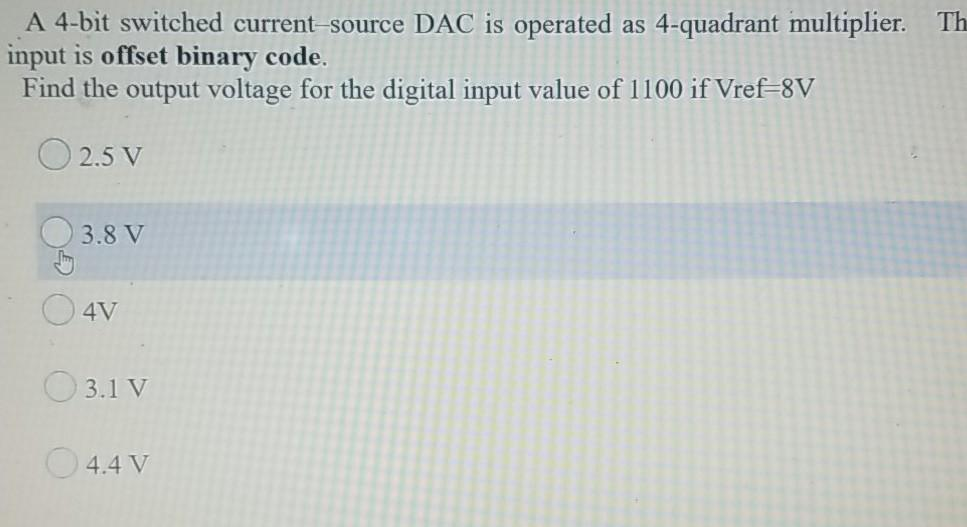
give answer with explanation at the end of each step and final answer at the endA 6-bit switched current-source DAC has R=25kQ and E¢¢=5V. Find output voltage when input is 010110. ()i3av. ele 9g 3.7V © 238V 0) 2.0. 171V, “A 4-bit switched current-—source DAC is operated as 4-quadrant multiplier. Th input is offset binary code. Find the output voltage for the digital input value of 1100 if Vref=8V O25v : O38v Lb) D4 D3.1V 44V
Question:
give answer with explanation at the end of each step and final answer at the end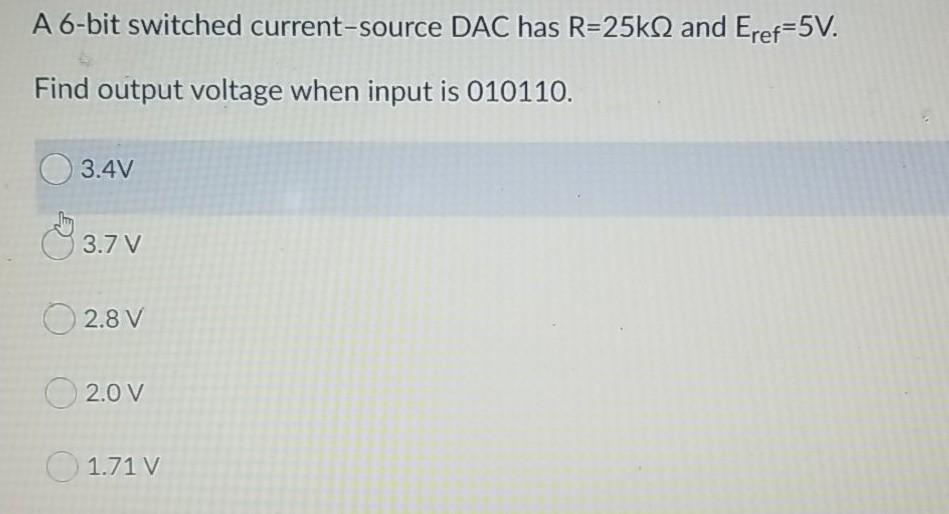
 A 6-bit switched current-source DAC has R=25kQ and E¢¢=5V.
Find output voltage when input is 010110.
()i3av.
ele 9g 3.7V
© 238V
0) 2.0.
171V,
“A 4-bit switched current-—source DAC is operated as 4-quadrant multiplier. Th
input is offset binary code.
Find the output voltage for the digital input value of 1100 if Vref=8V
O25v :
O38v
Lb)
D4
D3.1V
44V
A 6-bit switched current-source DAC has R=25kQ and E¢¢=5V.
Find output voltage when input is 010110.
()i3av.
ele 9g 3.7V
© 238V
0) 2.0.
171V,
“A 4-bit switched current-—source DAC is operated as 4-quadrant multiplier. Th
input is offset binary code.
Find the output voltage for the digital input value of 1100 if Vref=8V
O25v :
O38v
Lb)
D4
D3.1V
44V
This is AI generated Response.
Asked by: amu
Created at: 2025-07-26 15:24:48
Asked by: amu
Created at: 2025-07-26 15:24:48
Final Answer:
Rendered
Raw Text
Did you like this answer?
Let's solve both problems step-by-step:
---
### **First Question:**
#### **Given:**
- 6-bit DAC (so number of bits, n = 6)
- \( R = 25 \text{k}\Omega \) (not required for voltage calculation)
- \( E_{ref} = 5V \)
- Input = 010110 (binary)
#### **Step 1: Convert binary input to decimal**
- 010110 in binary = \( 0 \times 2^5 + 1 \times 2^4 + 0 \times 2^3 + 1 \times 2^2 + 1 \times 2^1 + 0 \times 2^0 \)
- \( = 0 + 16 + 0 + 4 + 2 + 0 = 22 \)
**Explanation**: Each bit represents a power of 2, starting from the right (least significant bit).
---
#### **Step 2: Calculate the output voltage**
The output voltage for an n-bit DAC is:
\[
V_{out} = \frac{D}{2^n - 1} \times E_{ref}
\]
Where \( D \) = decimal input, \( n \) = number of bits
\[
V_{out} = \frac{22}{2^6 - 1} \times 5
\]
\[
2^6 = 64 \implies 2^6 - 1 = 63
\]
\[
V_{out} = \frac{22}{63} \times 5 = \frac{110}{63} \approx 1.746 \text{ V}
\]
---
#### **Step 3: Match with options**
Closest option: **1.71 V**
---
### **Final Answer (Q1):**
**1.71 V**
---
---
### **Second Question:**
#### **Given:**
- 4-bit DAC (so n = 4)
- Input is offset binary code.
- Digital input value = 1100 (binary)
- \( V_{ref} = 8V \)
#### **Step 1: Convert offset binary code to decimal**
For a 4-bit offset binary code, the value is:
\[
\text{Decimal value} = \text{Binary value} - 8
\]
- 1100 (binary) = 12 (decimal)
- Offset: 12 - 8 = 4
**Explanation**: Offset binary code is "straight binary" minus half the range (\(2^{n-1}\)).
---
#### **Step 2: Calculate output voltage**
\[
V_{out} = \frac{\text{Decimal value}}{2^n - 1} \times V_{ref}
\]
\[
2^4 - 1 = 15
\]
\[
V_{out} = \frac{4}{15} \times 8 = \frac{32}{15} \approx 2.13 \text{ V}
\]
**However**, usually for 4-quadrant multiplying DACs with offset binary, the range is from -Vref to +Vref, and the formula is:
\[
V_{out} = \left( \frac{D}{2^{n-1}} - 1 \right) \times V_{ref}
\]
Where \( D \) = decimal value (binary input)
For 1100:
- D = 12
\[
V_{out} = \left( \frac{12}{8} - 1 \right) \times 8 = (1.5 - 1) \times 8 = 0.5 \times 8 = 4.0 \text{ V}
\]
---
#### **Step 3: Match with options**
Option: **4 V**
---
### **Final Answer (Q2):**
**4 V**
---
### **Summary Table**
| Question | Step | Explanation | Calculation/Result | Final Answer |
|----------|------|--------------------------------------------|--------------------|--------------|
| 1 | 1 | Convert 010110 to decimal | 22 | |
| 1 | 2 | Use DAC formula | 1.71 V | **1.71 V** |
| 2 | 1 | Offset binary: 1100 = 12, 12-8=4 | | |
| 2 | 2 | Use offset binary DAC formula | 4 V | **4 V** |
Question:
tell concept used in answering the question in paragraph form in very brief
This is AI generated Response.
Asked by: amu
Created at: 2025-07-26 15:29:40
Asked by: amu
Created at: 2025-07-26 15:29:40
Final Answer:
Rendered
Raw Text
Did you like this answer?
The concepts used involve understanding digital-to-analog conversion principles. For the first question, the key idea is converting the binary input to its decimal equivalent and then applying the DAC's voltage output formula, which relates the decimal value to the reference voltage based on the number of bits. For the second question, the concept of offset binary coding is employed, where the binary input represents a signed value centered around zero, requiring conversion from offset binary to a signed decimal value. Then, the output voltage is calculated considering this offset, typically using a formula that maps the decimal value to a voltage range spanning negative to positive voltages proportional to the reference voltage.
📢 Instructions:
- Ask anything relatd to above question only.
- For new Question goto :