 VIPSolutions
give detailed answer1. Aflat heater is sandwiched between two solid of equal areas (0.2 m?) and equal thickness (50 mm), but with the different thermal conductivities. Solid A has a thermal conductivity of 32 W/mK and solid B has a thermal conductivity of 10 W/mK. The heater operates at a uniform temperature and provides a constant power of 300 W. The external surface of each solid is 310 K, and there is perfect thermal contact at each internal interface. a) Calculate the heat flux through each solid. b) What is the operating temperature of the heater? A B T T, T 300 K 300K
Question:
give detailed answer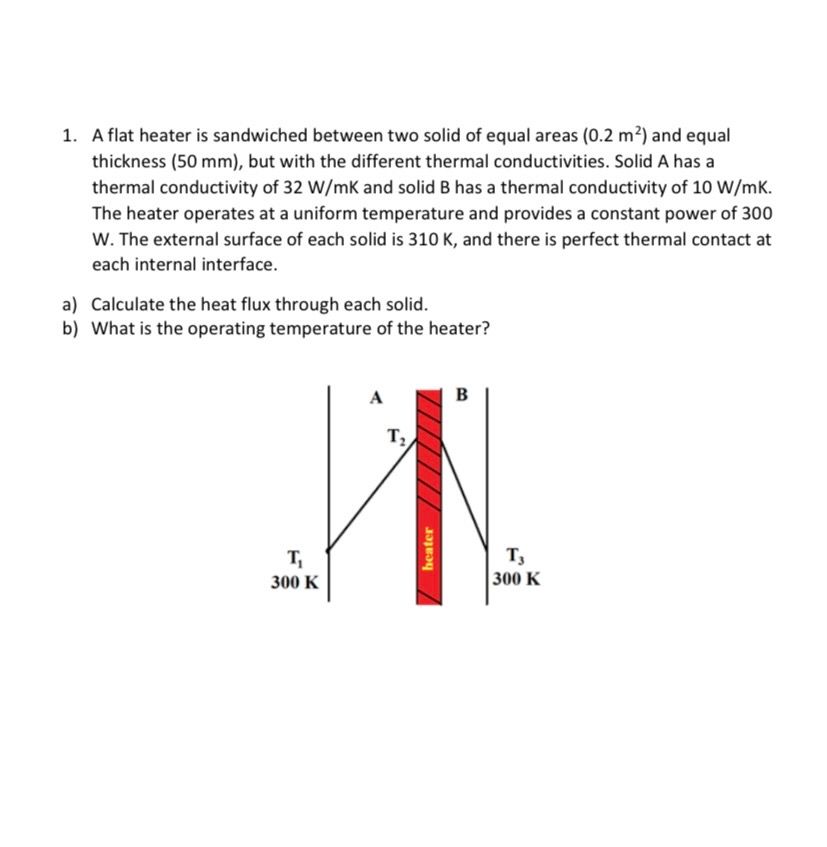 1. Aflat heater is sandwiched between two solid of equal areas (0.2 m?) and equal
thickness (50 mm), but with the different thermal conductivities. Solid A has a
thermal conductivity of 32 W/mK and solid B has a thermal conductivity of 10 W/mK.
The heater operates at a uniform temperature and provides a constant power of 300
W. The external surface of each solid is 310 K, and there is perfect thermal contact at
each internal interface.
a) Calculate the heat flux through each solid.
b) What is the operating temperature of the heater?
A B
T
T, T
300 K 300K
1. Aflat heater is sandwiched between two solid of equal areas (0.2 m?) and equal
thickness (50 mm), but with the different thermal conductivities. Solid A has a
thermal conductivity of 32 W/mK and solid B has a thermal conductivity of 10 W/mK.
The heater operates at a uniform temperature and provides a constant power of 300
W. The external surface of each solid is 310 K, and there is perfect thermal contact at
each internal interface.
a) Calculate the heat flux through each solid.
b) What is the operating temperature of the heater?
A B
T
T, T
300 K 300K
This is AI generated Response.
Asked by: manish kumar
Created at: 2026-01-15 12:26:12
Asked by: manish kumar
Created at: 2026-01-15 12:26:12
Final Answer:
Rendered
Raw Text
Did you like this answer?
# Solution
Let's break down the problem step by step.
## Given Data
- **Area of each solid, \( A \) = .2 m²**
- **Thickness of each solid, \( L \) = 50 mm = .05 m**
- **Thermal conductivity of A, \( k_A \) = 32 W/mK**
- **Thermal conductivity of B, \( k_B \) = 10 W/mK**
- **Power supplied by heater, \( Q = 300 \) W**
- **Surface temperature on both sides, \( T_1 = T_3 = 310 \) K**
- **Perfect thermal contact at interfaces**
Diagram:
```
T1 (310K) --| Solid A |-- T2 --| Heater |-- T3 --| Solid B |-- (310K)
```
---
## a) **Calculate the heat flux through each solid**
The heat supplied by the heater must flow through both solids A and B in series, so the heat flux through both is the same.
\[
Q = \dot{q} \cdot A
\]
\[
\dot{q} = \frac{Q}{A} = \frac{300}{.2} = 150\, \text{W/m}^2
\]
**Answer:**
**Heat flux through each solid = 150 W/m²**
---
## b) **What is the operating temperature of the heater?**
Let's denote:
- \( T_1 = 310\,K \) (left external surface)
- \( T_2 \) (interface between A and heater)
- \( T_3 \) (interface between B and heater)
- \( T_h \) (temperature of the heater, assumed uniform)
The heat transfer through each solid:
- Through A:
\[
Q = \frac{k_A A (T_2 - T_1)}{L}
\]
- Through B:
\[
Q = \frac{k_B A (T_3 - T_4)}{L}
\]
Where \( T_4 = 310\,K \) (right external surface).
The heater is sandwiched between A and B, so the temperature at the heater surface is \( T_h \), and:
- \( T_2 = T_h \) (interface with A)
- \( T_3 = T_h \) (interface with B)
So:
- \( Q = \frac{k_A A (T_h - T_1)}{L} \)
- \( Q = \frac{k_B A (T_h - T_4)}{L} \)
Both sides see the same \( Q \), so:
- On the left:
\[
T_h - T_1 = \frac{Q L}{k_A A}
\]
- On the right:
\[
T_h - T_4 = \frac{Q L}{k_B A}
\]
Plug in the numbers:
- For A:
\[
T_h - 310 = \frac{300 \times .05}{32 \times .2} = \frac{15}{6.4} = 2.34375\,K
\]
\[
T_h = 310 + 2.34375 = 312.34\,K
\]
- For B:
\[
T_h - 310 = \frac{300 \times .05}{10 \times .2} = \frac{15}{2} = 7.5\,K
\]
\[
T_h = 310 + 7.5 = 317.5\,K
\]
**But the heater is in the middle, and the temperature must be such that the heat flows are the same; so we need to solve for \( T_h \) considering both sides:**
Let \( Q = \frac{k_A A (T_h - 310)}{L} \) (left) and \( Q = \frac{k_B A (T_h - 310)}{L} \) (right).
However, both solids are exposed to 310 K at their external faces, and the heater sits between, so the heat supplied by the heater drives flow in both directions, and the temperature of the heater should be higher than 310 K.
But since the heater is sandwiched by two different thermal resistances, the temperature rise above 310 K is the sum of the temperature rises across each slab.
\[
Q = \frac{T_h - 310}{R_{\text{total}}}
\]
Where:
\[
R_{\text{total}} = R_A + R_B = \frac{L}{k_A A} + \frac{L}{k_B A}
\]
Calculate each resistance:
- \( R_A = \frac{.05}{32 \times .2} = \frac{.05}{6.4} = .0078125 \) K/W
- \( R_B = \frac{.05}{10 \times .2} = \frac{.05}{2} = .025 \) K/W
So,
\[
R_{\text{total}} = .0078125 + .025 = .0328125 \text{ K/W}
\]
Now,
\[
T_h = 310 + Q \times R_{\text{total}} = 310 + 300 \times .0328125 = 310 + 9.84375 = 319.84\,K
\]
---
## **Summary of Answers**
### a) **Heat flux through each solid**
\[
\boxed{150\, \text{W/m}^2}
\]
### b) **Operating temperature of the heater**
\[
\boxed{319.84\,K}
\]
📢 Instructions:
- Ask anything relatd to above question only.
- For new Question goto :