This is AI generated Response.
Asked by: sreegeeth
Created at: 2025-09-11 09:52:53
Final Answer:
RenderedRaw Text
Did you like this answer?
# Transportation Problem: Full Solution
## Problem Restatement
A manufacturer must supply:
- **650 tons** to Customer A
- **800 tons** to Customer B
Supply available:
- **Warehouse 1 (W1):** 400 tons
- **Warehouse 2 (W2):** 500 tons
- **Warehouse 3 (W3):** 600 tons
**Shipping costs per ton:**
| | W1 | W2 | W3 |
|----------|------|------|------|
| Cust A | 7.50 | 6.25 | 6.50 |
| Cust B | 6.75 | 7.00 | 8.00 |
Let \( X_{ij} \) be tons shipped to customer \( i \) from warehouse \( j \).
---
## a) Objective Function
**Minimize Total Cost:**
\[
\text{Minimize } Z = 7.50X_{A1} + 6.25X_{A2} + 6.50X_{A3} + 6.75X_{B1} + 7.00X_{B2} + 8.00X_{B3}
\]
---
## b) Constraints
### Supply Constraints
- Warehouse 1: \( X_{A1} + X_{B1} \leq 400 \)
- Warehouse 2: \( X_{A2} + X_{B2} \leq 500 \)
- Warehouse 3: \( X_{A3} + X_{B3} \leq 600 \)
### Demand Constraints
- Customer A: \( X_{A1} + X_{A2} + X_{A3} = 650 \)
- Customer B: \( X_{B1} + X_{B2} + X_{B3} = 800 \)
### Non-Negativity
- \( X_{ij} \geq 0 \) for all \( i, j \)
---
## c) Best Shipping Arrangement (Minimize Cost)
We set up the transportation tableau and use the **Least Cost Method** (or solve via Linear Programming):
### Step 1: Allocate to the lowest cost cells first:
- Lowest cost: 6.25 (A, W2), allocate as much as possible.
- W2 can supply 500, A needs 650 ⇒ allocate 500 to A from W2.
- \( X_{A2} = 500 \)
- Remaining for A: 650 - 500 = 150
- Next lowest for A: 6.50 (A, W3), W3 can supply 600.
- Allocate 150 to A from W3.
- \( X_{A3} = 150 \)
- A's demand is now met.
Now, allocate to B:
- W1 now has 400 supply, still unused. B's cost from W1 is 6.75.
- Allocate 400 to B from W1 (meets W1's capacity).
- \( X_{B1} = 400 \)
- Remaining B: 800 - 400 = 400
- Next lowest for B: W2 is used up. Next is W3 at 8.00.
- W3 has 600 - 150 = 450 left.
- Allocate 400 to B from W3.
- \( X_{B3} = 400 \)
- All demands and supplies are now met.
- \( X_{A1} = 0 \), \( X_{B2} = 0 \), \( X_{A2} = 500 \), \( X_{A3} = 150 \), \( X_{B1} = 400 \), \( X_{B3} = 400 \)
### Solution Table
| | W1 | W2 | W3 | Total |
|--------|----|----|----|-------|
| **A** | 0 | 500| 150| 650 |
| **B** |400 | 0 |400 | 800 |
| **Tot**|400 |500 |550 | 1450 |
**Note:** W3 has 50 tons unused (600-150-400).
### Total Cost Calculation
\[
Z = (7.50 \times 0) + (6.25 \times 500) + (6.50 \times 150) + (6.75 \times 400) + (7.00 \times 0) + (8.00 \times 400)
\]
\[
= 0 + 3125 + 975 + 2700 + 0 + 3200 = \boxed{10,000}
\]
---
## d) Non-binding Decision Variable
A non-binding variable is one where the constraint is not tight.
- **W3** only ships 550 tons (out of 600), so its capacity constraint is **not binding**.
- **Thus, \( X_{A3} \) and \( X_{B3} \) are non-binding**.
---
## e) Range of Optimality for \( X_{A3} \)
Since W3 has 50 extra tons capacity, \( X_{A3} \) could increase by up to 50 more tons before hitting the supply limit, assuming demand for A could increase.
- **Range:** \( 0 \leq X_{A3} \leq 200 \) (since original solution used 150, and up to 50 more can be shipped from W3, provided demand for A increases).
- If demand does not change, the range is just \( X_{A3} = 150 \).
---
## f) Savings from Shipping 10 Tons Less to Customer A
If A's demand is **reduced by 10 tons (to 640 tons)**, we would save the cost of shipping the 10 most expensive tons currently being shipped to A.
- The last 150 tons to A were shipped from W3 at **$6.50/ton**.
- So, reducing A's demand by 10 tons saves **$6.50 × 10 = $65**.
---
## **Final Summary**
- **Objective:** Minimize total shipping cost: \(\boxed{Z = 7.50X_{A1} + 6.25X_{A2} + 6.50X_{A3} + 6.75X_{B1} + 7.00X_{B2} + 8.00X_{B3}}\)
- **Constraints:** Meet customer demand, do not exceed warehouse supply, non-negativity.
- **Optimal Shipping Plan:** Ship as much as possible from lowest-cost routes (see above table).
- **Minimum Total Cost:** **$10,000**
- **Non-binding Variable:** Shipments from W3 (since it is underutilized).
- **Range of Optimality for \( X_{A3} \):** Up to 200 tons (if demand increased), currently 150 tons.
- **Saving by Reducing A's Demand by 10 Tons:** **$65** (at $6.50/ton).
Question:
give 2 sentence summmary in each question (a to f)
This is AI generated Response.
Asked by: sreegeeth
Created at: 2025-09-11 09:55:50
Final Answer:
RenderedRaw Text
Did you like this answer?
## a) Objective Function
The objective function aims to minimize the total shipping cost, represented as:
\[
\text{Minimize } Z = 7.50X_{A1} + 6.25X_{A2} + 6.50X_{A3} + 6.75X_{B1} + 7.00X_{B2} + 8.00X_{B3}
\]
This equation incorporates the shipping costs for each warehouse to both customers.
---
## b) Constraints
The constraints include supply limitations from each warehouse and the demand requirements from both customers. Specifically, each warehouse's total shipments cannot exceed its capacity, and the total shipments to each customer must meet their demand.
---
## c) Best Shipping Arrangement
Using the Least Cost Method, the optimal shipping arrangement is determined, resulting in allocations of 500 tons from W2 to A, 150 tons from W3 to A, 400 tons from W1 to B, and 400 tons from W3 to B. This arrangement meets all customer demands while minimizing shipping costs.
---
## d) Non-binding Decision Variable
The non-binding decision variable is associated with shipments from Warehouse 3 (W3), as it has the capacity to ship more than what is currently allocated. This indicates that the constraint on W3 is not tight, allowing for flexibility in allocations.
---
## e) Range of Optimality for \( X_{A3} \)
The range of optimality for \( X_{A3} \) is defined as being able to ship up to 200 tons if demand increases, given the current allocation of 150 tons from W3. This flexibility is due to W3 having 50 tons of unused capacity.
---
## f) Savings from Shipping 10 Tons Less to Customer A
If Customer A's demand is reduced by 10 tons, the savings would amount to $65, based on the shipping cost of $6.50 per ton from W3. This reduction allows for a lower overall shipping cost without compromising the supply to other customers.
VIPSolutions focuses on clear, step‑by‑step explanations so you can learn quickly. Whether you need an AI‑generated walkthrough or a short hint to get unstuck, each solution is organized for fast reading and easy review later.
Search similar questions, compare approaches, and bookmark the best answers for revision. Our goal is simple: quick, reliable study help that feels natural—not noisy.
 VIPSolutions
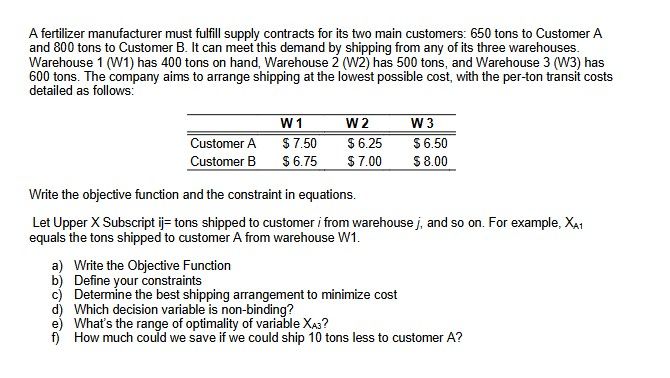 Afertizer manufacturer must fulfil supply contracts for its two main customers: 650 tons to Customer A
and 800 tons to Customer B. It can meet this demand by shipping from any of ts three warehouses.
Warehouse 1(W1) has 400 tons on hand, Warehouse 2 (W2) has 500 tons, and Warehouse 3 (W3) has
600 tons. The company aims to arrange shipping at the lowest possible cost. with the per-ton transit costs
detailed as follows:
WI 2k WER
CustomerA $750 $625 $650
CustomerB $675 $7.00 $800
Wiite the objective function and the constraint in equations.
Let Upper X Subscript f= tons shipped to customer from warehouse j, and so on. For example, Xa,
equals the tons shipped to customer A from warehouse W1
a) Wiite the Objective Function
b) Define your constraints
©) Determine the best shipping arrangement to minimize cost
d) Which decision variable is non-binding?
€) What's the range of optimality of variable Xu?
1) How much could we save if we could ship 10 tons less to customer A?
Afertizer manufacturer must fulfil supply contracts for its two main customers: 650 tons to Customer A
and 800 tons to Customer B. It can meet this demand by shipping from any of ts three warehouses.
Warehouse 1(W1) has 400 tons on hand, Warehouse 2 (W2) has 500 tons, and Warehouse 3 (W3) has
600 tons. The company aims to arrange shipping at the lowest possible cost. with the per-ton transit costs
detailed as follows:
WI 2k WER
CustomerA $750 $625 $650
CustomerB $675 $7.00 $800
Wiite the objective function and the constraint in equations.
Let Upper X Subscript f= tons shipped to customer from warehouse j, and so on. For example, Xa,
equals the tons shipped to customer A from warehouse W1
a) Wiite the Objective Function
b) Define your constraints
©) Determine the best shipping arrangement to minimize cost
d) Which decision variable is non-binding?
€) What's the range of optimality of variable Xu?
1) How much could we save if we could ship 10 tons less to customer A?