 VIPSolutions
give full answer and give final summary[Vi Neher | on | olEaplores Sey Do | stay 0 Tandy 255 oboe | 30 pred hs 5 J | ssi * “To hot plc n ht al cpoycs we wo ve comctive dys pr eck wih tn Come eyo (Sry snd Soy om) Sac +
Question:
give full answer and give final summary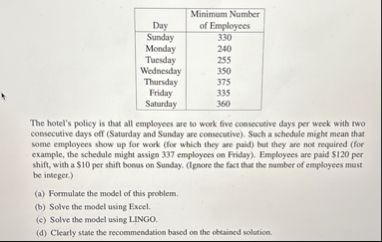 [Vi Neher
| on | olEaplores
Sey Do
| stay 0
Tandy 255
oboe | 30
pred
hs 5
J | ssi *
“To hot plc n ht al cpoycs we wo ve comctive dys pr eck wih tn
Come eyo (Sry snd Soy om) Sac +
[Vi Neher
| on | olEaplores
Sey Do
| stay 0
Tandy 255
oboe | 30
pred
hs 5
J | ssi *
“To hot plc n ht al cpoycs we wo ve comctive dys pr eck wih tn
Come eyo (Sry snd Soy om) Sac +
This is AI generated Response.
Asked by: lincy
Created at: 2025-10-02 22:18:53
Asked by: lincy
Created at: 2025-10-02 22:18:53
Final Answer:
Rendered
Raw Text
Did you like this answer?
# Workforce Scheduling: Hotel Employees## Problem OverviewA hotel requires minimum number of employees on each day of the week (see table). Each employee works **five consecutive days** with **two consecutive days off**. Employees are paid **$120 per shift**, with a **$10 bonus** for working on Sundays. The objective is to **minimize total labor costs** while ensuring daily staffing requirements are met.
| Day | Minimum Number of Employees |
|------------|----------------------------|
| Sunday | 330 |
| Monday | 240 |
| Tuesday | 255 |
| Wednesday | 350 |
| Thursday | 375 |
| Friday | 335 |
| Saturday | 360 |
## (a) Mathematical Formulation
### **Decision Variables**
Let:
- \( x_i \): Number of employees whose **first working day is day \( i \)**
(where \( i = 1 \) to \( 7 \): 1=Sunday, 2=Monday, ..., 7=Saturday)
### **Objective Function**
Minimize **total cost**:
\[
\text{Total Cost} = 120 \times \text{Total shifts worked} + 10 \times \text{Total Sunday shifts}
\]
But since each employee works five shifts, with only those scheduled on Sunday receiving a $10 bonus for that day:
\[
\text{Total Cost} = 120 \times 5 \times \sum_{i=1}^{7} x_i + 10 \times (\text{Number of employees working Sunday})
\]
But since every employee works 5 days, and we only pay bonus for those working on Sunday, we need to count how many employees work on Sunday.
Let’s note that anyone who **does not have Sunday or Saturday off** will work on Sunday.
Let’s clarify with the schedule:
- Employees starting on **Sunday**: work Sun, Mon, Tue, Wed, Thu
- Employees starting on **Monday**: work Mon, Tue, Wed, Thu, Fri
- Employees starting on **Tuesday**: work Tue, Wed, Thu, Fri, Sat
- Employees starting on **Wednesday**: work Wed, Thu, Fri, Sat, Sun
- Employees starting on **Thursday**: work Thu, Fri, Sat, Sun, Mon
- Employees starting on **Friday**: work Fri, Sat, Sun, Mon, Tue
- Employees starting on **Saturday**: work Sat, Sun, Mon, Tue, Wed
#### Therefore, the number of employees working on Sunday =
\( x_1 \) (start Sun)
+ \( x_4 \) (start Wed)
+ \( x_5 \) (start Thu)
+ \( x_6 \) (start Fri)
+ \(_7 \) (start Sat)
So:
\[
\text{Sunday Workers} = x_1 + x_4 + x_5 + x_6 + x_7
\]
#### **Objective Function (Full):**
\[
\text{Minimize } Z = 600 \sum_{i=1}^{7} x_i + 10(x_1 + x_4 + x_5 + x_6 + x_7)
\]
### **Constraints**
#### **Coverage Constraints**
On each day, the sum of all employees scheduled to work that day must be at least the minimum required:
Let’s define which variables cover each day:
- **Sunday**: \( x_1 \) (start Sun), \( x_4 \) (start Wed), \( x_5 \) (start Thu), \( x_6 \) (start Fri), \( x_7 \) (start Sat)
- **Monday**: \( x_1 \) (Sun), \( x_2 \) (Mon), \( x_5 \) (Thu), \( x_6 \) (Fri), \( x_7 \) (Sat)
- **Tuesday**: \( x_1 \) (Sun), \( x_2 \) (Mon), \( x_3 \) (Tue), \( x_6 \) (Fri), \( x_7 \) (Sat)
- **Wednesday**: \( x_1 \) (Sun), \( x_2 \) (Mon), \( x_3 \) (Tue), \( x_4 \) (Wed), \( x_7 \) (Sat)
- **Thursday**: \( x_1 \) (Sun), \( x_2 \) (Mon), \( x_3 \) (Tue), \( x_4 \) (Wed), \( x_5 \) (Thu)
- **Friday**: \( x_2 \) (Mon), \( x_3 \) (Tue), \( x_4 \) (Wed), \( x_5 \) (Thu), \( x_6 \) (Fri)
- **Saturday**: \( x_3 \) (Tue), \( x_4 \) (Wed), \( x_5 \) (Thu), \( x_6 \) (Fri), \( x_7 \) (Sat)
So, the constraints are:
\[
\begin{align*}
x_1 + x_4 + x_5 + x_6 + x_7 &\geq 330 \quad \text{(Sunday)} \\
x_1 + x_2 + x_5 + x_6 + x_7 &\geq 240 \quad \text{(Monday)} \\
x_1 + x_2 + x_3 + x_6 + x_7 &\geq 255 \quad \text{(Tuesday)} \\
x_1 + x_2 + x_3 + x_4 + x_7 &\geq 350 \quad \text{(Wednesday)} \\
x_1 + x_2 + x_3 + x_4 + x_5 &\geq 375 \quad \text{(Thursday)} \\
x_2 + x_3 + x_4 + x_5 + x_6 &\geq 335 \quad \text{(Friday)} \\
x_3 + x_4 + x_5 + x_6 + x_7 &\geq 360 \quad \text{(Saturday)} \\
\end{align*}
\]
#### **Non-negativity**
\[
x_i \geq \quad \text{and integer, for } i = 1,...,7
\]
---
## (b) **Excel Model**
Set up variables \( x_1 \) through \( x_7 \) in Excel, and use **Solver**:
- **Objective:** Minimize \( 600 \times \text{SUM}(x_1:x_7) + 10 \times (x_1+x_4+x_5+x_6+x_7) \)
- **Constraints:** As above (one for each day), and \( x_i \geq \), integer.
---
## (c) **LINGO Model**
LINGO code:
```LINGO
MODEL:
SETS:
DAYS /1..7/: x, req, sun_bonus;
ENDSETS
DATA:
req = @TABLE(
1, 330,
2, 240,
3, 255,
4, 350,
5, 375,
6, 335,
7, 360
);
sun_bonus(1) = 1;
sun_bonus(2) = ;
sun_bonus(3) = ;
sun_bonus(4) = 1;
sun_bonus(5) = 1;
sun_bonus(6) = 1;
sun_bonus(7) = 1;
! Coverage matrix: work[i][j] = 1 if shift i covers day j;
work(i,1) = @OR(i=1,i=4,i=5,i=6,i=7);
work(i,2) = @OR(i=1,i=2,i=5,i=6,i=7);
work(i,3) = @OR(i=1,i=2,i=3,i=6,i=7);
work(i,4) = @OR(i=1,i=2,i=3,i=4,i=7);
work(i,5) = @OR(i=1,i=2,i=3,i=4,i=5);
work(i,6) = @OR(i=2,i=3,i=4,i=5,i=6);
work(i,7) = @OR(i=3,i=4,i=5,i=6,i=7);
ENDSETS
! Objective
MIN = 600 * @SUM(DAYS(i): x(i)) + 10 * @SUM(DAYS(i): sun_bonus(i) * x(i));
! Coverage constraints
@FOR(DAYS(j):
@SUM(DAYS(i): work(i,j) * x(i)) >= req(j)
);
! Integrality
@FOR(DAYS(i): @GIN(x(i)));
END
```
---
## (d) **Recommendation**
- **Interpret the solution:**
The optimal values for \( x_1, ..., x_7 \) will give you the **number of employees to start on each day**.
- This ensures minimum cost while meeting staffing requirements.
- Employees should be scheduled according to the optimal start days as determined by the model.
---
## **Final Summary**
- **Formulate as an integer linear program**: variables represent number of employees starting each day, objective is to minimize total labor + Sunday bonus.
- **Implement in Excel or LINGO** using the model above.
- **Recommendation:** Hire and schedule employees so that their start days match the optimal solution to minimize costs and ensure daily coverage.
**(Actual numeric solution requires running the model in Excel or LINGO with real solvers.)**
📢 Instructions:
- Ask anything relatd to above question only.
- For new Question goto :