 VIPSolutions
give step by step answer and give final summaryWi HE i JERE 2 Hc = i=] He = Bie EEE : Bl = Hy
Question:
give step by step answer and give final summary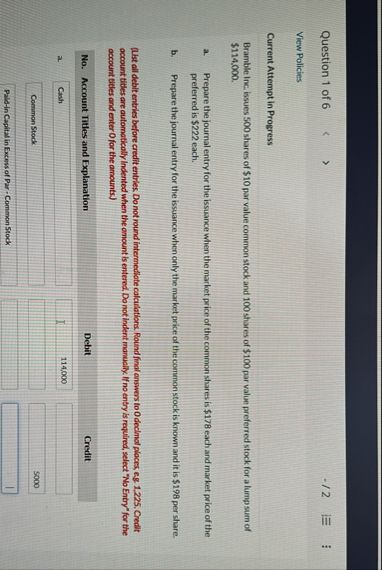 Wi HE
i JERE 2
Hc =
i=]
He =
Bie
EEE
: Bl =
Hy
Wi HE
i JERE 2
Hc =
i=]
He =
Bie
EEE
: Bl =
Hy
This is AI generated Response.
Asked by: sreegeeth
Created at: 2025-09-17 19:23:33
Asked by: sreegeeth
Created at: 2025-09-17 19:23:33
Final Answer:
Rendered
Raw Text
Did you like this answer?
Let's break down the question and solve it step by step.
---
### **Question Overview**
**Current Attempt in Progress:**
- Company issues 500 shares of $10 par value common stock and 100 shares of $10 par value preferred stock for a lump sum of $11,000.
You are asked:
**a.** Prepare the journal entry **if the issue was with the fair market price of common stock at $17.50 each and preferred stock at $19.80 each**.
**b.** Prepare the journal entry **if the issue was with only the par value of common stock known and it is $16.98 per share**.
---
## **Step-by-Step Solution**
### **a. Lump-Sum Issue Using Fair Market Value**
#### **Step 1: Calculate Total Fair Market Value**
- Common stock: 500 shares × $17.50 = **$8,750**
- Preferred stock: 100 shares × $19.80 = **$1,980**
- **Total FMV** = $8,750 + $1,980 = **$10,730**
#### **Step 2: Allocate Lump Sum Proportionately**
Total cash received = **$11,000**
- **Common Stock Allocation:**
= ($8,750 / $10,730) × $11,000
= 0.8155 × $11,000
= **$8,971**
- **Preferred Stock Allocation:**
= ($1,980 / $10,730) × $11,000
= 0.1845 × $11,000
= **$2,029**
#### **Step 3: Prepare Journal Entry**
- **Common Stock:** 500 shares × $10 par value = $5,000
- **Preferred Stock:** 100 shares × $10 par value = $1,000
- **Paid-in Capital in Excess of Par—Common:** $8,971 - $5,000 = $3,971
- **Paid-in Capital in Excess of Par—Preferred:** $2,029 - $1,000 = $1,029
**Journal Entry:**
| Account Title | Debit | Credit |
|-------------------------------------------|--------|--------|
| Cash | 11,000 | |
| Common Stock (500 × $10) | | 5,000 |
| Paid-in Capital in Excess of Par—Common | | 3,971 |
| Preferred Stock (100 × $10) | | 1,000 |
| Paid-in Capital in Excess of Par—Preferred | | 1,029 |
---
### **b. Lump-Sum Issue Using Only Par Value of Common Stock Known**
**Given:** Common stock value per share: $16.98
#### **Step 1: Calculate Total Value**
- Common stock: 500 shares × $16.98 = **$8,490**
- **Cash received:** $11,000
- **Preferred Stock allocation:** $11,000 - $8,490 = **$2,510**
#### **Step 2: Prepare Journal Entry**
- **Common Stock:** 500 × $10 = $5,000
- **Paid-in Capital in Excess of Par—Common:** $8,490 - $5,000 = $3,490
- **Preferred Stock:** 100 × $10 = $1,000
- **Paid-in Capital in Excess of Par—Preferred:** $2,510 - $1,000 = $1,510
**Journal Entry:**
| Account Title | Debit | Credit |
|-------------------------------------------|--------|--------|
| Cash | 11,000 | |
| Common Stock (500 × $10) | | 5,000 |
| Paid-in Capital in Excess of Par—Common | | 3,490 |
| Preferred Stock (100 × $10) | | 1,000 |
| Paid-in Capital in Excess of Par—Preferred | | 1,510 |
---
## **Final Summary**
- **When issuing stock for a lump sum, the proceeds are allocated based on the relative fair market value of each class of stock.**
- **If only one class’s value is known, allocate that value first, and the remainder to the other class.**
- **Journal entries record the par value to the "Stock" accounts, and the excess to "Paid-in Capital in Excess of Par" accounts.**
If you need the journal entries in a specific format or have follow-up questions, let me know!
📢 Instructions:
- Ask anything relatd to above question only.
- For new Question goto :