Give step-by-step solution with explanation and final answer:Problem 2 (25 points)
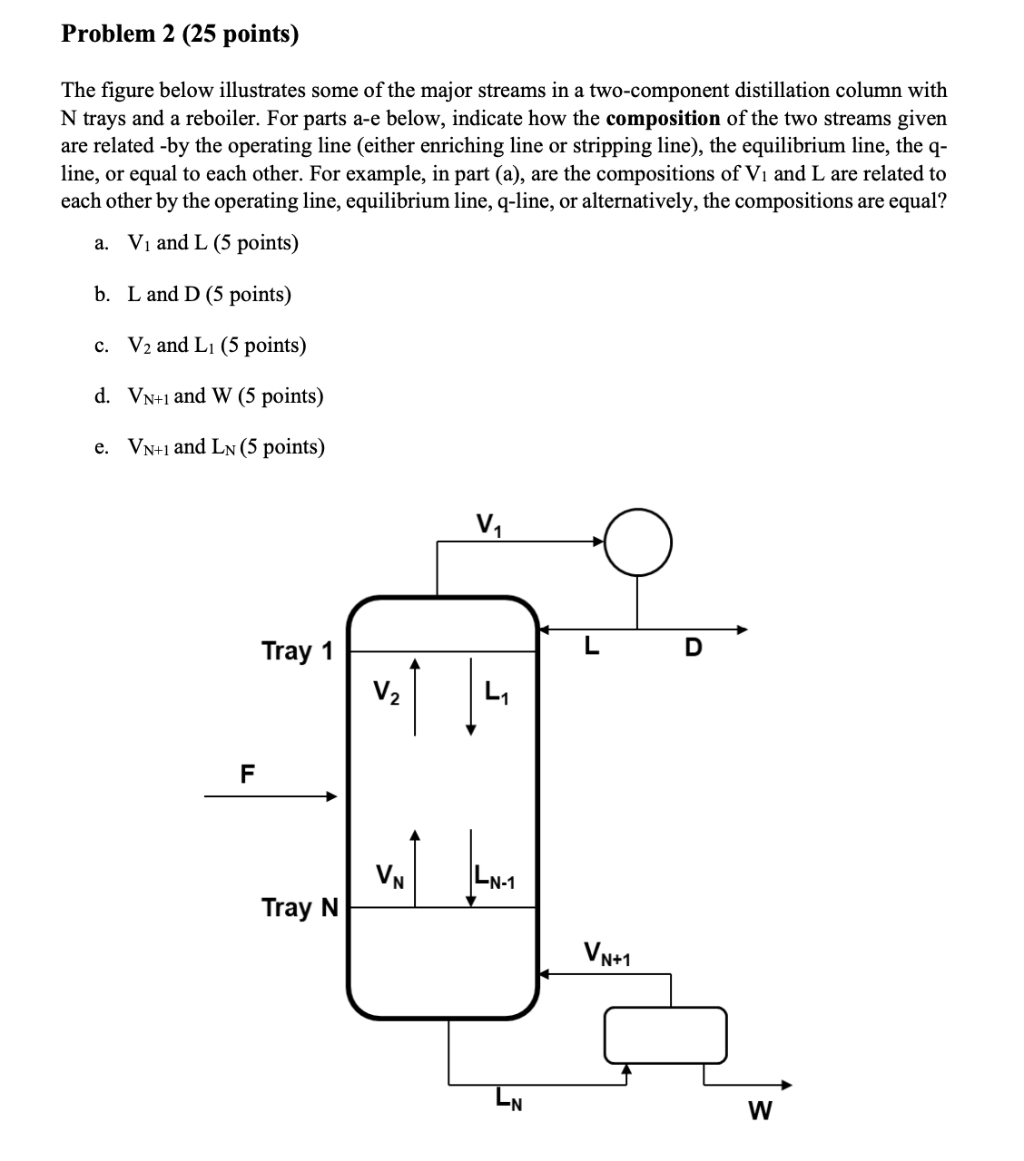
The figure below illustrates some of the major streams in a two-component distillation column with
N trays and a reboiler. For parts a-e below, indicate how the composition of the two streams given
are related -by the operating line (either enriching line or stripping line), the equilibrium line, the g-
line, or equal to each other. For example, in part (a), are the compositions of Vi and L are related to
each other by the operating line, equilibrium line, g-line, or alternatively, the compositions are equal?
a. Viand L (5 points)
b. Land D (5 points)
c. Vzand L; (5 points)
d. Vn:+rand W (5 points)
e. Vn+iand Li (5 points)
“—()
yi f— YT
ve | -
F
_—
Vn Ln.1
Tray N
uy =
N w
Question:
Give step-by-step solution with explanation and final answer:Problem 2 (25 points)
The figure below illustrates some of the major streams in a two-component distillation column with
N trays and a reboiler. For parts a-e below, indicate how the composition of the two streams given
are related -by the operating line (either enriching line or stripping line), the equilibrium line, the g-
line, or equal to each other. For example, in part (a), are the compositions of Vi and L are related to
each other by the operating line, equilibrium line, g-line, or alternatively, the compositions are equal?
a. Viand L (5 points)
b. Land D (5 points)
c. Vzand L; (5 points)
d. Vn:+rand W (5 points)
e. Vn+iand Li (5 points)
“—()
yi f— YT
ve | -
F
_—
Vn Ln.1
Tray N
uy =
N w
This is AI generated Response.
Asked by: francis
Created at: 2025-12-14 21:37:07
Final Answer:
RenderedRaw Text
Did you like this answer?
# Step-by-Step Solution
Let's consider the relationships in a standard two-component distillation column. The main concepts are:
- **Operating Lines:**
- **Enriching (Rectifying) Line:** Above feed, relates vapor and liquid compositions.
- **Stripping Line:** Below feed, relates vapor and liquid compositions.
- **Equilibrium Line:** Relates vapor and liquid in equilibrium on a tray.
- **q-line:** Feed condition (not directly related to the streams in these parts).
- **Equality:** Streams might be equal in composition in some cases.
Let’s answer each part:
---
## (a) \( V_1 \) and \( L \)
- **\( V_1 \):** Vapor leaving the top tray and going to the condenser.
- **\( L \):** Liquid returning from the condenser (reflux).
### Relationship:
- **\( V_1 \)** and **\( L \)** are not in equilibrium; rather, \( L \) is formed from condensation of \( V_1 \).
- The composition of **\( L \)** is **equal** to the composition of the condensed vapor \( V_1 \) (full condensation is assumed).
**Final Answer:**
**The compositions are equal.**
---
## (b) \( L \) and \( D \)
- **\( L \):** Reflux returned to the column.
- **\( D \):** Distillate withdrawn from condenser.
### Relationship:
- Both are drawn from the same condensed stream (the overhead vapor is condensed and then split).
- Thus, the composition is the **same**.
**Final Answer:**
**The compositions are equal.**
---
## (c) \( V_2 \) and \( L_1 \)
- **\( V_2 \):** Vapor rising from tray 2 to tray 1.
- **\( L_1 \):** Liquid descending from tray 1 to tray 2.
### Relationship:
- On a tray, the vapor leaving (upwards) and the liquid leaving (downwards) are in **equilibrium** with each other.
**Final Answer:**
**Their compositions are related by the equilibrium line.**
---
## (d) \( V_{N+1} \) and \( W \)
- **\( V_{N+1} \):** Vapor entering the reboiler.
- **\( W \):** Bottom product, liquid withdrawn from reboiler.
### Relationship:
- The reboiler acts as an equilibrium stage: the vapor leaving and the liquid remaining are in equilibrium.
**Final Answer:**
**Their compositions are related by the equilibrium line.**
---
## (e) \( V_{N+1} \) and \( L_N \)
- **\( V_{N+1} \):** Vapor rising from the reboiler to the bottom tray (tray N).
- **\( L_N \):** Liquid descending from tray N to the reboiler.
### Relationship:
- On a tray, the vapor going up and the liquid going down are in **equilibrium** with each other.
**Final Answer:**
**Their compositions are related by the equilibrium line.**
---
# **Summary Table**
| Part | Streams | Relationship |
|------|-------------------|--------------------------------------------|
| (a) | \( V_1 \) and \( L \) | Compositions are equal |
| (b) | \( L \) and \( D \) | Compositions are equal |
| (c) | \( V_2 \) and \( L_1 \) | Related by the equilibrium line |
| (d) | \( V_{N+1} \) and \( W \) | Related by the equilibrium line |
| (e) | \( V_{N+1} \) and \( L_N \)| Related by the equilibrium line |
---
These relationships are fundamental in McCabe-Thiele analysis and distillation column design.
VIPSolutions focuses on clear, step‑by‑step explanations so you can learn quickly. Whether you need an AI‑generated walkthrough or a short hint to get unstuck, each solution is organized for fast reading and easy review later.
Search similar questions, compare approaches, and bookmark the best answers for revision. Our goal is simple: quick, reliable study help that feels natural—not noisy.
 VIPSolutions
 Problem 2 (25 points)
The figure below illustrates some of the major streams in a two-component distillation column with
N trays and a reboiler. For parts a-e below, indicate how the composition of the two streams given
are related -by the operating line (either enriching line or stripping line), the equilibrium line, the g-
line, or equal to each other. For example, in part (a), are the compositions of Vi and L are related to
each other by the operating line, equilibrium line, g-line, or alternatively, the compositions are equal?
a. Viand L (5 points)
b. Land D (5 points)
c. Vzand L; (5 points)
d. Vn:+rand W (5 points)
e. Vn+iand Li (5 points)
“—()
yi f— YT
ve | -
F
_—
Vn Ln.1
Tray N
uy =
N w
Problem 2 (25 points)
The figure below illustrates some of the major streams in a two-component distillation column with
N trays and a reboiler. For parts a-e below, indicate how the composition of the two streams given
are related -by the operating line (either enriching line or stripping line), the equilibrium line, the g-
line, or equal to each other. For example, in part (a), are the compositions of Vi and L are related to
each other by the operating line, equilibrium line, g-line, or alternatively, the compositions are equal?
a. Viand L (5 points)
b. Land D (5 points)
c. Vzand L; (5 points)
d. Vn:+rand W (5 points)
e. Vn+iand Li (5 points)
“—()
yi f— YT
ve | -
F
_—
Vn Ln.1
Tray N
uy =
N w