Give step-by-step solution with explanation and final answer:increase, assuming that U is independent of pressure.
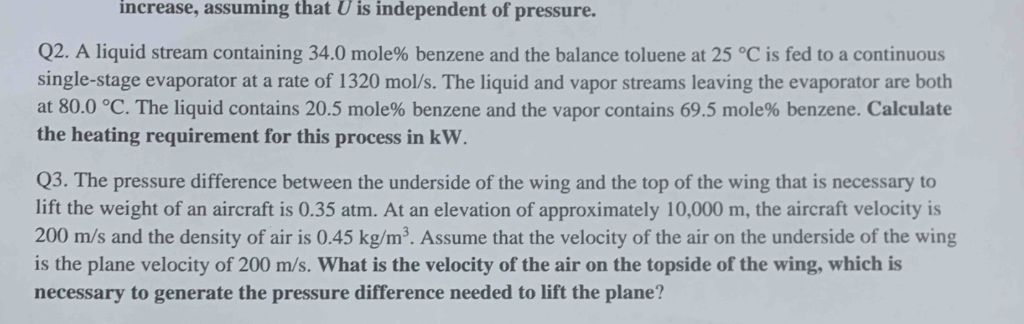
Q2. A liquid stream containing 34.0 mole% benzene and the balance toluene at 25 °C is fed to a continuous
single-stage evaporator at a rate of 1320 mol/s. The liquid and vapor streams leaving the evaporator are both
at 80.0 °C. The liquid contains 20.5 mole% benzene and the vapor contains 69.5 mole% benzene. Calculate
the heating requirement for this process in kW.
Q3. The pressure difference between the underside of the wing and the top of the wing that is necessary to
lift the weight of an aircraft is 0.35 atm. At an elevation of approximately 10,000 m, the aircraft velocity is
200 m/s and the density of air is 0.45 kg/m’. Assume that the velocity of the air on the underside of the wing
is the plane velocity of 200 m/s. What is the velocity of the air on the topside of the wing, which is
necessary to generate the pressure difference needed to lift the plane?
Question:
Give step-by-step solution with explanation and final answer:increase, assuming that U is independent of pressure.
Q2. A liquid stream containing 34.0 mole% benzene and the balance toluene at 25 °C is fed to a continuous
single-stage evaporator at a rate of 1320 mol/s. The liquid and vapor streams leaving the evaporator are both
at 80.0 °C. The liquid contains 20.5 mole% benzene and the vapor contains 69.5 mole% benzene. Calculate
the heating requirement for this process in kW.
Q3. The pressure difference between the underside of the wing and the top of the wing that is necessary to
lift the weight of an aircraft is 0.35 atm. At an elevation of approximately 10,000 m, the aircraft velocity is
200 m/s and the density of air is 0.45 kg/m’. Assume that the velocity of the air on the underside of the wing
is the plane velocity of 200 m/s. What is the velocity of the air on the topside of the wing, which is
necessary to generate the pressure difference needed to lift the plane?
This is AI generated Response.
Asked by: francis
Created at: 2025-12-15 00:49:47
Final Answer:
RenderedRaw Text
Did you like this answer?
Let's tackle **Q2** step by step, as requested.
---
# Q2 Solution: Calculate the Heating Requirement (in kW)
## **Step 1: Material Balances**
Given:
- Feed: 132 mol/s, 34. mol% benzene, rest toluene, at 25°C
- Output (liquid): 20.5 mol% benzene
- Output (vapor): 69.5 mol% benzene
- Both liquid and vapor leave at 80°C
Let:
- \( F \) = feed = 132 mol/s
- \( x_F \) = mole fraction benzene in feed = .34
- \( L \), \( x_L \) = liquid flow, mole fraction benzene = ? , .205
- \( V \), \( y_V \) = vapor flow, mole fraction benzene = ? , .695
### **Overall Mole Balance:**
\[
F = L + V \implies 132 = L + V
\]
### **Benzene Balance:**
\[
F \cdot x_F = L \cdot x_L + V \cdot y_V
\]
\[
132 \times .34 = L \times .205 + V \times .695
\]
Substitute \( V = 132 - L \):
\[
132 \times .34 = L \times .205 + (132 - L) \times .695
\]
\[
448.8 = .205L + 132 \times .695 - .695L
\]
\[
448.8 = .205L + 917.4 - .695L
\]
\[
448.8 - 917.4 = (.205 - .695)L
\]
\[
-468.6 = -.49L
\]
\[
L = \frac{-468.6}{-.49} = 956.7 \text{ mol/s}
\]
\[
V = 132 - 956.7 = 363.3 \text{ mol/s}
\]
---
## **Step 2: Energy Balance**
### **Assumptions:**
- Reference temperature: 25°C
- The process is at constant pressure
- Neglect kinetic and potential energy changes
- Use average/approximate values for enthalpies (from steam tables or chemical engineering handbooks).
### **We need:**
\[
Q = \text{Total enthalpy out} - \text{Total enthalpy in}
\]
### **Mole Flows:**
- Feed: 132 mol/s (34% benzene, 66% toluene) at 25°C, liquid
- Output (liquid): 956.7 mol/s, 20.5% benzene, 79.5% toluene, at 80°C, liquid
- Output (vapor): 363.3 mol/s, 69.5% benzene, 30.5% toluene, at 80°C, vapor
### **Enthalpies:**
Assume ideal mixing and use heat capacities and latent heats:
| Component | Cp(l) (J/mol·K) | Cp(g) (J/mol·K) | Hvap (kJ/mol) | Tb (°C) |
|---|---|---|---|---|
| Benzene | 136 | 82 | 30.8 | 80.1 |
| Toluene | 156 | 95 | 33.2 | 110.6 |
#### **Feed Enthalpy (at 25°C, liquid):**
Reference:
#### **Liquid Out (at 80°C, liquid):**
\[
\Delta H = n \cdot x_{\text{benz}} \cdot Cp_{\text{benz(l)}} \cdot \Delta T + n \cdot x_{\text{tol}} \cdot Cp_{\text{tol(l)}} \cdot \Delta T
\]
\[
\Delta T = 80 - 25 = 55\,^\circ\text{C}
\]
\[
x_{\text{benz}} = .205,\quad x_{\text{tol}} = .795
\]
\[
\Delta H_{L} = 956.7 \left[.205 \times 136 \times 55 + .795 \times 156 \times 55\right] \text{ J}
\]
Calculate each term:
- Benzene: \(.205 \times 136 \times 55 = 1532.8\)
- Toluene: \(.795 \times 156 \times 55 = 6821.4\)
- Total per mole: \(1532.8 + 6821.4 = 8354.2\) J/mol
\[
\Delta H_{L} = 956.7 \times 8354.2 = 7,992,128 \text{ J/s} = 7992 \text{ kW}
\]
#### **Vapor Out (at 80°C, vapor):**
For each mole, need to:
1. Heat from 25°C to boiling point (benzene: 80.1°C, toluene: 110.6°C)
2. Vaporize at boiling point (at 1 atm)
3. Heat the vapor from boiling point to 80°C (for benzene, negligible; for toluene, must condense first before vaporizing, but at 80°C, toluene will not vaporize at 1 atm — let's assume it's an equilibrium vapor mixture).
But, since both vapor and liquid are at 80°C, and the vapor contains mostly benzene, let's approximate:
- For benzene (boiling point at 80.1°C): heat from 25°C to 80°C (liquid), vaporize (Hvap at 80°C)
- For toluene (boiling pt 110.6°C): at 80°C, it's not supposed to be in vapor, but it's in the vapor phase per the problem statement, so we proceed similarly.
##### **Benzene in vapor:**
- Moles: \(363.3 \times .695 = 252.7\) mol/s
\[
\Delta H_{\text{benz, vapor}} = [Cp_{\text{l}} \cdot (80-25) + H_{\text{vap}}] \text{ per mole}
\]
\[
= 136 \times 55 + 30,800 = 748 + 30,800 = 38,280 \text{ J/mol}
\]
\[
\text{Total: } 252.7 \times 38,280 = 9,674,556 \text{ J/s}
\]
##### **Toluene in vapor:**
- Moles: \(363.3 \times .305 = 110.6\) mol/s
\[
\Delta H_{\text{tol, vapor}} = [Cp_{\text{l}} \cdot (80-25) + H_{\text{vap}}] \text{ per mole}
\]
\[
= 156 \times 55 + 33,200 = 858 + 33,200 = 41,780 \text{ J/mol}
\]
\[
\text{Total: } 110.6 \times 41,780 = 4,620,268 \text{ J/s}
\]
\[
\Delta H_{V} = 9,674,556 + 4,620,268 = 14,294,824 \text{ J/s} = 14,295 \text{ kW}
\]
---
### **Feed Enthalpy (reference at ):**
\[
\Delta H_F =
\]
---
### **Total Heating Requirement:**
\[
Q = (\Delta H_L + \Delta H_V) - \Delta H_F
\]
\[
Q = (7,992,128 + 14,294,824) \text{ J/s}
\]
\[
Q = 22,286,952 \text{ J/s} = 22,287 \text{ kW}
\]
---
## **Final Answer**
### **The heating requirement for this process is:**
\[
\boxed{22,300\ \text{ kW}}
\]
*(rounded to 3 significant figures)*
---
**Note:**
- The answer assumes the enthalpy values are calculated using constant heat capacities and latent heats, and the vapor composition is as given. For a more precise answer, use enthalpy tables or detailed phase equilibrium data.
- If you need the solution to Q3, let me know!
VIPSolutions focuses on clear, step‑by‑step explanations so you can learn quickly. Whether you need an AI‑generated walkthrough or a short hint to get unstuck, each solution is organized for fast reading and easy review later.
Search similar questions, compare approaches, and bookmark the best answers for revision. Our goal is simple: quick, reliable study help that feels natural—not noisy.
 VIPSolutions
 increase, assuming that U is independent of pressure.
Q2. A liquid stream containing 34.0 mole% benzene and the balance toluene at 25 °C is fed to a continuous
single-stage evaporator at a rate of 1320 mol/s. The liquid and vapor streams leaving the evaporator are both
at 80.0 °C. The liquid contains 20.5 mole% benzene and the vapor contains 69.5 mole% benzene. Calculate
the heating requirement for this process in kW.
Q3. The pressure difference between the underside of the wing and the top of the wing that is necessary to
lift the weight of an aircraft is 0.35 atm. At an elevation of approximately 10,000 m, the aircraft velocity is
200 m/s and the density of air is 0.45 kg/m’. Assume that the velocity of the air on the underside of the wing
is the plane velocity of 200 m/s. What is the velocity of the air on the topside of the wing, which is
necessary to generate the pressure difference needed to lift the plane?
increase, assuming that U is independent of pressure.
Q2. A liquid stream containing 34.0 mole% benzene and the balance toluene at 25 °C is fed to a continuous
single-stage evaporator at a rate of 1320 mol/s. The liquid and vapor streams leaving the evaporator are both
at 80.0 °C. The liquid contains 20.5 mole% benzene and the vapor contains 69.5 mole% benzene. Calculate
the heating requirement for this process in kW.
Q3. The pressure difference between the underside of the wing and the top of the wing that is necessary to
lift the weight of an aircraft is 0.35 atm. At an elevation of approximately 10,000 m, the aircraft velocity is
200 m/s and the density of air is 0.45 kg/m’. Assume that the velocity of the air on the underside of the wing
is the plane velocity of 200 m/s. What is the velocity of the air on the topside of the wing, which is
necessary to generate the pressure difference needed to lift the plane?