This is AI generated Response.
Asked by: karuna
Created at: 2025-12-16 00:04:29
Final Answer:
RenderedRaw Text
Did you like this answer?
## Q1. Attempt any five questions
**[5 x 5 = 25]**
Below are step-by-step solutions and explanations for each sub-question. Answer any five as required.
---
### (a) Define and explain relative of binary mixture and multicomponent mixture.
**Relative Volatility (α):**
- It is a measure of the ease of separation by distillation.
- For a binary mixture of components A (more volatile) and B (less volatile):
\[
\alpha_{AB} = \frac{(y_A/x_A)}{(y_B/x_B)}
\]
Where:
- \(y_A, y_B\): Mole fractions in vapor phase
- \(x_A, x_B\): Mole fractions in liquid phase
**Explanation:**
- If α > 1, A is more volatile and easier to separate from B.
- As α increases, separation becomes easier.
- For multicomponent mixtures, relative volatility is determined for each component with respect to a reference component.
---
### (b) Explain minimum reflux ratio and optimum reflux ratio in distillation.
**Minimum Reflux Ratio (\(R_{min}\)):**
- The lowest possible reflux ratio at which the desired separation can still be achieved.
- At \(R_{min}\), the number of stages required becomes infinite.
**Optimum Reflux Ratio:**
- Lies between the minimum and total reflux.
- At total reflux, all condensed vapor is returned as liquid (maximum stages, minimum energy).
- The optimum is chosen as a trade-off between capital cost (number of trays) and operating cost (reflux ratio).
---
### (c) Discuss the effect of quality of feed on minimum reflux ratio.
**Feed Quality (q):**
- Defined as the fraction of liquid in the feed.
- If q = 1: saturated liquid; if q = : saturated vapor.
**Effect:**
- The position of the feed line on the McCabe-Thiele diagram changes with q.
- As feed becomes more vapor (q decreases), the minimum reflux ratio decreases.
- If feed is subcooled liquid (q > 1) or superheated vapor (q < ), minimum reflux ratio increases.
---
### (d) Discuss about the basic principles of design of a trayed distillation tower.
**Basic Principles:**
1. **Stage-wise Contact:** Liquid and vapor phases contact on each tray.
2. **Mass Transfer:** Component transfer occurs between phases.
3. **Number of Stages:** Determined by desired separation (McCabe-Thiele or Ponchon-Savarit methods).
4. **Tray Types:** Sieve, valve, and bubble-cap trays.
5. **Tray Spacing:** To allow vapor-liquid disengagement.
6. **Column Diameter:** Based on vapor and liquid flow rates.
7. **Feed and Withdrawal Points:** Located for efficient separation.
---
### (e) "Selection of appropriate solvent is the key for successful separation by solvent extraction" – Explain.
**Explanation:**
- An effective solvent must:
1. Have high selectivity for the solute.
2. Be immiscible with feed phase.
3. Have high solubility for solute.
4. Be chemically stable and non-reactive.
5. Be easily recoverable and low in toxicity.
- Proper solvent selection ensures high separation efficiency and cost-effectiveness.
---
### (f) Discuss criteria for selection of adsorbent in adsorption.
**Criteria:**
1. **High Surface Area:** For maximum adsorption.
2. **Pore Size and Distribution:** Suitability for target molecules.
3. **Selectivity:** Preferential adsorption for desired component.
4. **Regenerability:** Can be reused after desorption.
5. **Mechanical Strength:** Withstands operating conditions.
6. **Cost and Availability:** Economically feasible.
7. **Thermal and Chemical Stability:** Withstands process conditions.
---
### (g) Explain basic principles of leaching with applications. Obtain the rate expression of leaching when dissolving a solid.
**Principles:**
- Involves extraction of soluble component from solid by solvent.
- Used in metallurgy (gold, copper), food (sugar, oil extraction).
**Rate Expression:**
- Assume solid particles are spheres, leaching is diffusion-controlled:
\[
\text{Rate} = kA(C_s - C)
\]
Where:
- \(k\): Mass transfer coefficient
- \(A\): Surface area
- \(C_s\): Saturation concentration
- \(C\): Bulk concentration
---
### (h) Explain various membrane separation process in terms of separation mechanism, pore size, operating pressure, and type of solute to be separated.
**Membrane Processes:**
1. **Microfiltration (MF):**
- Pore Size: .1–10 μm
- Pressure: Low (1–3 bar)
- Solutes: Suspended solids, bacteria
2. **Ultrafiltration (UF):**
- Pore Size: .01–.1 μm
- Pressure: Moderate (3–10 bar)
- Solutes: Proteins, polymers
3. **Nanofiltration (NF):**
- Pore Size: 1–10 nm
- Pressure: Higher (5–20 bar)
- Solutes: Small organics, divalent ions
4. **Reverse Osmosis (RO):**
- Pore Size: <2 nm (non-porous)
- Pressure: High (10–100 bar)
- Solutes: Salts, small molecules
**Mechanisms:**
- Size exclusion, charge repulsion, and solution-diffusion.
---
## **Final Note**
**Any five of the above can be chosen as answers. Each is explained with definitions, key points, and examples where required.**
VIPSolutions focuses on clear, step‑by‑step explanations so you can learn quickly. Whether you need an AI‑generated walkthrough or a short hint to get unstuck, each solution is organized for fast reading and easy review later.
Search similar questions, compare approaches, and bookmark the best answers for revision. Our goal is simple: quick, reliable study help that feels natural—not noisy.
 VIPSolutions
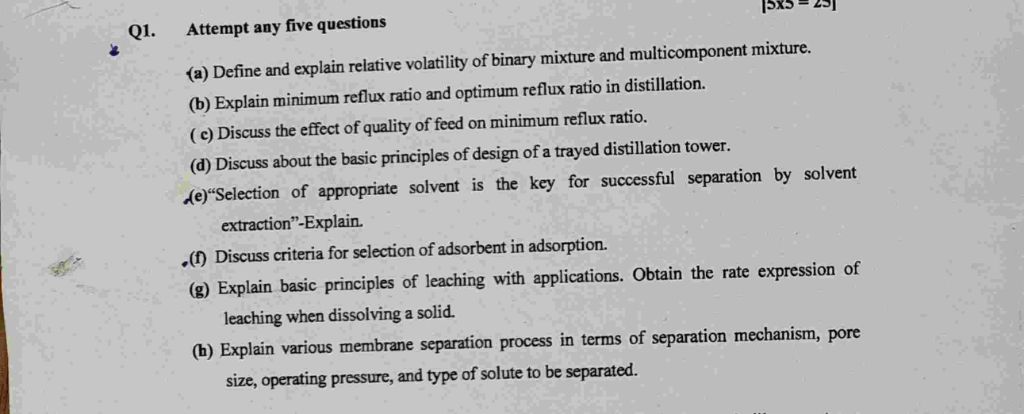 i Ql. Attempt any five questions Lp TH
(@) Define and explain relative volatility of binary mixture and multicomponent mixture.
(b) Explain minimum reflux ratio and optimum reflux ratio in distillation.
| (©) Discuss the effect of quality of feed on ‘minimum reflux ratio.
(@ Discuss about the basic principles of design ofa trayed distillation tower.
Ae)“Selection of appropriate solvent is the key for successful separation by solvent
extraction” Explain.
ad ,(f) Discuss criteria for selection of adsorbent in adsorption.
(@) Explain basic principles of leaching with applications. Obtain the rate expression of
leaching when dissolving a solid.
(b) Explain various membrane separation process in terms of separation mechanism, pore
Size, operating pressure, and type of solute to be separated.
i Ql. Attempt any five questions Lp TH
(@) Define and explain relative volatility of binary mixture and multicomponent mixture.
(b) Explain minimum reflux ratio and optimum reflux ratio in distillation.
| (©) Discuss the effect of quality of feed on ‘minimum reflux ratio.
(@ Discuss about the basic principles of design ofa trayed distillation tower.
Ae)“Selection of appropriate solvent is the key for successful separation by solvent
extraction” Explain.
ad ,(f) Discuss criteria for selection of adsorbent in adsorption.
(@) Explain basic principles of leaching with applications. Obtain the rate expression of
leaching when dissolving a solid.
(b) Explain various membrane separation process in terms of separation mechanism, pore
Size, operating pressure, and type of solute to be separated.