 VIPSolutions
Give step-by-step solution with explanation and final answer:1) Let L(q,q,t) be any Lagrangian and f(g, t) be an arbitrary function. Show that the equations of motion for the new Lagrangian L(g, ¢,t) which is defined as below are identical to those for L. Fo : df(q.t Lg .d,1) = La.) + LLY
Question:
Give step-by-step solution with explanation and final answer: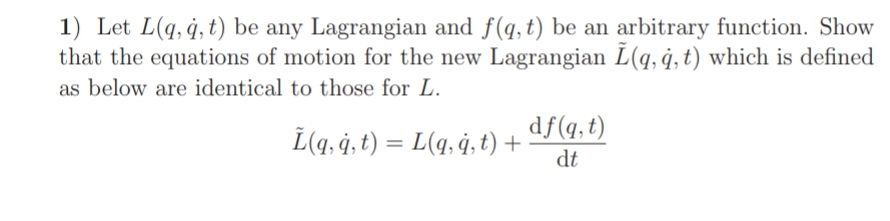 1) Let L(q,q,t) be any Lagrangian and f(g, t) be an arbitrary function. Show
that the equations of motion for the new Lagrangian L(g, ¢,t) which is defined
as below are identical to those for L.
Fo : df(q.t
Lg .d,1) = La.) + LLY
1) Let L(q,q,t) be any Lagrangian and f(g, t) be an arbitrary function. Show
that the equations of motion for the new Lagrangian L(g, ¢,t) which is defined
as below are identical to those for L.
Fo : df(q.t
Lg .d,1) = La.) + LLY
This is AI generated Response.
Asked by: Mallikarjun
Created at: 2025-12-24 04:39:27
Asked by: Mallikarjun
Created at: 2025-12-24 04:39:27
Final Answer:
Rendered
Raw Text
Did you like this answer?
Let's break down the problem step by step:
---
## **Step 1: Write the new Lagrangian**
Given:
\[
\tilde{L}(q, \dot{q}, t) = L(q, \dot{q}, t) + \frac{d}{dt} f(q, t)
\]
where \( f(q, t) \) is any arbitrary function of \( q \) and \( t \).
---
## **Step 2: Compute the Euler-Lagrange Equation for \( \tilde{L} \)**
The Euler-Lagrange equation for a Lagrangian \( L \) is:
\[
\frac{d}{dt} \left( \frac{\partial L}{\partial \dot{q}} \right) - \frac{\partial L}{\partial q} =
\]
Apply this to \( \tilde{L} \):
\[
\frac{d}{dt} \left( \frac{\partial \tilde{L}}{\partial \dot{q}} \right) - \frac{\partial \tilde{L}}{\partial q} =
\]
---
## **Step 3: Calculate the Partial Derivatives**
### **a) Compute \(\frac{\partial \tilde{L}}{\partial \dot{q}}\):**
\[
\tilde{L}(q, \dot{q}, t) = L(q, \dot{q}, t) + \frac{d}{dt} f(q, t)
\]
Note:
\[
\frac{d}{dt} f(q, t) = \frac{\partial f}{\partial q} \dot{q} + \frac{\partial f}{\partial t}
\]
So:
\[
\tilde{L}(q, \dot{q}, t) = L(q, \dot{q}, t) + \frac{\partial f}{\partial q} \dot{q} + \frac{\partial f}{\partial t}
\]
Now,
\[
\frac{\partial \tilde{L}}{\partial \dot{q}} = \frac{\partial L}{\partial \dot{q}} + \frac{\partial f}{\partial q}
\]
---
### **b) Compute \(\frac{\partial \tilde{L}}{\partial q}\):**
\[
\frac{\partial \tilde{L}}{\partial q}
= \frac{\partial L}{\partial q} + \frac{\partial}{\partial q} \left( \frac{\partial f}{\partial q} \dot{q} + \frac{\partial f}{\partial t} \right)
\]
\[
= \frac{\partial L}{\partial q} + \frac{\partial^2 f}{\partial q^2} \dot{q} + \frac{\partial^2 f}{\partial q \partial t}
\]
---
### **c) Compute \(\frac{d}{dt} \left( \frac{\partial \tilde{L}}{\partial \dot{q}} \right)\):**
\[
\frac{d}{dt} \left( \frac{\partial \tilde{L}}{\partial \dot{q}} \right)
= \frac{d}{dt} \left( \frac{\partial L}{\partial \dot{q}} + \frac{\partial f}{\partial q} \right)
\]
\[
= \frac{d}{dt} \left( \frac{\partial L}{\partial \dot{q}} \right) + \frac{d}{dt} \left( \frac{\partial f}{\partial q} \right)
\]
\[
= \frac{d}{dt} \left( \frac{\partial L}{\partial \dot{q}} \right) + \frac{\partial^2 f}{\partial q^2} \dot{q} + \frac{\partial^2 f}{\partial q \partial t}
\]
---
## **Step 4: Plug into Euler-Lagrange Equation**
\[
\frac{d}{dt} \left( \frac{\partial \tilde{L}}{\partial \dot{q}} \right) - \frac{\partial \tilde{L}}{\partial q}
\]
\[
= \left[ \frac{d}{dt} \left( \frac{\partial L}{\partial \dot{q}} \right) + \frac{\partial^2 f}{\partial q^2} \dot{q} + \frac{\partial^2 f}{\partial q \partial t} \right] - \left[ \frac{\partial L}{\partial q} + \frac{\partial^2 f}{\partial q^2} \dot{q} + \frac{\partial^2 f}{\partial q \partial t} \right]
\]
\[
= \frac{d}{dt} \left( \frac{\partial L}{\partial \dot{q}} \right) - \frac{\partial L}{\partial q}
\]
---
## **Step 5: Conclusion**
The extra terms from \( f(q, t) \) **cancel out** exactly. Therefore, the equations of motion for \( \tilde{L} \) are **identical** to those for \( L \).
---
## **Final Answer**
**Adding a total time derivative of any function \( f(q,t) \) to the Lagrangian does not change the equations of motion.**
Mathematically,
\[
\frac{d}{dt} \left( \frac{\partial \tilde{L}}{\partial \dot{q}} \right) - \frac{\partial \tilde{L}}{\partial q}
= \frac{d}{dt} \left( \frac{\partial L}{\partial \dot{q}} \right) - \frac{\partial L}{\partial q}
\]
So the equations of motion for \( \tilde{L} \) and \( L \) are **identical**.
📢 Instructions:
- Ask anything relatd to above question only.
- For new Question goto :