Give step-by-step solution with explanation and final answer:Plot the variation of the spectral coherence between the gas-phase and liquid-phase
concentration fluctuations a the entrance of a tray tower. Assume the fluctuations are driven
by a stochastic inlet concentration with a Power Spectral Density Sya(£) = Co/(1 + £2). The
tray efficiency Ey acts as a low-pass filter on the incoming scalar variance, reducing the high-
frequency spectral content. Consider the frequency range from 0..01Hz to 10Hz to observe
the dampening effect of the liquid holdup on the tray. The governing equation for the exit
Spectrum is Sous (£) = Sea (£)-/H(£)| where H(£) is the tray transfer function.
Identify the frequency £ in Hz where the output power spectral density is attenuated by 10dB
relative to the input
Establish the identity of the penetration theory for interphase transport by assuming a
constant exposure time for al fluid elements at the interface. Develop the constitutive equation
for the time-averaged mass transfer coefficient k, by integrating the instantaneous flux over
the renewal period t.. Generate the governing differential form for the scalar dissipation rate
based on the gradient of the concentration Power Spectral Density. Obtain the expression for
the Sherwood number Sh as a function of the Reynolds number and the Schmidt number for a
Question:
Give step-by-step solution with explanation and final answer:Plot the variation of the spectral coherence between the gas-phase and liquid-phase
concentration fluctuations a the entrance of a tray tower. Assume the fluctuations are driven
by a stochastic inlet concentration with a Power Spectral Density Sya(£) = Co/(1 + £2). The
tray efficiency Ey acts as a low-pass filter on the incoming scalar variance, reducing the high-
frequency spectral content. Consider the frequency range from 0..01Hz to 10Hz to observe
the dampening effect of the liquid holdup on the tray. The governing equation for the exit
Spectrum is Sous (£) = Sea (£)-/H(£)| where H(£) is the tray transfer function.
Identify the frequency £ in Hz where the output power spectral density is attenuated by 10dB
relative to the input
Establish the identity of the penetration theory for interphase transport by assuming a
constant exposure time for al fluid elements at the interface. Develop the constitutive equation
for the time-averaged mass transfer coefficient k, by integrating the instantaneous flux over
the renewal period t.. Generate the governing differential form for the scalar dissipation rate
based on the gradient of the concentration Power Spectral Density. Obtain the expression for
the Sherwood number Sh as a function of the Reynolds number and the Schmidt number for a
This is AI generated Response.
Asked by: vemuri swathi
Created at: 2025-12-26 09:53:52
Final Answer:
RenderedRaw Text
Did you like this answer?
Let's break down the problem into **two main tasks** and solve step-by-step:
---
# **1. Frequency at 10 dB Attenuation**
### **Governing Equation**
Given:
- Input Power Spectral Density: \( S_{in}(f) = \frac{C_}{1 + f^2} \)
- Output: \( S_{out}(f) = S_{in}(f) \cdot |H(f)|^2 \)
- \( H(f) \) = Tray transfer function (low-pass filter)
Assume a simple **first-order low-pass filter** for a tray:
\[
H(f) = \frac{1}{1 + j \frac{f}{f_c}}
\]
So,
\[
|H(f)|^2 = \frac{1}{1 + \left(\frac{f}{f_c}\right)^2}
\]
Thus,
\[
S_{out}(f) = \frac{C_}{1 + f^2} \cdot \frac{1}{1 + \left(\frac{f}{f_c}\right)^2}
\]
### **Attenuation Condition**
10 dB attenuation means output/input power spectral density ratio is \(10^{-1} \) (in power):
\[
\left| H(f_{10dB}) \right|^2 = 10^{-1} = .1
\]
So,
\[
\frac{1}{1 + \left(\frac{f_{10dB}}{f_c}\right)^2} = .1
\]
\[
1 + \left(\frac{f_{10dB}}{f_c}\right)^2 = 10
\]
\[
\left(\frac{f_{10dB}}{f_c}\right)^2 = 9
\]
\[
f_{10dB} = 3f_c
\]
**Final Answer:**
\[
\boxed{f_{10dB} = 3 f_c}
\]
This is the frequency at which the output spectral density is attenuated by 10 dB relative to the input.
---
# **2. Penetration Theory and Sherwood Number (Sh)**
### **Penetration Theory for Mass Transfer**
- **Assume**: Constant exposure time (\(t_e\)) for elements at the interface.
- **Instantaneous mass transfer flux:**
\[
j(t) = k_L [C^* - C(t)]
\]
For short contact times, \(C(t)\) ≈ at the start.
- **Average mass transfer coefficient (\(k_L\))**:
\[
k_L = \frac{2D}{\pi t_e}
\]
where \(D\) is the diffusivity, \(t_e\) is the exposure time.
---
### **Sherwood Number (\(Sh\))**
\[
Sh = \frac{k_L L}{D}
\]
For a rippling film, \(t_e \sim \frac{L}{u}\) (L = characteristic length, u = velocity):
\[
k_L = \frac{2D}{\pi t_e} = \frac{2D u}{\pi L}
\]
\[
Sh = \frac{k_L L}{D} = \frac{2u}{\pi}
\]
For turbulent/rippling flow, empirical correlations relate Sh to Reynolds (\(Re\)) and Schmidt (\(Sc\)) numbers:
\[
Sh = a Re^b Sc^c
\]
Where \(a, b, c\) are constants determined experimentally. For a rippling liquid film, often:
- \(b \approx .5\)
- \(c \approx 1/3\)
**Final Expression:**
\[
\boxed{Sh = a \, Re^{.5} \, Sc^{1/3}}
\]
---
## **Summary Table**
| Step | Expression/Result |
|-----------------------------|-----------------------------------------------------------------|
| 10 dB attenuation frequency | \( f_{10dB} = 3 f_c \) |
| Penetration theory \(k_L\) | \( k_L = \frac{2D}{\pi t_e} \) |
| Sherwood Number \(Sh\) | \( Sh = a \, Re^{.5} \, Sc^{1/3} \) (for rippling film) |
---
### **If you need the plot, let me know which variables to use for \(f_c\) and \(C_\), or if you want a MATLAB/Python code!**
VIPSolutions focuses on clear, step‑by‑step explanations so you can learn quickly. Whether you need an AI‑generated walkthrough or a short hint to get unstuck, each solution is organized for fast reading and easy review later.
Search similar questions, compare approaches, and bookmark the best answers for revision. Our goal is simple: quick, reliable study help that feels natural—not noisy.
 VIPSolutions
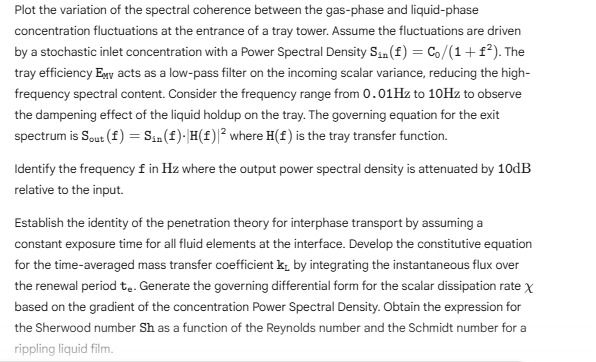 Plot the variation of the spectral coherence between the gas-phase and liquid-phase
concentration fluctuations a the entrance of a tray tower. Assume the fluctuations are driven
by a stochastic inlet concentration with a Power Spectral Density Sya(£) = Co/(1 + £2). The
tray efficiency Ey acts as a low-pass filter on the incoming scalar variance, reducing the high-
frequency spectral content. Consider the frequency range from 0..01Hz to 10Hz to observe
the dampening effect of the liquid holdup on the tray. The governing equation for the exit
Spectrum is Sous (£) = Sea (£)-/H(£)| where H(£) is the tray transfer function.
Identify the frequency £ in Hz where the output power spectral density is attenuated by 10dB
relative to the input
Establish the identity of the penetration theory for interphase transport by assuming a
constant exposure time for al fluid elements at the interface. Develop the constitutive equation
for the time-averaged mass transfer coefficient k, by integrating the instantaneous flux over
the renewal period t.. Generate the governing differential form for the scalar dissipation rate
based on the gradient of the concentration Power Spectral Density. Obtain the expression for
the Sherwood number Sh as a function of the Reynolds number and the Schmidt number for a
Plot the variation of the spectral coherence between the gas-phase and liquid-phase
concentration fluctuations a the entrance of a tray tower. Assume the fluctuations are driven
by a stochastic inlet concentration with a Power Spectral Density Sya(£) = Co/(1 + £2). The
tray efficiency Ey acts as a low-pass filter on the incoming scalar variance, reducing the high-
frequency spectral content. Consider the frequency range from 0..01Hz to 10Hz to observe
the dampening effect of the liquid holdup on the tray. The governing equation for the exit
Spectrum is Sous (£) = Sea (£)-/H(£)| where H(£) is the tray transfer function.
Identify the frequency £ in Hz where the output power spectral density is attenuated by 10dB
relative to the input
Establish the identity of the penetration theory for interphase transport by assuming a
constant exposure time for al fluid elements at the interface. Develop the constitutive equation
for the time-averaged mass transfer coefficient k, by integrating the instantaneous flux over
the renewal period t.. Generate the governing differential form for the scalar dissipation rate
based on the gradient of the concentration Power Spectral Density. Obtain the expression for
the Sherwood number Sh as a function of the Reynolds number and the Schmidt number for a