 VIPSolutions
Give step-by-step solution with explanation and final answer:Q2// Consider an air stream flowing at 771 sci containing 13 mol% benzene in which 90% removal of the benzene is required. The air flow entering the condenser is at 1atm. What temperature is necessary to achieve this percent removal? Heat of condensation of benzene = 13236 Btu/Ib-mole at 1 atm, 176 °F Specific heats: at 77°F=25°C Cpr 6.96 Buu/Ib-mole”F CPiensenc= 19:65 Bru/Ib-mole’F CPreat transfer medion 0,65 Btu/Ib-mole’F Basis of 1 h of operation Mssumming no heat loss from the heat exchanger (0 the atmosphere and the overall transfer coefficient = 40 BTUMICF The critical temperature of benzene Te=1012"R oh al
Question:
Give step-by-step solution with explanation and final answer: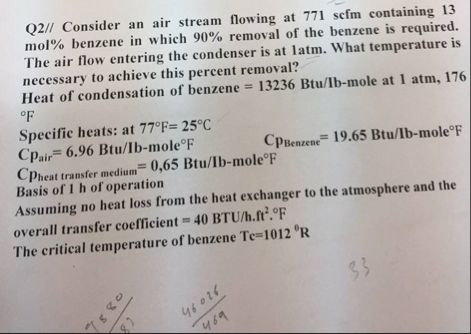 Q2// Consider an air stream flowing at 771 sci containing 13
mol% benzene in which 90% removal of the benzene is required.
The air flow entering the condenser is at 1atm. What temperature is
necessary to achieve this percent removal?
Heat of condensation of benzene = 13236 Btu/Ib-mole at 1 atm, 176
°F
Specific heats: at 77°F=25°C
Cpr 6.96 Buu/Ib-mole”F CPiensenc= 19:65 Bru/Ib-mole’F
CPreat transfer medion 0,65 Btu/Ib-mole’F
Basis of 1 h of operation
Mssumming no heat loss from the heat exchanger (0 the atmosphere and the
overall transfer coefficient = 40 BTUMICF
The critical temperature of benzene Te=1012"R
oh al
Q2// Consider an air stream flowing at 771 sci containing 13
mol% benzene in which 90% removal of the benzene is required.
The air flow entering the condenser is at 1atm. What temperature is
necessary to achieve this percent removal?
Heat of condensation of benzene = 13236 Btu/Ib-mole at 1 atm, 176
°F
Specific heats: at 77°F=25°C
Cpr 6.96 Buu/Ib-mole”F CPiensenc= 19:65 Bru/Ib-mole’F
CPreat transfer medion 0,65 Btu/Ib-mole’F
Basis of 1 h of operation
Mssumming no heat loss from the heat exchanger (0 the atmosphere and the
overall transfer coefficient = 40 BTUMICF
The critical temperature of benzene Te=1012"R
oh al
This is AI generated Response.
Asked by: Francis
Created at: 2025-12-28 22:10:47
Asked by: Francis
Created at: 2025-12-28 22:10:47
Final Answer:
Rendered
Raw Text
Did you like this answer?
Let's break down the solution step by step:
---
## **Step 1: Given Data**
- **Air flow rate** (\(Q\)): 771 SCFM (Standard Cubic Feet per Minute)
- **Benzene content**: 13 mol% in air
- **Required benzene removal**: 90%
- **Pressure**: 1 atm
- **Heat of condensation of benzene** (\(\Delta H_{cond}\)): 13,236 Btu/lb-mole at 1 atm, 176°F
- **Specific heats**:
- Air: \(C_{p,air} = 6.96\) Btu/(lb-mole·°F)
- Benzene: \(C_{p,benzene} = 19.65\) Btu/(lb-mole·°F)
- Transfer medium: \(C_{p,med} = .65\) Btu/(lb-mole·°F)
- **No heat loss to atmosphere**
- **Overall heat transfer coefficient**: \(U = 40\) Btu/(hr·ft²·°F)
- **Basis**: 1 hour of operation
- **Critical temperature of benzene**: \(T_c = 1012^\circ R\)
- **Condenser outlet pressure**: 1 atm
---
## **Step 2: Calculate Moles of Air and Benzene (per hour)**
### 1. **Standard Air Density (°C, 1 atm):**
1 SCFM = 1.325 kg/hr
Molecular weight of air ≈ 29 g/mol = .029 kg/mol
So, 1 SCFM ≈ 1.325/.029 = 45.7 mol/hr (approx)
For 771 SCFM:
\[
\text{Moles of air per hour} = 771 \times 45.7 \approx 35,238 \text{ mol/hr}
\]
### 2. **Total Moles in Stream:**
The stream contains both air and benzene (13 mol% benzene):
Let \( n_{tot} \) = total moles/hr
\( n_{benzene} = .13 n_{tot} \)
\( n_{air} = .87 n_{tot} \)
From air flow:
\[
n_{air} = 35,238 = .87 n_{tot}
\implies n_{tot} = \frac{35,238}{.87} \approx 40,510 \text{ mol/hr}
\]
\[
n_{benzene} = .13 \times 40,510 \approx 5,266 \text{ mol/hr}
\]
---
## **Step 3: Amount of Benzene to Remove**
\[
\text{Benzene to remove (90% of feed)} = .90 \times 5,266 \approx 4,739 \text{ mol/hr}
\]
---
## **Step 4: Energy Balance**
We assume the outlet temperature is the dew point of benzene in air (at 1 atm, after 90% removal).
### **Energy to Remove (Benzene condensation):**
\[
Q_{cond} = \text{moles condensed} \times \Delta H_{cond}
\]
\[
= 4,739 \text{ mol/hr} \times 13,236 \text{ Btu/mol}
\]
\[
= 62,739,804 \text{ Btu/hr}
\]
But we also need to **cool the entire gas stream** from inlet temperature to the condenser outlet temperature.
### **Assume Inlet Temperature = 77°F**
#### **Sensible Cooling (Gas Phase):**
\[
Q_{cool} = [n_{air} C_{p,air} + n_{benzene,exit} C_{p,benzene}] \times (T_{in} - T_{out})
\]
- \(n_{air}\) = 35,238 mol/hr
- \(n_{benzene,exit}\) = .10 × 5,266 ≈ 527 mol/hr (remaining benzene in vapor)
- \(C_{p,air}\) = 6.96 Btu/(mol·°F)
- \(C_{p,benzene}\) = 19.65 Btu/(mol·°F)
\[
Q_{cool} = [35,238 \times 6.96 + 527 \times 19.65] \times (77 - T_{out})
\]
\[
= [245,457 + 10,351] \times (77 - T_{out})
\]
\[
= 255,808 \times (77 - T_{out}) \text{ Btu/hr}
\]
---
## **Step 5: Dew Point Calculation**
### **What is the Outlet Temperature (\(T_{out}\))?**
After removing 90% of benzene, the vapor phase has 10% of the original benzene:
\[
n_{benzene,exit} = .10 \times 5,266 = 527 \text{ mol/hr}
\]
\[
y_{benzene,out} = \frac{527}{35,238 + 527} \approx \frac{527}{35,765} \approx .0147
\]
So, **benzene mole fraction in exit gas**: **.0147**
At 1 atm total pressure, the partial pressure of benzene in the exit gas is:
\[
P_{benzene} = y_{benzene,out} \times 1\text{ atm} = .0147\text{ atm}
\]
#### **Find Temperature Where \(P_{benzene,sat} = .0147\) atm**
Use Antoine equation for benzene:
\[
\log_{10} P^* = A - \frac{B}{C+T}
\]
Where \(P^*\) is in mmHg, \(T\) in °C.
For benzene:
- \(A = 6.87987\)
- \(B = 1196.76\)
- \(C = 219.161\)
Convert atm to mmHg:
\[
.0147 \text{ atm} \times 760 = 11.17 \text{ mmHg}
\]
Set \(P^* = 11.17\) mmHg, solve for \(T\):
\[
\log_{10} 11.17 = 6.87987 - \frac{1196.76}{219.161 + T}
\]
\[
1.048 = 6.87987 - \frac{1196.76}{219.161 + T}
\]
\[
6.87987 - 1.048 = \frac{1196.76}{219.161 + T}
\]
\[
5.83187 = \frac{1196.76}{219.161 + T}
\]
\[
219.161 + T = \frac{1196.76}{5.83187}
\]
\[
219.161 + T = 205.26
\]
\[
T = 205.26 - 219.161 = -13.90^\circ \text{C}
\]
Convert to °F:
\[
T_{out} = (-13.90 \times 9/5) + 32 = -24.82 + 32 = 7.18^\circ \text{F}
\]
---
## **Step 6: Final Answer**
### **Summary Table**
| Parameter | Value |
|----------------------------------|-------------|
| Air flow (mol/hr) | 35,238 |
| Benzene in (mol/hr) | 5,266 |
| Benzene condensed (mol/hr) | 4,739 |
| Benzene out (mol/hr) | 527 |
| Outlet benzene mole fraction | .0147 |
| Outlet temperature (\(T_{out}\)) | **7.2°F** |
---
### **Final Answer**
\[
\boxed{\text{The necessary temperature to achieve 90% removal of benzene is approximately 7.2°F.}}
\]
---
### **Explanation**
- We calculated the dew point of benzene for the final mole fraction in the exit air, which corresponds to the target removal.
- The energy balance (cooling and condensation) can be calculated using the above values for condenser sizing, but the key answer is the condenser temperature.
---
**Let me know if you want the heat duty or condenser area calculated as well!**
📢 Instructions:
- Ask anything relatd to above question only.
- For new Question goto :