Give step-by-step solution with explanation and final answer:EO ZINNE =
| 1 2 peer Loni ivi FAB 2nd Ne 05 ii
ro a olestnaton coturn aq joo Keo l JA IE
fraeck'on £
A GONE EE ae DEE
Te feed 3 a satoeatedl pigwed (a=1D tpporen d=
Vi £5 dhe mst yolatlle
Given pntodae equation s (mg =e)?
Cpe dpe
. = rece
J Acdevity (oefticient folio) the eigen roel FREY
5 v=" = #5) bE 2 ly
3 = x A
3 S¢ RES
> Adderdenad data
5 Motel pressure = 1 atm
$ pesieed distillate Cmpoghpen 2 Xp, p= O72 hs
4 ¥ Re Flv¥ Tao = [5 X Mdm Ref LVR b Nd
4 TafKS NS
Re, ryote VLE at “he Peeol Heal h :
4- [gtmate mindmem numbec of Steg s Using BRON
Lens he bgyabion - L%
3 (atevlote Mundy ™ efVX Ttaddo Using inolertio On
0.49040 8
1 fstmaete aelve] cgay ring. Gini lands
Ontree jatz"con ~
Question:
Give step-by-step solution with explanation and final answer:EO ZINNE =
| 1 2 peer Loni ivi FAB 2nd Ne 05 ii
ro a olestnaton coturn aq joo Keo l JA IE
fraeck'on £
A GONE EE ae DEE
Te feed 3 a satoeatedl pigwed (a=1D tpporen d=
Vi £5 dhe mst yolatlle
Given pntodae equation s (mg =e)?
Cpe dpe
. = rece
J Acdevity (oefticient folio) the eigen roel FREY
5 v=" = #5) bE 2 ly
3 = x A
3 S¢ RES
> Adderdenad data
5 Motel pressure = 1 atm
$ pesieed distillate Cmpoghpen 2 Xp, p= O72 hs
4 ¥ Re Flv¥ Tao = [5 X Mdm Ref LVR b Nd
4 TafKS NS
Re, ryote VLE at “he Peeol Heal h :
4- [gtmate mindmem numbec of Steg s Using BRON
Lens he bgyabion - L%
3 (atevlote Mundy ™ efVX Ttaddo Using inolertio On
0.49040 8
1 fstmaete aelve] cgay ring. Gini lands
Ontree jatz"con ~
This is AI generated Response.
Asked by: singaluri krishna kumari
Created at: 2025-12-29 08:14:09
Final Answer:
RenderedRaw Text
Did you like this answer?
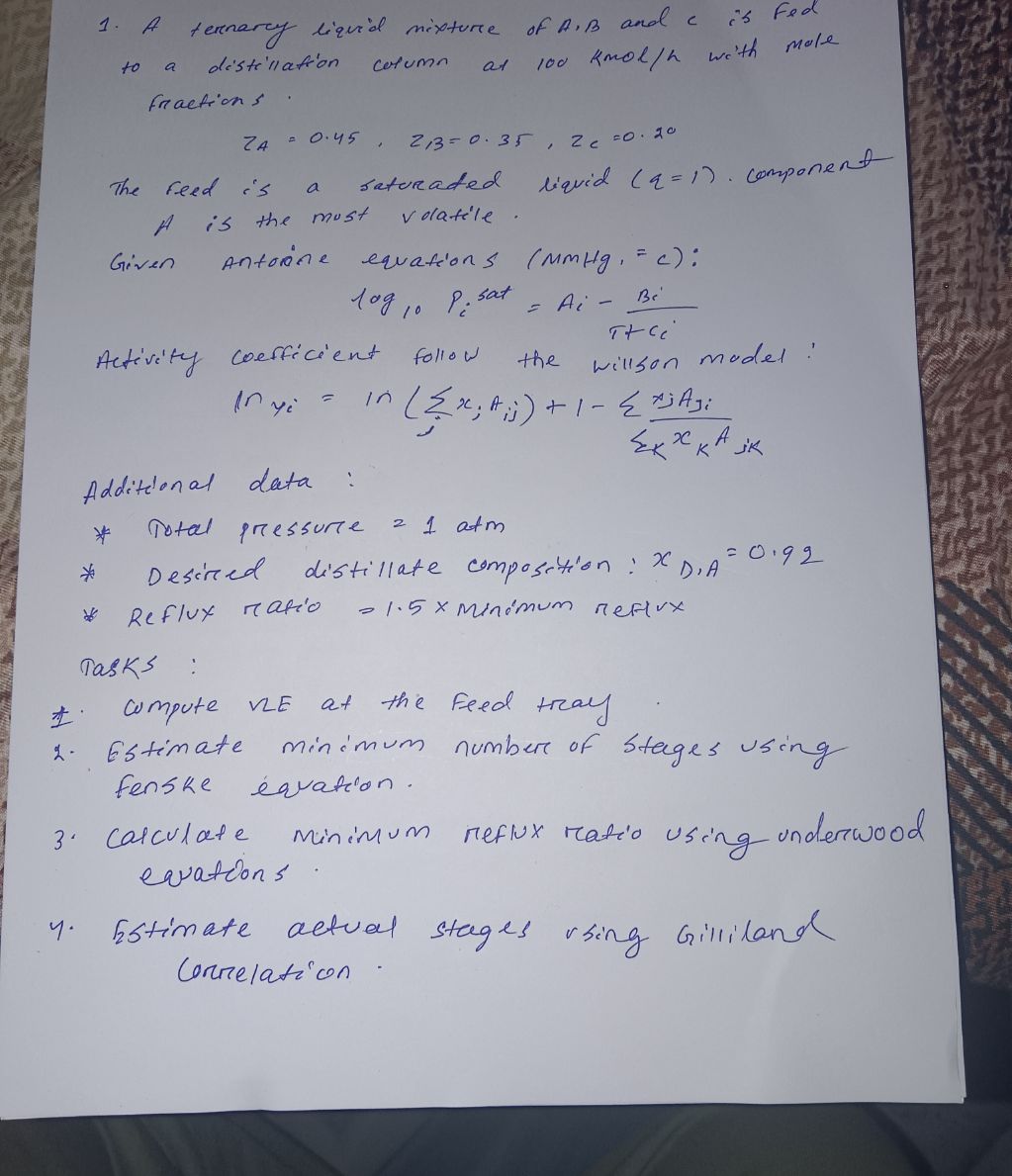
Let's break down your problem and address each task **step-by-step**. This is a **ternary distillation** problem with components A (most volatile), B, and C.
### **Given Data**
- Feed: 100 kmol/h, saturated liquid (q = 1)
- Feed mole fractions:
\( z_A = .45, \; z_B = .35, \; z_C = .20 \)
- Total pressure: 1 atm
- Distillate composition: \( x_{D,A} = .92 \)
- Reflux ratio: 1.5 × minimum reflux
- Antoine equation for each component:
\[
\log_{10} P_i^{sat} = A_i - \frac{B_i}{T+C_i}
\]
- Activity coefficients: **Wilson model**
\[
\ln \gamma_i = \ln\left(\sum_j x_j \Lambda_{ji}\right) + 1 - \sum_j \frac{x_j \Lambda_{ij}}{\sum_k x_k \Lambda_{kj}}
\]
- Tasks:
1. Compute VLE at the feed tray
2. Estimate minimum number of stages (Fenske)
3. Calculate minimum reflux ratio (Underwood)
4. Estimate actual stages (Gilliland)
---
## **1. Compute VLE at the Feed Tray**
**Step 1: Calculate K-values (using Wilson model & Antoine equation)**
**a. Calculate \( P_i^{sat} \) for each component using the Antoine equation.**
You need \( A_i, B_i, C_i \) values for each component and the tray temperature.
Assume temperature or iterate to find it (not provided, so let's denote as T).
**b. Calculate Wilson activity coefficients, \( \gamma_i \), using feed composition.**
- Use given Wilson model equation and feed mole fractions.
**c. Calculate K-values:**
\[
K_i = \frac{\gamma_i P_i^{sat}}{P}
\]
where \( P = 1 \) atm.
---
## **2. Estimate Minimum Number of Stages (Fenske Equation)**
\[
N_{min} = \frac{\log \left[ \frac{(x_{D,A}/x_{D,B})}{(x_{B,A}/x_{B,B})} \right]}{\log \alpha_{AB,avg}}
\]
- \( x_{D,A} = .92 \), \( x_{D,B} = 1 - x_{D,A} - x_{D,C} \) (assume \( x_{D,C} \) small/negligible for approximation)
- \( x_{B,A}, x_{B,B} \) from bottoms (need to estimate or assume a value for significant separation, say \( x_{B,A} \approx .01 \))
- \( \alpha_{AB,avg} \) is the average relative volatility at the top and bottom.
---
## **3. Calculate Minimum Reflux Ratio (Underwood Equations)**
**Underwood equation:**
\[
\sum_{i} \frac{q z_i}{\alpha_i - \theta} = 1
\]
where \( \alpha_i = K_i/K_{ref} \), \( q \) is feed condition, and \( \theta \) is solved iteratively.
Once \( \theta \) is found,
\[
R_{min} = \sum_{i} \frac{x_{D,i} (\alpha_i)}{\alpha_i - \theta} - 1
\]
---
## **4. Estimate Actual Stages (Gilliland Correlation)**
Given:
- \( N_{min} \) (from Fenske)
- \( R_{min} \) (from Underwood)
- Actual \( R = 1.5 R_{min} \)
**Gilliland correlation** (graphical or empirical correlation):
\[
Y = \frac{N - N_{min}}{N + 1}
\]
\[
X = \frac{R - R_{min}}{R + 1}
\]
- Use empirical charts or Eduljee's equation to relate X and Y, then solve for actual stages \( N \).
---
# **Summary and Final Answer Format**
Since the precise values for Antoine constants and Wilson parameters are not given, **here is the structured solution template**:
---
## **Step 1: VLE at Feed Tray**
1. **Calculate \( P_i^{sat} \) for A, B, C at assumed/estimated T using Antoine equation.**
2. **Compute Wilson activity coefficients \( \gamma_i \) using feed compositions.**
3. **Calculate K-values:**
\[
K_i = \frac{\gamma_i P_i^{sat}}{P}
\]
---
## **Step 2: Minimum Number of Stages**
\[
N_{min} = \frac{\log \left[ \frac{(x_{D,A}/x_{D,B})}{(x_{B,A}/x_{B,B})} \right]}{\log \alpha_{AB,avg}}
\]
---
## **Step 3: Minimum Reflux Ratio**
1. **Solve Underwood equation for \( \theta \).**
2. **Calculate \( R_{min} \):**
\[
R_{min} = \sum_{i} \frac{x_{D,i} (\alpha_i)}{\alpha_i - \theta} - 1
\]
---
## **Step 4: Actual Number of Stages**
1. **Calculate \( X = \frac{R - R_{min}}{R + 1} \).**
2. **Use Gilliland correlation to find \( Y \).**
3. **Solve for actual stages \( N \):**
\[
Y = \frac{N - N_{min}}{N + 1}
\]
---
### **NOTE**
If you provide the Antoine constants, Wilson parameters, or a temperature, I can plug in the numbers for a complete numerical solution.
---
**Would you like to proceed with assumed values for missing data, or do you have the required constants?**
VIPSolutions focuses on clear, step‑by‑step explanations so you can learn quickly. Whether you need an AI‑generated walkthrough or a short hint to get unstuck, each solution is organized for fast reading and easy review later.
Search similar questions, compare approaches, and bookmark the best answers for revision. Our goal is simple: quick, reliable study help that feels natural—not noisy.
 VIPSolutions
 EO ZINNE =
| 1 2 peer Loni ivi FAB 2nd Ne 05 ii
ro a olestnaton coturn aq joo Keo l JA IE
fraeck'on £
A GONE EE ae DEE
Te feed 3 a satoeatedl pigwed (a=1D tpporen d=
Vi £5 dhe mst yolatlle
Given pntodae equation s (mg =e)?
Cpe dpe
. = rece
J Acdevity (oefticient folio) the eigen roel FREY
5 v=" = #5) bE 2 ly
3 = x A
3 S¢ RES
> Adderdenad data
5 Motel pressure = 1 atm
$ pesieed distillate Cmpoghpen 2 Xp, p= O72 hs
4 ¥ Re Flv¥ Tao = [5 X Mdm Ref LVR b Nd
4 TafKS NS
Re, ryote VLE at “he Peeol Heal h :
4- [gtmate mindmem numbec of Steg s Using BRON
Lens he bgyabion - L%
3 (atevlote Mundy ™ efVX Ttaddo Using inolertio On
0.49040 8
1 fstmaete aelve] cgay ring. Gini lands
Ontree jatz"con ~
EO ZINNE =
| 1 2 peer Loni ivi FAB 2nd Ne 05 ii
ro a olestnaton coturn aq joo Keo l JA IE
fraeck'on £
A GONE EE ae DEE
Te feed 3 a satoeatedl pigwed (a=1D tpporen d=
Vi £5 dhe mst yolatlle
Given pntodae equation s (mg =e)?
Cpe dpe
. = rece
J Acdevity (oefticient folio) the eigen roel FREY
5 v=" = #5) bE 2 ly
3 = x A
3 S¢ RES
> Adderdenad data
5 Motel pressure = 1 atm
$ pesieed distillate Cmpoghpen 2 Xp, p= O72 hs
4 ¥ Re Flv¥ Tao = [5 X Mdm Ref LVR b Nd
4 TafKS NS
Re, ryote VLE at “he Peeol Heal h :
4- [gtmate mindmem numbec of Steg s Using BRON
Lens he bgyabion - L%
3 (atevlote Mundy ™ efVX Ttaddo Using inolertio On
0.49040 8
1 fstmaete aelve] cgay ring. Gini lands
Ontree jatz"con ~