Give step-by-step solution with explanation and final answer:1.
(a)
(i) Using the distillation process data in Table Q1, calculate the
minimum number of theoretical stages (N,,;,)-
(6 marks)
(ify If the Underwood constant (6) is 2.4, calculate the minimum reflux
ratio (Rn )-
(5 marks)
(iii) Using the values obtained in part (i) and (ii), calculate the number
of theoretical stages (N).
(8 marks)
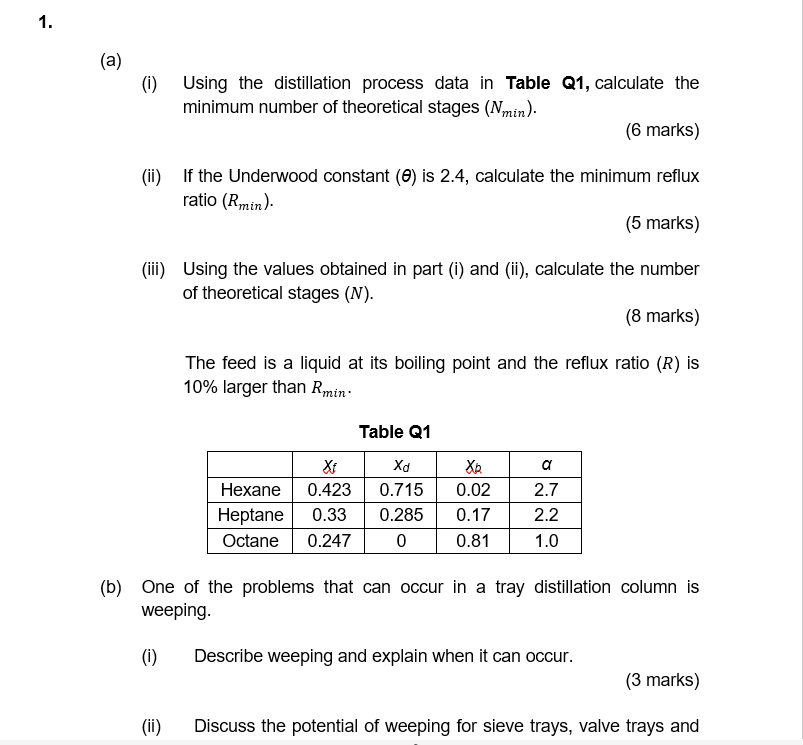
The feed is a liquid at its boiling point and the reflux ratio (R) is
10% larger than Rp,
Table Q1
[Ts [x] x [a]
0423 | 0775
025
02a] 0 | oar | 10]
(b) One of the problems that can occur in a fray distillation column is
weeping.
(i) Describe weeping and explain when it can occur.
(3 marks)
(ity Discuss the potential of weeping for sieve trays, valve trays and
Question:
Give step-by-step solution with explanation and final answer:1.
(a)
(i) Using the distillation process data in Table Q1, calculate the
minimum number of theoretical stages (N,,;,)-
(6 marks)
(ify If the Underwood constant (6) is 2.4, calculate the minimum reflux
ratio (Rn )-
(5 marks)
(iii) Using the values obtained in part (i) and (ii), calculate the number
of theoretical stages (N).
(8 marks)
The feed is a liquid at its boiling point and the reflux ratio (R) is
10% larger than Rp,
Table Q1
[Ts [x] x [a]
0423 | 0775
025
02a] 0 | oar | 10]
(b) One of the problems that can occur in a fray distillation column is
weeping.
(i) Describe weeping and explain when it can occur.
(3 marks)
(ity Discuss the potential of weeping for sieve trays, valve trays and
This is AI generated Response.
Asked by: singaluri krishna kumari
Created at: 2025-12-30 04:58:07
Final Answer:
RenderedRaw Text
Did you like this answer?
# Step-by-Step Solution
## (a) Distillation Calculations
### (i) **Minimum Number of Theoretical Stages (\(N_{min}\))**
We use the **Fenske Equation** for the minimum number of stages at total reflux:
\[
N_{min} = \frac{\log \left[ \frac{(x_{D}/(1-x_{D}))}{(x_{B}/(1-x_{B}))} \right]}{\log \alpha}
\]
Where:
- \(x_D\): mole fraction of more volatile component (Hexane) in distillate
- \(x_B\): mole fraction of more volatile component (Hexane) in bottom product
- \(\alpha\): relative volatility of Hexane with respect to Octane
From the table:
- For Hexane: \(x_{f} = .423\), \(x_{D} = .715\), \(x_{B} = .02\), \(\alpha = 2.7\)
Substitute into Fenske’s equation:
\[
N_{min} = \frac{\log \left[ \frac{.715/(1-.715)}{.02/(1-.02)} \right]}{\log 2.7}
\]
Calculate numerator:
- \(.715/(1-.715) = .715/.285 = 2.5088\)
- \(.02/(1-.02) = .02/.98 = .0204\)
- Ratio: \(2.5088/.0204 = 122.99\)
Calculate denominator:
- \(\log 2.7 = .431\) (base 10)
So,
\[
N_{min} = \frac{\log(122.99)}{.431}
\]
\[
= \frac{2.089}{.431}
\]
\[
= 4.85
\]
**Final Answer (i):**
\[
\boxed{N_{min} = 4.85}
\]
---
### (ii) **Minimum Reflux Ratio (\(R_{min}\))**
Use the **Underwood Equation** for minimum reflux ratio (for a saturated liquid feed):
\[
R_{min} = \sum_{i} \frac{x_{D,i} \alpha_i}{\alpha_i - \theta} - 1
\]
Given \(\theta = 2.4\).
From the table:
- Hexane: \(x_{D,1} = .715\), \(\alpha_1 = 2.7\)
- Heptane: \(x_{D,2} = .285\), \(\alpha_2 = 2.2\)
- Octane: \(x_{D,3} = \), \(\alpha_3 = 1.\)
Plug in:
\[
R_{min} = \left[ \frac{.715 \times 2.7}{2.7 - 2.4} + \frac{.285 \times 2.2}{2.2 - 2.4} + \frac{ \times 1.}{1. - 2.4} \right] - 1
\]
Calculate each term:
- Hexane: \(.715 \times 2.7 = 1.9305\), denominator: \(2.7 - 2.4 = .3\), so \(1.9305/.3 = 6.435\)
- Heptane: \(.285 \times 2.2 = .627\), denominator: \(2.2 - 2.4 = -.2\), so \(.627/-.2 = -3.135\)
- Octane: zero.
Sum: \(6.435 + (-3.135) = 3.3\)
\[
R_{min} = 3.3 - 1 = 2.3
\]
**Final Answer (ii):**
\[
\boxed{R_{min} = 2.3}
\]
---
### (iii) **Number of Theoretical Stages (\(N\))**
Given:
- The feed is a liquid at its boiling point (\(q = 1\))
- Reflux ratio is \(R = 1.1 R_{min} = 1.1 \times 2.3 = 2.53\)
Use the **Gilliland Correlation** (graphical or empirical):
One empirical form (Eduljee equation):
\[
Y = \frac{N - N_{min}}{N + 1}
\]
\[
X = \frac{R - R_{min}}{R + 1}
\]
\[
Y = .75 \left( \frac{X^{.566}}{1 + X^{.566} (.75 - .566)} \right)
\]
But you can use a shortcut for typical design:
For \(R = 1.1 R_{min}\):
\[
\frac{N - N_{min}}{N + 1} \approx .65 \left(\frac{R - R_{min}}{R + 1}\right)
\]
Calculate \(X\):
\[
X = \frac{2.53 - 2.3}{2.53 + 1} = \frac{.23}{3.53} = .065
\]
So,
\[
Y = .65 \times .065 = .042
\]
Now,
\[
\frac{N - 4.85}{N + 1} = .042
\]
\[
N - 4.85 = .042(N + 1)
\]
\[
N - 4.85 = .042N + .042
\]
\[
N - .042N = 4.85 + .042
\]
\[
.958N = 4.892
\]
\[
N = \frac{4.892}{.958} = 5.11
\]
**Final Answer (iii):**
\[
\boxed{N = 5.1}
\]
---
## (b) Weeping in Tray Distillation Columns
### (i) **Describe Weeping and When It Occurs**
- **Weeping** is the phenomenon where liquid flows (leaks) through the perforations in a tray instead of being retained on the tray.
- It occurs when the vapor flow rate is too low to support (hold up) the liquid on the tray, causing liquid to "weep" down to the tray below.
---
### (ii) **Potential of Weeping for Different Tray Types**
- **Sieve Trays:** High potential for weeping at low vapor rates, as holes are always open.
- **Valve Trays:** Less susceptible to weeping because valves close at low vapor flow, reducing the chance of liquid passing through.
- **Bubble Cap Trays:** Least likely to weep, as caps prevent liquid from passing through unless vapor pushes it up.
---
## **Summary of Answers**
### (a)
- (i) \(N_{min} = \boxed{4.85}\)
- (ii) \(R_{min} = \boxed{2.3}\)
- (iii) \(N = \boxed{5.1}\)
### (b)
- (i) Weeping is leakage of liquid through tray holes at low vapor rates.
- (ii) Sieve trays are most susceptible, valve trays less so, and bubble cap trays least susceptible to weeping.
VIPSolutions focuses on clear, step‑by‑step explanations so you can learn quickly. Whether you need an AI‑generated walkthrough or a short hint to get unstuck, each solution is organized for fast reading and easy review later.
Search similar questions, compare approaches, and bookmark the best answers for revision. Our goal is simple: quick, reliable study help that feels natural—not noisy.
 VIPSolutions
 1.
(a)
(i) Using the distillation process data in Table Q1, calculate the
minimum number of theoretical stages (N,,;,)-
(6 marks)
(ify If the Underwood constant (6) is 2.4, calculate the minimum reflux
ratio (Rn )-
(5 marks)
(iii) Using the values obtained in part (i) and (ii), calculate the number
of theoretical stages (N).
(8 marks)
The feed is a liquid at its boiling point and the reflux ratio (R) is
10% larger than Rp,
Table Q1
[Ts [x] x [a]
0423 | 0775
025
02a] 0 | oar | 10]
(b) One of the problems that can occur in a fray distillation column is
weeping.
(i) Describe weeping and explain when it can occur.
(3 marks)
(ity Discuss the potential of weeping for sieve trays, valve trays and
1.
(a)
(i) Using the distillation process data in Table Q1, calculate the
minimum number of theoretical stages (N,,;,)-
(6 marks)
(ify If the Underwood constant (6) is 2.4, calculate the minimum reflux
ratio (Rn )-
(5 marks)
(iii) Using the values obtained in part (i) and (ii), calculate the number
of theoretical stages (N).
(8 marks)
The feed is a liquid at its boiling point and the reflux ratio (R) is
10% larger than Rp,
Table Q1
[Ts [x] x [a]
0423 | 0775
025
02a] 0 | oar | 10]
(b) One of the problems that can occur in a fray distillation column is
weeping.
(i) Describe weeping and explain when it can occur.
(3 marks)
(ity Discuss the potential of weeping for sieve trays, valve trays and