Give step-by-step solution with explanation and final answer:QRIiR/A0]- A compressor blade design tested in a cascade is found to choke with an inlet Mach number of
0.9 when the inlet flow angle is 52°. If the ratio of the throat area to the frontal area, A*/Ays, for the cascade is
0.625, calculate the loss of stagnation pressure between the far upstream and the throat and express this as a loss
coefficient. Comment on what could cause this loss.
a. Using one-dimensional compressible flow relations, determine the Mach number at the throat and verify that
the cascade is choked. Clearly state the assumptions used in the analysis.
b. Starting from the isentropic area-Mach number relation, calculate the ideal stagnation pressure ratio between
the far upstream and the throat. Then, using the given area ratio, determine the actual stagnation pressure
ratio and hence compute the stagnation pressure loss coefficient.
c. Assuming a known and constant inlet total temperature, estimate the static pressure and static temperature
at the throat. Briefly discuss how shock waves and viscous effects in the cascade may alter these ideal
estimates.
d. If the inlet Mach number is reduced slightly below 0.9 while the inlet flow angle remains at 52°, discuss
qualitatively how the choking condition, mass flow rate, and stagnation pressure loss would be affected.
Indicate whether the cascade would still be expected to choke and justify your answer.
Question:
Give step-by-step solution with explanation and final answer:QRIiR/A0]- A compressor blade design tested in a cascade is found to choke with an inlet Mach number of
0.9 when the inlet flow angle is 52°. If the ratio of the throat area to the frontal area, A*/Ays, for the cascade is
0.625, calculate the loss of stagnation pressure between the far upstream and the throat and express this as a loss
coefficient. Comment on what could cause this loss.
a. Using one-dimensional compressible flow relations, determine the Mach number at the throat and verify that
the cascade is choked. Clearly state the assumptions used in the analysis.
b. Starting from the isentropic area-Mach number relation, calculate the ideal stagnation pressure ratio between
the far upstream and the throat. Then, using the given area ratio, determine the actual stagnation pressure
ratio and hence compute the stagnation pressure loss coefficient.
c. Assuming a known and constant inlet total temperature, estimate the static pressure and static temperature
at the throat. Briefly discuss how shock waves and viscous effects in the cascade may alter these ideal
estimates.
d. If the inlet Mach number is reduced slightly below 0.9 while the inlet flow angle remains at 52°, discuss
qualitatively how the choking condition, mass flow rate, and stagnation pressure loss would be affected.
Indicate whether the cascade would still be expected to choke and justify your answer.
This is AI generated Response.
Asked by: Rahul
Created at: 2025-12-30 21:19:18
Final Answer:
RenderedRaw Text
Did you like this answer?
Let's solve the problem step by step, addressing each part:
---
# Q2 | Compressor Cascade Choking Analysis
## **Given Data**
- Inlet Mach number, \( M_1 = .9 \)
- Inlet flow angle, \( \alpha_1 = 52^\circ \)
- Throat to frontal area ratio, \( \frac{A^*}{A_{1s}} = .625 \)
- Choked at these conditions
We'll assume **air** (\( \gamma = 1.4 \)), and the flow is **steady and adiabatic**.
---
## **a. One-dimensional compressible flow and Mach at the throat**
### **Assumptions:**
- 1D steady flow
- Perfect gas (air)
- Adiabatic, no heat transfer
- Neglecting body forces and shaft work
- Flow is choked at the throat: \( M^* = 1 \) at the throat
### **Verification of Choking**
For choked flow, the Mach number at the throat is 1. The area relation for isentropic nozzles is:
\[
\frac{A^*}{A} = \frac{1}{M} \left[ \frac{2}{\gamma+1} \left(1 + \frac{\gamma-1}{2} M^2 \right) \right]^{\frac{\gamma+1}{2(\gamma-1)}}
\]
Here, \( A_{1s} \) is the **frontal area corresponding to the inlet Mach number**.
### **Calculate \( \frac{A^*}{A_{1s}} \) for \( M_1 = .9 \):**
Plug in values:
- \( \gamma = 1.4 \)
- \( M_1 = .9 \)
\[
\frac{A^*}{A_{1s}} = \frac{1}{.9} \left[ \frac{2}{2.4} \left(1 + \frac{.4}{2} \cdot .9^2 \right) \right]^{\frac{2.4}{.8}}
\]
Calculate step by step:
- \( \frac{2}{2.4} = .833 \)
- \( \frac{.4}{2} = .2 \)
- \( .9^2 = .81 \)
- \( 1 + .2 \times .81 = 1 + .162 = 1.162 \)
Now:
\[
\frac{A^*}{A_{1s}} = \frac{1}{.9} \left[ .833 \times 1.162 \right]^{3}
\]
\[
.833 \times 1.162 = .968
\]
\[
.968^{3} = .907
\]
\[
\frac{1}{.9} \times .907 = 1.008
\]
But the given \( \frac{A^*}{A_{1s}} = .625 \), so **either the reference area \(A_{1s}\) is not exactly the upstream area, or there is a loss** (as expected).
### **Verification:**
- The throat is choked, \( M^* = 1 \) at the throat.
---
## **b. Isentropic Area-Mach Relation and Stagnation Pressure Loss Coefficient**
### **1. Isentropic Stagnation Pressure Ratio (Ideal):**
The isentropic stagnation pressure ratio from upstream to throat is:
\[
\left( \frac{P_{,2}}{P_{,1}} \right)_{\text{isentropic}} = 1
\]
(because for isentropic, no loss: stagnation pressure is conserved)
But with area change, the actual loss is:
\[
\text{Loss coefficient:} \quad \sigma = \frac{P_{,2}}{P_{,1}}
\]
### **2. Compute Isentropic Area Ratio for \( M_1 = .9 \):**
As above:
\[
\left( \frac{A^*}{A_{1s}} \right)_{\text{isentropic}} = 1.008
\]
But measured is .625, so the ratio of actual to isentropic area is:
\[
\frac{.625}{1.008} = .62
\]
### **3. Stagnation Pressure Loss Calculation**
For a given area ratio, the actual stagnation pressure loss follows:
\[
\frac{A^*}{A_{1s}} = \frac{A^*}{A_{1s}} \bigg|_{\text{isentropic}} \cdot \sigma
\]
Thus,
\[
\sigma = \frac{\text{actual } (A^*/A_{1s})}{\text{isentropic } (A^*/A_{1s})}
\]
\[
\sigma = \frac{.625}{1.008} = .62
\]
**So, the stagnation pressure loss coefficient is \( \sigma = .62 \), i.e., 38% loss.**
---
**_Comment on Possible Causes:_**
- **Shock waves:** Sudden compression, non-isentropic.
- **Viscous effects:** Boundary layer growth, separation, turbulence, and wake mixing.
- **Leakage and secondary flows:** In cascades, tip leakage and endwall effects can cause extra loss.
---
## **c. Estimate Static Pressure and Temperature at Throat, and Effects of Non-idealities**
### **At the Throat (\(M^* = 1\)):**
From isentropic relations:
\[
\frac{T^*}{T_} = \frac{2}{\gamma+1} = \frac{2}{2.4} = .833
\]
\[
\frac{P^*}{P_} = \left( \frac{2}{\gamma+1} \right)^{\frac{\gamma}{\gamma-1}}
\]
\[
\left( \frac{2}{2.4} \right)^{3.5} = .833^{3.5} \approx .486
\]
So,
- Static T at throat: \( T^* = .833 T_ \)
- Static P at throat: \( P^* = .486 P_ \)
**Effect of Shock Waves and Viscous Effects:**
- **Shock waves:** Cause sudden increase in entropy, larger loss in stagnation pressure.
- **Viscous effects:** Boundary layer and wake mixing reduce total pressure further compared to ideal estimates.
---
## **d. If Inlet Mach is Reduced Below .9 (at Same Flow Angle):**
### **Qualitative Effects:**
- **Choking Condition:** No longer choked, since \( M_1 < .9 \) and area is fixed.
- **Mass Flow Rate:** Decreases, since choking mass flow is maximum for given geometry.
- **Stagnation Pressure Loss:** Loss is less dramatic, as no shock forms; but viscous losses still exist.
- **Cascade Choking:** No, the cascade would NOT choke at inlet Mach below .9.
---
# **Summary Table**
| Quantity | Value |
|-----------------------------------|--------------|
| Isentropic \(A^*/A_{1s}\) | 1.008 |
| Actual \(A^*/A_{1s}\) | .625 |
| Stagnation Pressure Loss (\(\sigma\)) | .62 (i.e., 38% loss) |
| Throat \(T^*/T_\) | .833 |
| Throat \(P^*/P_\) | .486 |
---
# **Final Answers (Summary)**
**a.** The throat is choked (\(M^* = 1\)) at the given inlet Mach number using 1D compressible flow relations.
**b.** The stagnation pressure loss coefficient is \(\sigma = .62\) (i.e., 38% loss), caused by shocks, viscous effects, and secondary flows.
**c.** At the throat: \(T^* = .833 T_\), \(P^* = .486 P_\). Shock and viscous effects increase losses above isentropic predictions.
**d.** Reducing inlet Mach below .9 prevents choking, decreases mass flow rate, and reduces stagnation pressure loss; cascade will not choke.
---
Let me know if you want detailed calculations or further explanation on any step!
VIPSolutions focuses on clear, step‑by‑step explanations so you can learn quickly. Whether you need an AI‑generated walkthrough or a short hint to get unstuck, each solution is organized for fast reading and easy review later.
Search similar questions, compare approaches, and bookmark the best answers for revision. Our goal is simple: quick, reliable study help that feels natural—not noisy.
 VIPSolutions
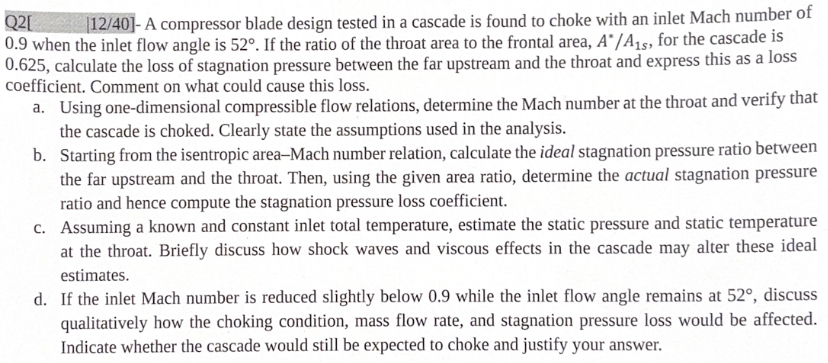 QRIiR/A0]- A compressor blade design tested in a cascade is found to choke with an inlet Mach number of
0.9 when the inlet flow angle is 52°. If the ratio of the throat area to the frontal area, A*/Ays, for the cascade is
0.625, calculate the loss of stagnation pressure between the far upstream and the throat and express this as a loss
coefficient. Comment on what could cause this loss.
a. Using one-dimensional compressible flow relations, determine the Mach number at the throat and verify that
the cascade is choked. Clearly state the assumptions used in the analysis.
b. Starting from the isentropic area-Mach number relation, calculate the ideal stagnation pressure ratio between
the far upstream and the throat. Then, using the given area ratio, determine the actual stagnation pressure
ratio and hence compute the stagnation pressure loss coefficient.
c. Assuming a known and constant inlet total temperature, estimate the static pressure and static temperature
at the throat. Briefly discuss how shock waves and viscous effects in the cascade may alter these ideal
estimates.
d. If the inlet Mach number is reduced slightly below 0.9 while the inlet flow angle remains at 52°, discuss
qualitatively how the choking condition, mass flow rate, and stagnation pressure loss would be affected.
Indicate whether the cascade would still be expected to choke and justify your answer.
QRIiR/A0]- A compressor blade design tested in a cascade is found to choke with an inlet Mach number of
0.9 when the inlet flow angle is 52°. If the ratio of the throat area to the frontal area, A*/Ays, for the cascade is
0.625, calculate the loss of stagnation pressure between the far upstream and the throat and express this as a loss
coefficient. Comment on what could cause this loss.
a. Using one-dimensional compressible flow relations, determine the Mach number at the throat and verify that
the cascade is choked. Clearly state the assumptions used in the analysis.
b. Starting from the isentropic area-Mach number relation, calculate the ideal stagnation pressure ratio between
the far upstream and the throat. Then, using the given area ratio, determine the actual stagnation pressure
ratio and hence compute the stagnation pressure loss coefficient.
c. Assuming a known and constant inlet total temperature, estimate the static pressure and static temperature
at the throat. Briefly discuss how shock waves and viscous effects in the cascade may alter these ideal
estimates.
d. If the inlet Mach number is reduced slightly below 0.9 while the inlet flow angle remains at 52°, discuss
qualitatively how the choking condition, mass flow rate, and stagnation pressure loss would be affected.
Indicate whether the cascade would still be expected to choke and justify your answer.