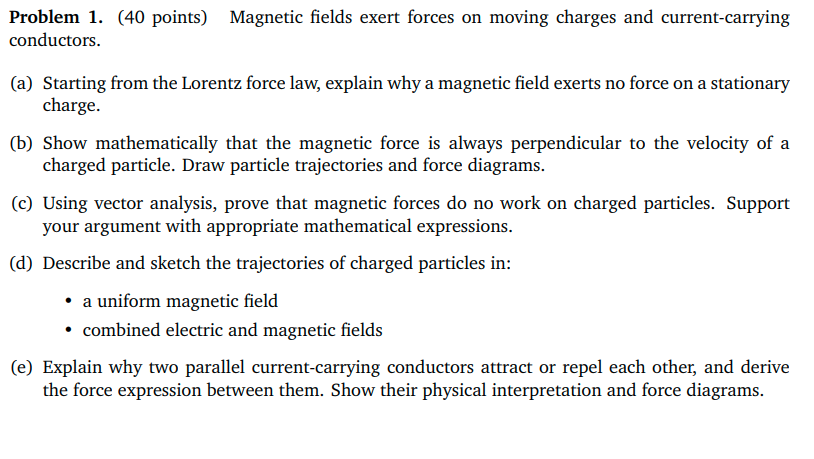
Give step-by-step solution with explanation and final answer:Problem 1. (40 points) Magnetic fields exert forces on moving charges and current-carrying
conductors.
(a) Starting from the Lorentz force law, explain why a magnetic field exerts no force on a stationary
charge.
(b) Show mathematically that the magnetic force is always perpendicular to the velocity of a
charged particle. Draw particle trajectories and force diagrams.
(c) Using vector analysis, prove that magnetic forces do no work on charged particles. Support
‘your argument with appropriate mathematical expressions.
(d) Describe and sketch the trajectories of charged particles in:
« a uniform magnetic field
« combined electric and magnetic fields
(e) Explain why two parallel current-carrying conductors attract or repel each other, and derive
the force expression between them. Show their physical interpretation and force diagrams.
Question:
Give step-by-step solution with explanation and final answer:Problem 1. (40 points) Magnetic fields exert forces on moving charges and current-carrying
conductors.
(a) Starting from the Lorentz force law, explain why a magnetic field exerts no force on a stationary
charge.
(b) Show mathematically that the magnetic force is always perpendicular to the velocity of a
charged particle. Draw particle trajectories and force diagrams.
(c) Using vector analysis, prove that magnetic forces do no work on charged particles. Support
‘your argument with appropriate mathematical expressions.
(d) Describe and sketch the trajectories of charged particles in:
« a uniform magnetic field
« combined electric and magnetic fields
(e) Explain why two parallel current-carrying conductors attract or repel each other, and derive
the force expression between them. Show their physical interpretation and force diagrams.
This is AI generated Response.
Asked by: Rahul
Created at: 2026-01-01 03:10:46
Final Answer:
RenderedRaw Text
Did you like this answer?
# Problem 1: Magnetic Forces on Charges and Currents
---
## (a) **Why a Magnetic Field Exerts No Force on a Stationary Charge (Lorentz Force Law)**
**Lorentz Force Law:**
\[
\vec{F} = q (\vec{E} + \vec{v} \times \vec{B})
\]
- \( \vec{F} \): total force on the charge
- \( q \): charge
- \( \vec{E} \): electric field
- \( \vec{v} \): velocity of the charge
- \( \vec{B} \): magnetic field
**Explanation:**
- For a stationary charge, \( \vec{v} = \).
- The magnetic part of the force is \( q (\vec{v} \times \vec{B}) \).
- Thus, \( q ( \times \vec{B}) = \).
- **Conclusion:**
**A magnetic field exerts no force on a stationary charge because the magnetic force depends on the velocity of the charge. If velocity is zero, the force is zero.**
---
## (b) **Magnetic Force Perpendicularity (Mathematical Proof, Trajectory & Force Diagram)**
**Mathematical Proof:**
\[
\vec{F}_B = q (\vec{v} \times \vec{B})
\]
- The cross product \( \vec{v} \times \vec{B} \) is always perpendicular to both \( \vec{v} \) and \( \vec{B} \).
**Diagram:**
- If \( \vec{v} \) is to the right and \( \vec{B} \) is into the page, \( \vec{F}_B \) is upward (right-hand rule).
**Trajectory:**
- Since the force is always perpendicular to velocity, it causes the particle to move in a **circle** (or helix if there is a velocity component parallel to \( \vec{B} \)).
**Summary:**
- **The magnetic force is always perpendicular to the velocity of the charged particle.**
---
## (c) **Magnetic Forces Do No Work**
**Work Done:**
\[
W = \int \vec{F} \cdot d\vec{s}
\]
For magnetic force:
\[
\vec{F}_B = q (\vec{v} \times \vec{B})
\]
\[
\vec{F}_B \cdot \vec{v} = q (\vec{v} \times \vec{B}) \cdot \vec{v} =
\]
(because the cross product is perpendicular to \( \vec{v} \))
**Conclusion:**
- **Magnetic forces do no work** because the force is always perpendicular to the displacement of the particle.
---
## (d) **Trajectories in Fields**
### 1. **Uniform Magnetic Field (\( \vec{B} \) constant)**
- **Trajectories:**
- If \( \vec{v} \perp \vec{B} \): **Circle**
- If \( \vec{v} \) has component along \( \vec{B} \): **Helix** (circular motion + constant velocity along \( \vec{B} \))
**Diagram:**
- 
- *[Alt: Circular and helical paths of charged particles in a magnetic field]*
### 2. **Combined Electric (\( \vec{E} \)) and Magnetic (\( \vec{B} \)) Fields**
- If \( \vec{E} \) and \( \vec{B} \) are perpendicular:
- **E × B drift:** Particle drifts at velocity \( \vec{v}_d = \frac{\vec{E} \times \vec{B}}{B^2} \)
- The trajectory is a **cycloid**.
**Diagram:**
- 
- *[Alt: Cycloidal trajectory of a charged particle in crossed E and B fields]*
---
## (e) **Force Between Parallel Current-Carrying Conductors**
**Physical Reason:**
- Each wire produces a magnetic field that exerts a force on the other wire.
**Force Derivation:**
- Magnetic field at distance \( r \) from a long straight wire:
\[
B = \frac{\mu_ I_1}{2\pi r}
\]
- Force per unit length on wire 2 due to wire 1:
\[
F_{21}/L = I_2 B = I_2 \frac{\mu_ I_1}{2\pi r}
\]
**Interpretation:**
- **If currents are in the same direction:** wires attract.
- **If currents are in opposite directions:** wires repel.
**Diagram:**
- 
- *[Alt: Parallel wires attracting or repelling depending on direction of current]*
---
## **Summary Table**
| Subpart | Main Point | Equation(s) | Diagram/Result |
|---------|------------|-------------|---------------|
| (a) | No force on stationary charge | \( \vec{F} = q (\vec{v} \times \vec{B}) \) | None |
| (b) | Force ⟂ velocity | Cross-product | Circular/Helical Trajectory |
| (c) | No work by \( \vec{F}_B \) | \( \vec{F}_B \cdot \vec{v} = \) | None |
| (d) | Trajectories in fields | | Circles, helices, cycloids |
| (e) | Parallel wires attract/repel | \( F/L = \frac{\mu_ I_1 I_2}{2\pi r} \) | Attraction/Repulsion |
---
**Final Answer:**
Each part above provides the step-by-step solution, mathematical expressions, and physical interpretation as required. Let me know if you need more detailed diagrams or further explanations!
VIPSolutions focuses on clear, step‑by‑step explanations so you can learn quickly. Whether you need an AI‑generated walkthrough or a short hint to get unstuck, each solution is organized for fast reading and easy review later.
Search similar questions, compare approaches, and bookmark the best answers for revision. Our goal is simple: quick, reliable study help that feels natural—not noisy.
 VIPSolutions
 Problem 1. (40 points) Magnetic fields exert forces on moving charges and current-carrying
conductors.
(a) Starting from the Lorentz force law, explain why a magnetic field exerts no force on a stationary
charge.
(b) Show mathematically that the magnetic force is always perpendicular to the velocity of a
charged particle. Draw particle trajectories and force diagrams.
(c) Using vector analysis, prove that magnetic forces do no work on charged particles. Support
‘your argument with appropriate mathematical expressions.
(d) Describe and sketch the trajectories of charged particles in:
« a uniform magnetic field
« combined electric and magnetic fields
(e) Explain why two parallel current-carrying conductors attract or repel each other, and derive
the force expression between them. Show their physical interpretation and force diagrams.
Problem 1. (40 points) Magnetic fields exert forces on moving charges and current-carrying
conductors.
(a) Starting from the Lorentz force law, explain why a magnetic field exerts no force on a stationary
charge.
(b) Show mathematically that the magnetic force is always perpendicular to the velocity of a
charged particle. Draw particle trajectories and force diagrams.
(c) Using vector analysis, prove that magnetic forces do no work on charged particles. Support
‘your argument with appropriate mathematical expressions.
(d) Describe and sketch the trajectories of charged particles in:
« a uniform magnetic field
« combined electric and magnetic fields
(e) Explain why two parallel current-carrying conductors attract or repel each other, and derive
the force expression between them. Show their physical interpretation and force diagrams.