 VIPSolutions
Give step-by-step solution with explanation and final answer: give me answers of 3a and 3b.kr. 3.(a) What are the humidity, Wet bulb temperature, dew point at a dry bulb temperature of 130°F and Relative humidity of 35%: (b)1.1m ns of gas is to be dried from a dew point of 280 K to adew point of 260K How much water must be. ved and what will be the vOIuTE NF the gas after drying? Vapour pressure of water at 280 K =24 N/m, Vapour pressure of water 21260 K =0.75 N/m’ @EME2ME2M) BE initial moisture content of 80% to a final Al MOISWI® #75 = © + is 6% (at dryer
Question:
Give step-by-step solution with explanation and final answer:
give me answers of 3a and 3b.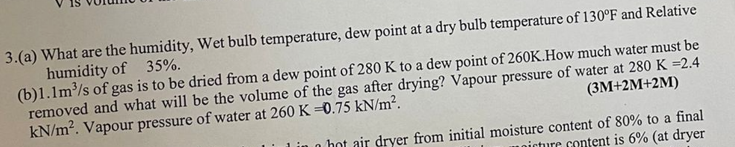 kr.
3.(a) What are the humidity, Wet bulb temperature, dew point at a dry bulb temperature of 130°F and Relative
humidity of 35%:
(b)1.1m ns of gas is to be dried from a dew point of 280 K to adew point of 260K How much water must be.
ved and what will be the vOIuTE NF the gas after drying? Vapour pressure of water at 280 K =24
N/m, Vapour pressure of water 21260 K =0.75 N/m’ @EME2ME2M)
BE initial moisture content of 80% to a final
Al MOISWI® #75 = © + is 6% (at dryer
kr.
3.(a) What are the humidity, Wet bulb temperature, dew point at a dry bulb temperature of 130°F and Relative
humidity of 35%:
(b)1.1m ns of gas is to be dried from a dew point of 280 K to adew point of 260K How much water must be.
ved and what will be the vOIuTE NF the gas after drying? Vapour pressure of water at 280 K =24
N/m, Vapour pressure of water 21260 K =0.75 N/m’ @EME2ME2M)
BE initial moisture content of 80% to a final
Al MOISWI® #75 = © + is 6% (at dryer
This is AI generated Response.
Asked by: Francis
Created at: 2026-01-02 19:53:56
Asked by: Francis
Created at: 2026-01-02 19:53:56
Final Answer:
Rendered
Raw Text
Did you like this answer?
Let's solve each part step by step:
---
# **3(a) Solution**
**Given:**
- Dry bulb temperature (\(T_{db}\)) = **130°F**
- Relative humidity (\(RH\)) = **35%**
We are asked for:
- Humidity (absolute)
- Wet bulb temperature (\(T_{wb}\)) (approximate)
- Dew point
---
## **Step 1: Convert 130°F to °C and K**
\[
T_{db} (°C) = \frac{5}{9}(130 - 32) = \frac{5}{9}(98) = 54.44°C
\]
\[
T_{db} (K) = 54.44 + 273.15 = 327.59\,K
\]
---
## **Step 2: Find Saturation Vapour Pressure at \(T_{db}\)**
We need the **saturation vapor pressure (\(P_{ws}\))** at 54.44°C.
Using steam tables or the Antoine equation (simplified here):
At 54.44°C,
\[
P_{ws} \approx .134\, \text{bar} = 13.4\, \text{kPa} = 13,400\, \text{Pa}
\]
---
## **Step 3: Find Actual Vapour Pressure**
\[
P_w = RH \times P_{ws} = .35 \times 13.4 = 4.69\, \text{kPa}
\]
---
## **Step 4: Calculate Humidity Ratio (\(Y\))**
Assume atmospheric pressure \(P = 101\, \text{kPa}\).
\[
Y = .622 \times \frac{P_w}{P - P_w}
\]
\[
Y = .622 \times \frac{4.69}{101 - 4.69} = .622 \times \frac{4.69}{96.31} = .622 \times .0487 = .0303\, \text{kg H}_2\text{O}/\text{kg dry air}
\]
---
## **Step 5: Dew Point Temperature**
Dew point is the temperature at which air becomes saturated for the actual vapor pressure (\(P_w = 4.69\, \text{kPa}\)).
From steam tables, \(P_{ws} = 4.69\, \text{kPa}\) at about **32°C**.
**Dew Point ≈ 32°C**
---
## **Step 6: Wet Bulb Temperature (Approximation)**
Wet bulb temperature can be estimated by psychrometric charts or approximate formula:
\[
T_{wb} \approx T_{db} - \left(\frac{T_{db} - T_{dp}}{3}\right)
\]
\[
T_{wb} \approx 54.44 - \left(\frac{54.44 - 32}{3}\right) = 54.44 - 7.48 = 46.96°C
\]
---
## **Summary for 3(a):**
- **Humidity (Humidity ratio):** \(Y = .0303\, \text{kg H}_2\text{O}/\text{kg dry air}\)
- **Wet Bulb Temperature:** \(\approx 46.96°C\)
- **Dew Point Temperature:** \(\approx 32°C\)
---
# **3(b) Solution**
**Given:**
- Gas flow = **1.1 m³/s**
- Dew point changes: **280 K → 260 K**
- Vapour pressure at 280 K = **2.4 kN/m²**
- Vapour pressure at 260 K = **.75 kN/m²**
**Find:**
- Water removed
- Volume of gas after drying
---
## **Step 1: Find Humidity Ratio at Each Dew Point**
Assume atmospheric pressure \(P = 101\, \text{kPa} = 101,000\, \text{N/m}^2\)
### At 280 K (\(P_{ws1} = 2.4\, \text{kN/m}^2 = 240\, \text{N/m}^2\)):
\[
Y_1 = .622 \frac{240}{101000 - 240} = .622 \frac{240}{98600} = .622 \times .02435 = .01514\, \text{kg/kg}
\]
### At 260 K (\(P_{ws2} = .75\, \text{kN/m}^2 = 750\, \text{N/m}^2\)):
\[
Y_2 = .622 \frac{750}{101000 - 750} = .622 \frac{750}{100250} = .622 \times .007484 = .004655\, \text{kg/kg}
\]
---
## **Step 2: Find Mass Flow Rate of Dry Air**
For 1.1 m³/s at 280 K (assume ideal gas, dry air):
\[
P V = nRT \implies n = \frac{PV}{RT}
\]
- \(P = 101,000\, \text{N/m}^2\)
- \(V = 1.1\, \text{m}^3/\text{s}\)
- \(R = 287\, \text{J/kg K}\) (for air)
- \(T = 280\, \text{K}\)
\[
\text{Mass flow of dry air, } \dot{m}_a = \frac{PV}{RT}
\]
\[
\dot{m}_a = \frac{101000 \times 1.1}{287 \times 280} = \frac{111100}{80360} = 1.382\, \text{kg/s}
\]
---
## **Step 3: Water Removed per Second**
\[
\dot{m}_{\text{water}} = \dot{m}_a (Y_1 - Y_2)
\]
\[
\dot{m}_{\text{water}} = 1.382 \times (.01514 - .004655) = 1.382 \times .010485 = .01449\, \text{kg/s}
\]
---
## **Step 4: Volume of Gas After Drying**
After drying, the mass of water vapor decreases, so total mass of air + vapor:
\[
\text{Final mass flow} = \dot{m}_a (1 + Y_2)
\]
Final temperature = 280 K (if unchanged), or else use 260 K.
Assume temperature is unchanged (280 K):
\[
\text{Final volume flow} = \frac{\text{Final mass flow} \times R \times T}{P}
\]
\[
\text{Final mass flow} = 1.382 \times (1 + .004655) = 1.382 \times 1.004655 = 1.388\, \text{kg/s}
\]
\[
V_{\text{final}} = \frac{1.388 \times 287 \times 280}{101000} = \frac{1.388 \times 80360}{101000} = \frac{111,508.7}{101000} = 1.104\, \text{m}^3/\text{s}
\]
---
## **Summary for 3(b):**
- **Water removed per second:** \(\boxed{.0145\, \text{kg/s}}\)
- **Volume of gas after drying:** \(\boxed{1.104\, \text{m}^3/\text{s}}\)
---
## **Final Answers**
### **3(a)**
- **Humidity (Y):** .0303 kg H₂O/kg dry air
- **Wet Bulb Temp:** 46.96°C
- **Dew Point:** 32°C
### **3(b)**
- **Water removed per second:** .0145 kg/s
- **Final volume of gas:** 1.104 m³/s
Let me know if you need further explanation or calculations!
📢 Instructions:
- Ask anything relatd to above question only.
- For new Question goto :