 VIPSolutions
Give step-by-step solution with explanation and final answer: Consider the following process scheme describing a chemostat with a recycle. The product stream of the chemostat is separated into two streams, and one of them (cell-rich stream) is recycled into the reactor. The recycle ratio is defined as and the cell concentration ratio in the cell separator is defined as a) Write the mass balance for biomass around the chemostat. b) Assuming steady -state operation with sterile fresh feed (XO = 0), and neglecting cell death (kd = 0), show that the growth rate is proportional to the dilution rate with the following relationship:Separator F stimer x x [11] V x s R Xp
Question:
Give step-by-step solution with explanation and final answer:
Consider the following process scheme describing a chemostat with a recycle.
The product stream of the chemostat is separated into two streams, and one of them (cell-rich stream) is recycled into the reactor. The recycle ratio is defined as and the cell concentration ratio in the cell separator is defined as a) Write the mass balance for biomass around the chemostat. b) Assuming steady -state operation with sterile fresh feed (XO = 0), and neglecting cell death (kd = 0), show that the growth rate is proportional to the dilution rate with the following relationship: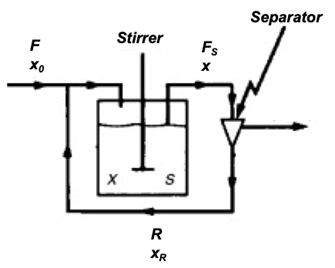 Separator
F stimer
x x
[11]
V
x s
R
Xp
Separator
F stimer
x x
[11]
V
x s
R
Xp
This is AI generated Response.
Asked by: Francis
Created at: 2026-01-04 23:35:53
Asked by: Francis
Created at: 2026-01-04 23:35:53
Final Answer:
Rendered
Raw Text
Did you like this answer?
# Chemostat with Recycle: Biomass Mass Balance
Let's break the problem into two parts as requested:
---
## a) **Mass Balance for Biomass around the Chemostat**
### **Definitions and Nomenclature**
- \( F \): Fresh feed flow rate (L/h)
- \( X_ \): Biomass concentration in feed (assume sterile, so \( X_ = \))
- \( X \): Biomass concentration in reactor (g/L)
- \( S \): Substrate concentration in reactor (not directly needed here)
- \( F_s \): Product stream flow rate (L/h)
- \( x \): Biomass concentration in product stream
- \( R \): Recycle flow rate (L/h)
- \( x_R \): Biomass concentration in recycle stream
- **Recycle ratio:** \( r = \frac{R}{F} \)
- **Cell concentration ratio (separator):** \( \alpha = \frac{x_R}{x} \)
### **Step 1: Mass Balance for Biomass**
At steady state, **accumulation = **.
\[ \text{Input} + \text{Generation} = \text{Output} \]
#### **Inputs:**
- Feed: \( F X_ \) (since \( X_ = \), this term = )
- Recycle: \( R x_R \)
#### **Generation:**
- Biomass generated by growth: \( \mu X V \)
- \( \mu \): specific growth rate (\( \mathrm{h}^{-1} \))
- \( V \): reactor volume
#### **Outputs:**
- Product stream: \( F_s x \)
#### **Total Output from Reactor:**
- Product + Recycle: \( F_s + R = F + R \) (since total outflow = total inflow for steady state)
#### **Mass Balance Equation:**
\[
\underbrace{F X_}_{\text{Feed}} + \underbrace{R x_R}_{\text{Recycle}} + \underbrace{\mu X V}_{\text{Generation}} = \underbrace{F_s x}_{\text{Product}}
+ \underbrace{R x_R}_{\text{Recycle output (but this returns to input)}}
\]
**But since the recycle is not leaving the system, only the product stream leaves, so the output is only \( F_s x \):**
\[
F X_ + R x_R + \mu X V = F_s x + R x_R
\]
**\( R x_R \) cancels on both sides:**
\[
F X_ + \mu X V = F_s x
\]
But with **sterile feed** (\( X_ = \)):
\[
\boxed{
\mu X V = F_s x
}
\]
---
## b) **Show \(\mu\) is proportional to \(D\) (dilution rate) with a recycle**
### **Step 1: Relationships Between Streams**
- **Recycle ratio:** \( r = \frac{R}{F} \)
- **Cell concentration ratio:** \( \alpha = \frac{x_R}{x} \)
- **Total outflow from reactor:** \( F + R = F_s + R \implies F_s = F \) (since recycle returns to reactor)
- **Dilution rate:** \( D = \frac{F}{V} \)
### **Step 2: Express Everything in Terms of F, r, α, x, and X**
**Separator splits product stream (\(F_s x\)) into:**
- Recycle: \( R x_R \)
- Net product: \( (F_s - R)x \) (if recycle is removed before measuring \(F_s\))
But usually, separator takes total output, splits off R at concentration x_R, remainder leaves at x.
From separator:
- \( F_s x = R x_R + (F_s - R)x \)
- \( x_R = \alpha x \)
- So:
\[
F_s x = R x_R + (F_s - R)x = R \alpha x + (F_s - R)x = R \alpha x + F_s x - R x
\]
\[
F_s x - F_s x = R \alpha x - R x = R (\alpha - 1)x
\]
So this is just for checking; our main equation is from above.
### **Step 3: Main Mass Balance**
Previously we got:
\[
\mu X V = F_s x
\]
But we want everything in terms of reactor quantity \( X \) and dilution rate \( D \).
#### **Relate \( x \) to \( X \):**
In a well-mixed reactor, output cell concentration (\( x \)) is the same as reactor (\( X \)), so \( x = X \).
#### **Relate \( F_s \) to \( F \) and \( r \):**
Total outflow from reactor is \( F + R \), but only \( F_s \) exits the process (non-recycled). By definition, \( R = r F \).
From separator:
- \( F_s = F + R \)
- So \( F_s = F + r F = F (1 + r) \)
#### **Plug into Mass Balance:**
\[
\mu X V = F_s x = F (1 + r) X
\]
\[
\mu X V = F (1 + r) X
\]
Divide both sides by \( X V \):
\[
\mu = \frac{F (1 + r)}{V}
\]
Recall: \( D = \frac{F}{V} \):
\[
\boxed{
\mu = D (1 + r)
}
\]
---
## **Final Answers**
### **a) Biomass Mass Balance:**
\[
\boxed{
\mu X V = F_s x
}
\]
### **b) Proportionality of Growth Rate to Dilution Rate:**
\[
\boxed{
\mu = D (1 + r)
}
\]
Where:
- \( \mu \): specific growth rate
- \( D = \frac{F}{V} \): dilution rate
- \( r = \frac{R}{F} \): recycle ratio
---
**This shows that with recycle, the specific growth rate is proportional to the dilution rate, scaled by the recycle ratio.**
📢 Instructions:
- Ask anything relatd to above question only.
- For new Question goto :