 VIPSolutions
Give step-by-step solution with explanation and final answer:Discussion (All Cases) Provide a critical evaluation of the differences between fugacity and fugacity coefficient across all three cases. Your discussion should highlight: o How interactions between ethylene and propylene in the mixture cause the fugacity and fugacity coefficient to differ from the pure-component cases. o Evaluate the differences in the resulting values and describe the physical meaning behind these differences. o How your chosen method affects interpretation. o How fugacity helps engineers predict real-gas behaviour accurately for design and safety calculations.
Question:
Give step-by-step solution with explanation and final answer: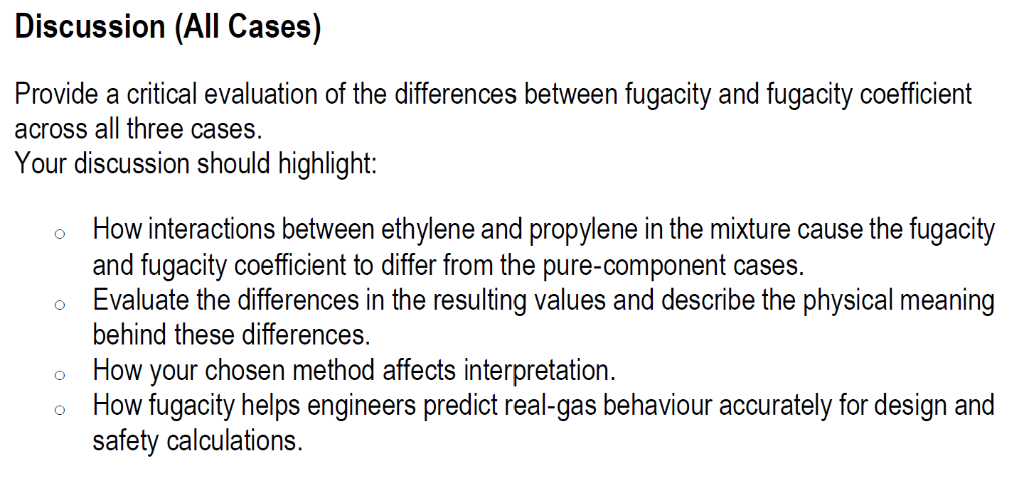 Discussion (All Cases)
Provide a critical evaluation of the differences between fugacity and fugacity coefficient
across all three cases.
Your discussion should highlight:
o How interactions between ethylene and propylene in the mixture cause the fugacity
and fugacity coefficient to differ from the pure-component cases.
o Evaluate the differences in the resulting values and describe the physical meaning
behind these differences.
o How your chosen method affects interpretation.
o How fugacity helps engineers predict real-gas behaviour accurately for design and
safety calculations.
Discussion (All Cases)
Provide a critical evaluation of the differences between fugacity and fugacity coefficient
across all three cases.
Your discussion should highlight:
o How interactions between ethylene and propylene in the mixture cause the fugacity
and fugacity coefficient to differ from the pure-component cases.
o Evaluate the differences in the resulting values and describe the physical meaning
behind these differences.
o How your chosen method affects interpretation.
o How fugacity helps engineers predict real-gas behaviour accurately for design and
safety calculations.
This is AI generated Response.
Asked by: Francis
Created at: 2026-01-08 23:06:07
Asked by: Francis
Created at: 2026-01-08 23:06:07
Final Answer:
Rendered
Raw Text
Did you like this answer?
# Critical Evaluation:acity and Fug Coefficient DifferencesBelow is a, step-by discussion addressing the's requirements about fugacity and fugacity coefficients for ethylene and propylene mixtures versus pure components:
---
## **1. Effect of Mixture Interactions on Fugacity and Fugacity Coefficient**
### **Pure Components**
- **Fugacity (\( f \))**: For a pure component, fugacity is a corrected pressure reflecting non-ideal behavior.
- **Fugacity Coefficient (\( \phi \))**: Defined as \( \phi = \frac{f}{yP} \) (for pure gases, \( y = 1 \)), it shows deviation from ideal gas behavior.
### **Mixtures (Ethylene + Propylene)**
- **Interactions**: In a mixture, ethylene and propylene molecules interact differently than in pure form. These intermolecular forces (attractive/repulsive) alter the escaping tendency of each species.
- **Differences**:
- **Fugacity**: Each component’s fugacity in the mixture is affected by both self and cross interactions, not just its own.
- **Fugacity Coefficient**: The value for each component changes because mixture non-idealities are more complex than for pure substances.
**Physical Meaning**:
Stronger or weaker molecular interactions in the mixture (than in pure states) lead to significant deviations in fugacity and fugacity coefficient values, indicating non-ideality.
---
## **2. Evaluation and Physical Interpretation of Resulting Differences**
- **Resulting Values**: Typically, in mixtures, fugacity coefficients are neither 1 (ideal gas) nor the same as in pure components.
- **Why?**
- **Positive deviations** (φ > 1): Repulsive interactions predominate, increasing escaping tendency.
- **Negative deviations** (φ < 1): Attractive interactions predominate, decreasing escaping tendency.
- **Interpretation**:
The difference between pure and mixture values quantifies the strength and nature of the interactions. Larger deviations point to stronger non-ideal behavior.
---
## **3. Impact of Chosen Method on Interpretation**
- **Method Choices**: Common models include:
- **Ideal solution model (Raoult’s Law)** (assumes no excess interactions; not accurate for real gases)
- **Equations of State (EOS):** (e.g., van der Waals, Peng-Robinson)
These incorporate parameters for molecular size and attraction, better predicting fugacity and φ in real systems.
- **Effect**:
The sophistication of the method determines accuracy. EOS-based calculations reveal non-idealities and cross-interactions; simpler models might underestimate or miss them.
---
## **4. Importance of Fugacity in Engineering Design and Safety**
- **Predicting Real-Gas Behavior**: Fugacity allows engineers to account for non-idealities in gases, which is crucial at moderate/high pressures and in mixtures.
- **Applications**:
- **Design**: Accurate fugacity ensures correct sizing of equipment (reactors, separators).
- **Safety**: Prevents underestimation of pressures or wrong phase predictions, which could lead to hazardous conditions.
---
## **Summary Table**
| Aspect | Pure Component | Mixture (Ethylene + Propylene) | Physical Meaning |
|-----------------------|-----------------------|----------------------------------------|-----------------------------------------------------|
| Fugacity (\( f \)) | Function of self | Function of self + cross interactions | Reflects escaping tendency considering all interactions |
| Fugacity Coefficient (\( \phi \)) | Pure behavior | Altered by mixture non-idealities | Quantifies non-ideality in each environment |
| Interpretation Method | Simpler (Raoult’s Law) | Complex (EOS required) | Accuracy depends on model |
| Engineering Impact | Approximate | Accurate, safe | Essential for real-world (non-ideal) systems |
---
## **Final Takeaway**
In summary, **mixture interactions between ethylene and propylene cause fugacity and fugacity coefficients to differ significantly from pure cases** due to complex molecular interactions. The choice of calculation method affects how well these differences are captured. Accurate fugacity calculations are vital in engineering for **predicting real-gas behavior, ensuring design accuracy, and maintaining safety** in industrial processes.
📢 Instructions:
- Ask anything relatd to above question only.
- For new Question goto :