Give step-by-step solution with explanation and final answer:Eh Ao pf Cinnovenihes J
£afe “) enomormis )
coo TEE
Ez 0TH fra CR
panei LE ? Badri
EE ads Rl
be ol ; “as We 7) 9 oie TH
Re, Each dmnng =b=12m) ; Lc
20 eed Freckm = d= pyo Re
IE t pene adi = 2m Ne
15 Le Atl Ee on oe rt
: [2024 Hae auf ba c= buodieaye EE |
| Foc ancy oH Comilinchiy Kc ped
Inlet Coneenpakn. * Hs
fi AE
Cho = 2 ia RI
Fn. Aopen | Ho cow : EL
Seipentroed velvah = Giese be
Lect trander or
3 ovenal Luof harfn (sof. (Jr 1600 fun er ox. by
3 Crofart temp” Ee GES (2 "
End! : Sa
1. penive lop vans Genangy bad ome 0 i:
2. ne SIE proditls hele lity terp? ependinte i
2. peienmind ertechvenn oto wn tehal eect
YU, Cateerfar mopinus) Codalytt petit, Bi.
£. Zdertoly, ohotns infernal ov erlernal thendpoq Conds Lnnelaig
ir
rath Be Sif
BRE
Question:
Give step-by-step solution with explanation and final answer:Eh Ao pf Cinnovenihes J
£afe “) enomormis )
coo TEE
Ez 0TH fra CR
panei LE ? Badri
EE ads Rl
be ol ; “as We 7) 9 oie TH
Re, Each dmnng =b=12m) ; Lc
20 eed Freckm = d= pyo Re
IE t pene adi = 2m Ne
15 Le Atl Ee on oe rt
: [2024 Hae auf ba c= buodieaye EE |
| Foc ancy oH Comilinchiy Kc ped
Inlet Coneenpakn. * Hs
fi AE
Cho = 2 ia RI
Fn. Aopen | Ho cow : EL
Seipentroed velvah = Giese be
Lect trander or
3 ovenal Luof harfn (sof. (Jr 1600 fun er ox. by
3 Crofart temp” Ee GES (2 "
End! : Sa
1. penive lop vans Genangy bad ome 0 i:
2. ne SIE proditls hele lity terp? ependinte i
2. peienmind ertechvenn oto wn tehal eect
YU, Cateerfar mopinus) Codalytt petit, Bi.
£. Zdertoly, ohotns infernal ov erlernal thendpoq Conds Lnnelaig
ir
rath Be Sif
BRE
This is AI generated Response.
Asked by: Francis
Created at: 2026-01-09 11:16:06
Final Answer:
RenderedRaw Text
Did you like this answer?
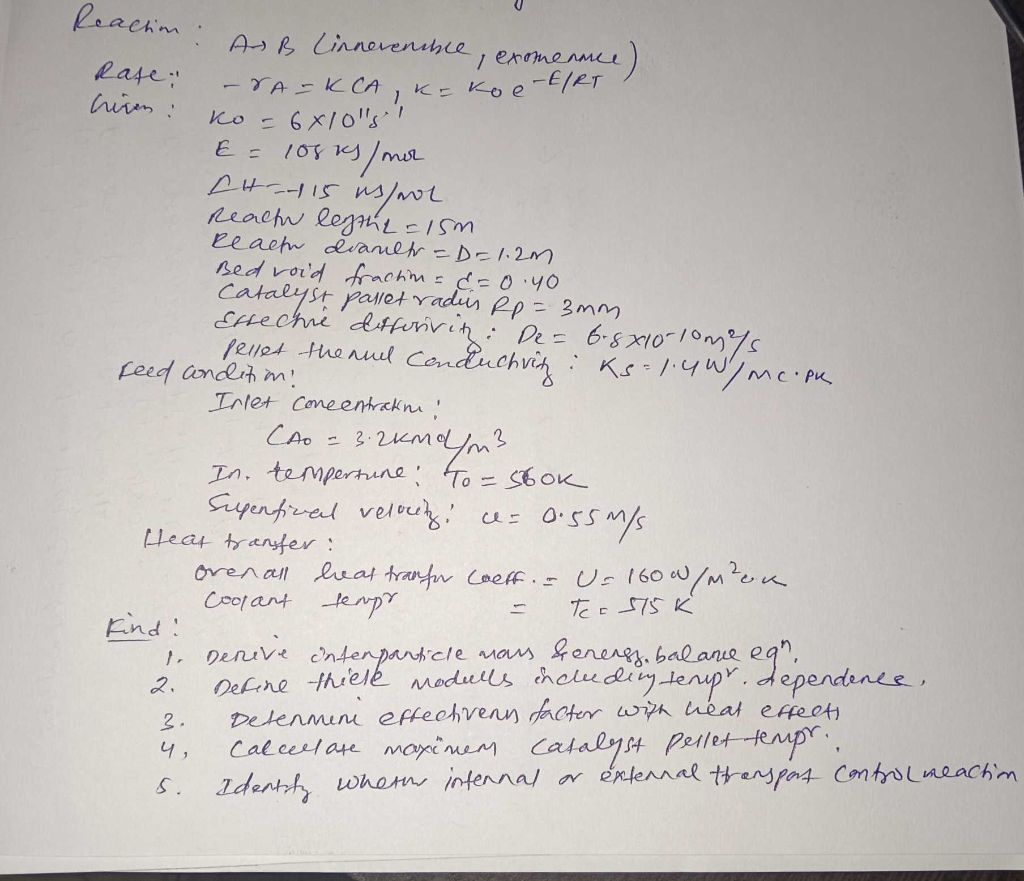
Let's break down the problem step-by-step as per the instructions and the provided data.
---
# **Given Data**
**Reaction:**
A → B (1st order, exothermic)
**Rate:**
\[-r_A = k C_A,\]
\[k = k_ \exp\left(-\frac{E}{RT}\right)\]
**Constants:**
- \(k_ = 6 \times 10^5 \ \text{s}^{-1}\)
- \(E = 108 \ \text{kJ/mol} = 108,000 \ \text{J/mol}\)
- \(\Delta H = -115 \ \text{kJ/mol}\) (exothermic)
- Reactor length \(L = 15 \ \text{m}\)
- Reactor diameter \(D = 1.2 \ \text{m}\)
- Bed void fraction \(\epsilon = .40\)
- Catalyst pellet radius \(R_p = 3 \ \text{mm} = .003 \ \text{m}\)
- Effective diffusivity, \(D_e = 6.5 \times 10^{-10} \ \text{m}^2/\text{s}\)
- Pellet thermal conductivity \(k_s = 1.4 \ \text{W}/\text{m}\cdot\text{K}\)
### **Feed Conditions**
- Inlet concentration \(C_{A} = 3.2 \ \text{kmol}/\text{m}^3\)
- Inlet temperature \(T_ = 580 \ \text{K}\)
- Superficial velocity \(u = .55 \ \text{m/s}\)
### **Heat Transfer**
- Overall heat transfer coefficient \(U = 160 \ \text{W}/\text{m}^2\cdot\text{K}\)
- Coolant temperature \(T_c = 515 \ \text{K}\)
---
## **Step 1: Derive the Interparticle Mass/Energy Balance Equation**
### **a. Mass Balance (Steady-State, 1st-order, Isothermal)**
For a first-order reaction inside a spherical catalyst pellet (radius \(R_p\)):
\[
\frac{1}{r^2} \frac{d}{dr} \left( r^2 D_e \frac{dC_A}{dr} \right) = k C_A
\]
### **b. Energy Balance (With Heat Generation)**
\[
\frac{1}{r^2} \frac{d}{dr} \left( r^2 k_s \frac{dT}{dr} \right) + (-\Delta H) k C_A =
\]
where \(k_s\) is the thermal conductivity of the solid, and \(-\Delta H\) is the heat generated per unit mole of \(A\) reacted.
---
## **Step 2: Define Thiele Modulus (Including Temperature Dependence)**
Thiele modulus (\(\phi\)) relates diffusion and reaction rates:
\[
\phi = R_p \sqrt{\frac{k}{D_e}}
\]
Since \(k\) is temperature-dependent:
\[
k = k_ e^{-E/RT}
\]
So,
\[
\phi = R_p \sqrt{\frac{k_ e^{-E/RT}}{D_e}}
\]
---
## **Step 3: Determine Effectiveness Factor with Heat Effect**
The effectiveness factor (\(\eta\)) for a first-order reaction in a sphere:
\[
\eta = \frac{3}{\phi^2} \left[ \phi \coth(\phi) - 1 \right]
\]
**With heat effect:**
The temperature inside the pellet can be higher than the surface due to exothermicity. The modified effectiveness factor can be estimated using the **Damköhler number** and the energy balance, but for now, we use the above formula with the local \(T\).
---
**Step 4: Calculate Maximum Catalyst Pellet Temperature**
### **a. Surface Temperature (\(T_s\))**
heat generated in the pellet must be transferred to the surroundings:
\[
U a (T_s - T_c) = (-\Delta H) r_A V_p
\]
Where:
- \(U\): overall heat transfer coefficient
- \(a\): external surface area per unit volume \(= \frac{3}{R_p}\)
- \(T_s\): surface temperature of pellet
- \(T_c\): coolant temperature
- \(r_A\): reaction rate at surface
- \(V_p\): pellet volume
But to find **maximum temperature (center of pellet)**, consider the pellet energy balance:
\[
T_{center} - T_s = \frac{(-\Delta H) r_A R_p^2}{6 k_s}
\]
### **b. Calculate \(r_A\) at Surface**
First, estimate \(k\) at \(T_s\) (initially assume \(T_s = T_\)), then iterate.
\[
k(T_s) = k_ e^{-E/(RT_s)}
\]
\[
r_A = k(T_s) C_{A,s}
\]
### **c. Calculate \(\Delta T_{max}\) (center to surface)**
\[
\Delta T_{max} = \frac{(-\Delta H) r_A R_p^2}{6 k_s}
\]
---
## **Step 5: Determine Whether Internal or External Transport Controls**
**Criteria:**
- **Internal diffusion controlled:** \(\eta \ll 1\) (Thiele modulus \(\phi \gg 1\))
- **External mass transfer controlled:** External mass transfer coefficient is limiting
- **Reaction controlled:** \(\eta \approx 1\) (\(\phi \ll 1\))
Compare characteristic resistances (diffusion, reaction, heat transfer).
---
# **Solution Steps with Calculations**
## **Step 2: Calculate Thiele Modulus (\(\phi\))**
\[
k(T_) = 6 \times 10^5 \exp\left( -\frac{108,000}{8.314 \times 580} \right)
\]
First, calculate the exponent:
\[
\frac{108,000}{8.314 \times 580} = \frac{108,000}{4822.12} \approx 22.41
\]
So,
\[
k(T_) = 6 \times 10^5 \exp(-22.41) \approx 6 \times 10^5 \times 1.82 \times 10^{-10} \approx 1.09 \times 10^{-4} \ \text{s}^{-1}
\]
Now,
\[
\phi = .003 \sqrt{\frac{1.09 \times 10^{-4}}{6.5 \times 10^{-10}}}
\]
\[
\frac{1.09 \times 10^{-4}}{6.5 \times 10^{-10}} \approx 1.677 \times 10^5
\]
\[
\sqrt{1.677 \times 10^5} \approx 409.7
\]
\[
\phi = .003 \times 409.7 \approx 1.23
\]
---
## **Step 3: Effectiveness Factor (\(\eta\))**
\[
\eta = \frac{3}{\phi^2} [\phi \coth(\phi) - 1]
\]
First, compute \(\coth(\phi)\):
For \(\phi = 1.23\):
\[
\coth(1.23) = \frac{\cosh(1.23)}{\sinh(1.23)} \approx \frac{1.86}{1.56} \approx 1.19
\]
\[
\phi \coth(\phi) = 1.23 \times 1.19 \approx 1.46
\]
\[
\eta = \frac{3}{1.23^2} (1.46 - 1) = \frac{3}{1.51} \times .46 \approx 1.99 \times .46 \approx .92
\]
---
## **Step 4: Maximum Catalyst Pellet Temperature**
### **a. Estimate \(r_A\) at surface:**
\[
r_A = k(T_) C_{A} = 1.09 \times 10^{-4} \times 3.2 \times 10^3 = .349 \ \text{mol}/(\text{m}^3 \cdot \text{s})
\]
### **b. \(\Delta T_{max}\):**
\[
\Delta T_{max} = \frac{(-\Delta H) r_A R_p^2}{6 k_s}
\]
Use \(|\Delta H| = 115,000 \ \text{J/mol}\):
\[
\Delta T_{max} = \frac{115,000 \times .349 \times (.003)^2}{6 \times 1.4}
\]
\[
= \frac{115,000 \times .349 \times 9 \times 10^{-6}}{8.4}
\]
\[
= \frac{115,000 \times 3.141 \times 10^{-6}}{8.4}
\]
\[
= \frac{361.215}{8.4} \times 10^{-3}
\]
\[
= 43. \times 10^{-3}
\]
\[
= .043 \ \text{K}
\]
So, the temperature rise inside the pellet is tiny (about .04 K).
---
## **Step 5: Identify Rate-Limiting Step**
- Because \(\eta \approx .92\), the reaction is **not strongly diffusion-limited** (\(\eta\) close to 1).
- The temperature rise is very small, so **no significant heat transport limitations**.
- **Reaction is surface-reaction controlled** (kinetic control).
---
# **Summary Table**
| Step | Result |
|------|--------|
| 1 | Mass: \(\frac{1}{r^2} \frac{d}{dr} (r^2 D_e \frac{dC_A}{dr}) = k C_A\); Energy: \(\frac{1}{r^2} \frac{d}{dr} (r^2 k_s \frac{dT}{dr}) + (-\Delta H) k C_A = \) |
| 2 | \(\phi = 1.23\) |
| 3 | \(\eta = .92\) |
| 4 | \(\Delta T_{max} \approx .04\, \text{K}\) |
| 5 | **Reaction is surface-reaction (kinetically) controlled**. |
---
## **Final Answers**
1. **Derived balances:**
- Mass: \(\frac{1}{r^2} \frac{d}{dr} (r^2 D_e \frac{dC_A}{dr}) = k C_A\)
- Energy: \(\frac{1}{r^2} \frac{d}{dr} (r^2 k_s \frac{dT}{dr}) + (-\Delta H) k C_A = \)
2. **Thiele modulus (temp-dependent):**
\(\phi = R_p \sqrt{\frac{k_ e^{-E/RT}}{D_e}}\). For \(T_ = 580\,K\), \(\phi = 1.23\).
3. **Effectiveness factor (with heat):**
\(\eta = .92\) (no significant heat effect due to low \(\Delta T_{max}\)).
4. **Maximum catalyst pellet temperature:**
\(\approx .04\,K\) above surface value.
5. **Controlling step:**
**Reaction is kinetically (surface-reaction) controlled**. Neither internal diffusion nor heat transport are limiting.
VIPSolutions focuses on clear, step‑by‑step explanations so you can learn quickly. Whether you need an AI‑generated walkthrough or a short hint to get unstuck, each solution is organized for fast reading and easy review later.
Search similar questions, compare approaches, and bookmark the best answers for revision. Our goal is simple: quick, reliable study help that feels natural—not noisy.
 VIPSolutions
 Eh Ao pf Cinnovenihes J
£afe “) enomormis )
coo TEE
Ez 0TH fra CR
panei LE ? Badri
EE ads Rl
be ol ; “as We 7) 9 oie TH
Re, Each dmnng =b=12m) ; Lc
20 eed Freckm = d= pyo Re
IE t pene adi = 2m Ne
15 Le Atl Ee on oe rt
: [2024 Hae auf ba c= buodieaye EE |
| Foc ancy oH Comilinchiy Kc ped
Inlet Coneenpakn. * Hs
fi AE
Cho = 2 ia RI
Fn. Aopen | Ho cow : EL
Seipentroed velvah = Giese be
Lect trander or
3 ovenal Luof harfn (sof. (Jr 1600 fun er ox. by
3 Crofart temp” Ee GES (2 "
End! : Sa
1. penive lop vans Genangy bad ome 0 i:
2. ne SIE proditls hele lity terp? ependinte i
2. peienmind ertechvenn oto wn tehal eect
YU, Cateerfar mopinus) Codalytt petit, Bi.
£. Zdertoly, ohotns infernal ov erlernal thendpoq Conds Lnnelaig
ir
rath Be Sif
BRE
Eh Ao pf Cinnovenihes J
£afe “) enomormis )
coo TEE
Ez 0TH fra CR
panei LE ? Badri
EE ads Rl
be ol ; “as We 7) 9 oie TH
Re, Each dmnng =b=12m) ; Lc
20 eed Freckm = d= pyo Re
IE t pene adi = 2m Ne
15 Le Atl Ee on oe rt
: [2024 Hae auf ba c= buodieaye EE |
| Foc ancy oH Comilinchiy Kc ped
Inlet Coneenpakn. * Hs
fi AE
Cho = 2 ia RI
Fn. Aopen | Ho cow : EL
Seipentroed velvah = Giese be
Lect trander or
3 ovenal Luof harfn (sof. (Jr 1600 fun er ox. by
3 Crofart temp” Ee GES (2 "
End! : Sa
1. penive lop vans Genangy bad ome 0 i:
2. ne SIE proditls hele lity terp? ependinte i
2. peienmind ertechvenn oto wn tehal eect
YU, Cateerfar mopinus) Codalytt petit, Bi.
£. Zdertoly, ohotns infernal ov erlernal thendpoq Conds Lnnelaig
ir
rath Be Sif
BRE