This is AI generated Response.
Asked by: Francis
Created at: 2026-01-10 15:54:32
Final Answer:
RenderedRaw Text
Did you like this answer?
Let's break down and solve the ammonia converter problem step by step as required.
## Given Data
- Feed: Stoichiometric N₂ : H₂ mixture (1 : 3 molar ratio)
- **Single-pass conversion:** 10%
- **All ammonia** is removed in a condenser.
- **Unconverted gases** are recycled.
- **Argon** in feed from air: Air composition:
- O₂ = 20.99%
- N₂ = 78.03%
- Ar = .95%
- **Argon concentration at reactor inlet** must be ≤ .5%
- **Assume 100 mol fresh feed**
---
## Step 1: Basis and Fresh Feed Composition
### **Let’s take basis: 100 mol fresh feed**
#### From air:
- N₂ in air: 78.03%
- Ar in air: .95%
Let N₂ in fresh feed = \( x \) mol
Ar in fresh feed = \( y \) mol
\[
\frac{y}{x} = \frac{.95}{78.03} \implies y = x \times \frac{.95}{78.03}
\]
But since the fresh feed is stoichiometric (N₂:H₂ = 1:3),
Let N₂ = 25 mol, H₂ = 75 mol.
**Total = 100 mol** (basis).
\[
y = 25 \times \frac{.95}{78.03} = .304 \text{ mol}
\]
So,
- N₂: 25 mol
- H₂: 75 mol
- Ar: .304 mol
---
## Step 2: Material Balance - Single Pass Through Converter
### **10% single pass conversion**
- **N₂ converted:** \( 25 \times .10 = 2.5 \) mol
- **H₂ consumed:** \( 2.5 \times 3 = 7.5 \) mol (stoichiometry)
- **NH₃ formed:** \( 2 \text{ N}_2 + 3 \text{ H}_2 \rightarrow 2 \text{ NH}_3 \)
- \( 1 \text{ N}_2 \rightarrow 2 \text{ NH}_3 \)
- \( 2.5 \text{ N}_2 \rightarrow 5. \text{ NH}_3 \) mol
#### **Unreacted:**
- N₂: \( 25 - 2.5 = 22.5 \) mol
- H₂: \( 75 - 7.5 = 67.5 \) mol
- Ar: .304 mol (inert, unchanged)
---
## Step 3: Recycle and Purge
After condenser (removes NH₃), the unreacted gases (N₂, H₂, Ar) are recycled.
**But a purge is needed to limit Ar build-up.**
Let:
- **R** = moles of recycle stream
- **P** = moles of purge stream
- **F** = fresh feed = 100 mol
Let the **recycle + fresh feed = total feed to converter**.
Let the **fraction of recycle that is purged = x**.
### **Argon Balance at Reactor Inlet**
Let total feed to reactor inlet = fresh + recycle.
Let the **mole fraction of Ar at reactor inlet = .5% = .005**.
#### **Let’s write the balance:**
Let’s denote:
- F = fresh feed = 100 mol
- R = recycle stream (after purge)
- P = purge stream (fraction of recycle purged)
Let the amount of Ar entering reactor inlet (fresh + recycle) per cycle =
\[
\text{Ar in fresh (per 100 mol)} = .304 \text{ mol}
\]
\[
\text{Ar in recycle} = \text{Ar in recycle stream}
\]
Let the total feed to reactor inlet = \( F + R \).
Let’s denote the **fraction of recycle purged** as \( y \).
So, \( P = yR \), and \( (1-y)R \) is recycled.
### **At steady state:**
\[
\text{Total Ar entering reactor inlet} = \text{Ar in fresh} + \text{Ar in recycle}
\]
But since **all Ar is inert**, all Ar entering must leave via the purge.
\[
\text{Ar in purge} = \text{Ar in fresh} \text{ (since Ar is inert and steady state)}
\]
Let the **total flow to reactor inlet** = \( F + R \).
\[
\text{Mole fraction of Ar at reactor inlet} = \frac{\text{Ar in fresh} + \text{Ar in recycle}}{F + R}
\]
But at steady state, the Ar in recycle = Ar in purge = Ar in fresh, so the total Ar entering = total Ar leaving = .304 mol per cycle.
### **Mole fraction constraint:**
\[
\frac{.304 + \text{Ar in recycle}}{F + R} = .005
\]
But **Ar in recycle** = **Ar in recycle stream**, which is the same as the amount of Ar that is not purged.
Let’s denote **S = total moles entering reactor inlet = F + R**.
But since the only way for Ar to leave is purge (since in recycle it comes back), **Ar in purge = Ar in fresh**.
Let’s now write the composition of the recycle stream.
---
## Step 4: Recycle and Purge Streams
Let’s denote:
- **U** = unreacted stream leaving reactor (before split): N₂, H₂, Ar (total = 90% of input to reactor, since 10% is converted each pass)
- **P** = purge (fraction \( y \) of U)
- **R** = recycle (fraction \( 1-y \) of U)
**U** = unreacted:
- N₂: 90% of inlet N₂
- H₂: 90% of inlet H₂
- Ar: all argon entering
Let’s write a general equation for **steady state**.
#### **Let S = total to reactor inlet**
- N₂ (to converter): \( S_{N_2} \)
- H₂ (to converter): \( S_{H_2} \)
- Ar (to converter): \( S_{Ar} \)
**Single-pass conversion:**
- Fraction of N₂ converted = .10, so .90 leaves unreacted.
- Same for H₂ (stoichiometric, 3 times N₂).
- Ar is inert.
So, after condenser, the unreacted stream (U) is:
- N₂: \( .90 S_{N_2} \)
- H₂: \( .90 S_{H_2} \)
- Ar: \( S_{Ar} \)
From U, fraction \( y \) is purged, fraction \( 1-y \) is recycled.
So, recycled:
- N₂: \( .90 S_{N_2} (1-y) \)
- H₂: \( .90 S_{H_2} (1-y) \)
- Ar: \( S_{Ar} (1-y) \)
Purge:
- N₂: \( .90 S_{N_2} y \)
- H₂: \( .90 S_{H_2} y \)
- Ar: \( S_{Ar} y \)
The recycle stream is added to the fresh feed for the next cycle.
### **Steady-State Argon Balance**
Since Ar is inert, all Ar entering as fresh feed must leave via purge.
\[
\text{Ar in purge} = S_{Ar} y = \text{Ar in fresh feed} = .304
\]
But at the same time,
\[
S_{Ar} = \text{Ar in reactor inlet} = \text{Ar in fresh feed} + \text{Ar in recycle}
\]
But **Ar in recycle** = \( S_{Ar} (1-y) \).
But since the total argon entering the converter = argon in fresh + argon in recycle = \( .304 + S_{Ar} (1-y) \).
But the total moles entering the converter = \( S = F + R \).
But \( R = \) recycle = sum of all components recycled = \( .90 S_{N_2} (1-y) + .90 S_{H_2} (1-y) + S_{Ar} (1-y) \).
But since the feed is always stoichiometric, and the mole fraction of Ar at the inlet must be .5%, let’s write:
\[
\frac{S_{Ar}}{S} = .005
\]
But \( S_{Ar} = .304 + S_{Ar} (1-y) \).
But this recursive equation can be simplified by expressing everything in terms of y.
But the only way for Ar to leave the system is via purge.
\[
S_{Ar} y = .304 \implies S_{Ar} = \frac{.304}{y}
\]
\[
S = \text{total to reactor} = F + R
\]
But \( R = \) total recycle = sum of recycled components.
But the feed is always stoichiometric, so N₂ and H₂ in recycle are in 1:3 ratio.
Let’s use a **shortcut for an inert in a recycle system**:
### **Shortcut: Inert in Recycle System**
For a system like this, the steady-state concentration of an inert in the recycle loop is:
\[
\text{Mole fraction of inert at reactor inlet} = \frac{\text{inert in fresh feed}}{\text{total feed to reactor} \times (\text{fraction purged})}
\]
But more generally, for steady state,
\[
\text{Fraction of purge needed} = \frac{\text{inert in fresh feed}}{\text{total inert in system}}
\]
But since we want the **concentration at the reactor inlet** to be .5%,
\[
\text{Mole fraction of Ar at reactor inlet} = \frac{S_{Ar}}{S} = .005
\]
But \( S_{Ar} = \frac{.304}{y} \), and \( S = \) total to reactor.
But total feed to the reactor per cycle:
\[
S = F + R
\]
But \( R = \) total recycle = sum of recycled components.
Let’s find the total recycle.
---
## Step 5: Calculation
Let’s assume \( x \) = fraction of unreacted stream that is **purged**.
From basis:
- Fresh feed: N₂ = 25, H₂ = 75, Ar = .304
After 10% conversion:
- Unreacted N₂: 22.5
- Unreacted H₂: 67.5
- Unreacted Ar: .304
Let \( x \) = fraction purged each cycle.
So,
- Purge: 22.5x N₂, 67.5x H₂, .304x Ar
- Recycle: 22.5(1-x) N₂, 67.5(1-x) H₂, .304(1-x) Ar
Total feed to reactor each cycle:
- N₂: 25 + 22.5(1-x)
- H₂: 75 + 67.5(1-x)
- Ar: .304 + .304(1-x)
Total moles to reactor:
\[
S = [25 + 22.5(1-x)] + [75 + 67.5(1-x)] + [.304 + .304(1-x)]
\]
\[
= (25+75+.304) + (22.5+67.5+.304)(1-x)
\]
\[
= 100.304 + 90.304(1-x)
\]
\[
= 100.304 + 90.304 - 90.304x
\]
\[
= 190.608 - 90.304x
\]
Total Ar to reactor:
\[
\text{Ar to reactor} = .304 + .304(1-x) = .304(2-x)
\]
Mole fraction of Ar at reactor inlet:
\[
\frac{.304(2-x)}{190.608 - 90.304x} = .005
\]
Solve for \( x \):
\[
.304(2-x) = .005(190.608 - 90.304x)
\]
\[
.608 - .304x = .95304 - .45152x
\]
\[
(.45152 - .304)x = .95304 - .608
\]
\[
.14752x = .34504
\]
\[
x = \frac{.34504}{.14752} = 2.339
\]
But \( x \) must be < 1 (fraction cannot be > 1). Let's check for error in the calculation.
**Let's use correct mass balances:**
Total Ar to reactor = Ar in fresh + Ar in recycle
Recycle Ar = Ar in recycle = .304(1-x)
So, total Ar to reactor = .304 + .304(1-x) = .304(2-x)
Total moles to reactor = sum of all components:
N₂:
VIPSolutions focuses on clear, step‑by‑step explanations so you can learn quickly. Whether you need an AI‑generated walkthrough or a short hint to get unstuck, each solution is organized for fast reading and easy review later.
Search similar questions, compare approaches, and bookmark the best answers for revision. Our goal is simple: quick, reliable study help that feels natural—not noisy.
 VIPSolutions
 © Question: 5. An ammonia converter is fed with a stoichiometric mixture of N2 and H2. The single
passconversion in the converter is only 10%. The ammonia formed is completely removed in a...
5. An ammonia converter is fed with a stoichiometric mixture of N2 and H2. The single pass
conversion in the converter is only 10% . The ammonia formed is completely removed in a condenser,
and the unconverted gases are recycled the reactor. A bleed stream is incorporated in the recycle
line to prevent buildup of rare gases (essentially argon) . Determine the fraction of recycle gas that
must be bled off if the argon concentration at the converter inlet is to be limited to 0.5% . NOTE. The true analysis of air is
20.99% 02, 78.03% N2, and
0. 95% Ar. The nitrogen in the fresh feed is obtained from air; and all the argon in the fresh feed may
be assumed to have come from this source only. a. the moles of recycle,
b. the moles of purge,
c. the moles of liquid ammonia,
d. the composition of the purge
e. the ratio of recycle to fresh feed,
f. the fraction of the gases leaving the condenser that is purged,
g. overall and single - pass conversions with respect to the limiting reactant,
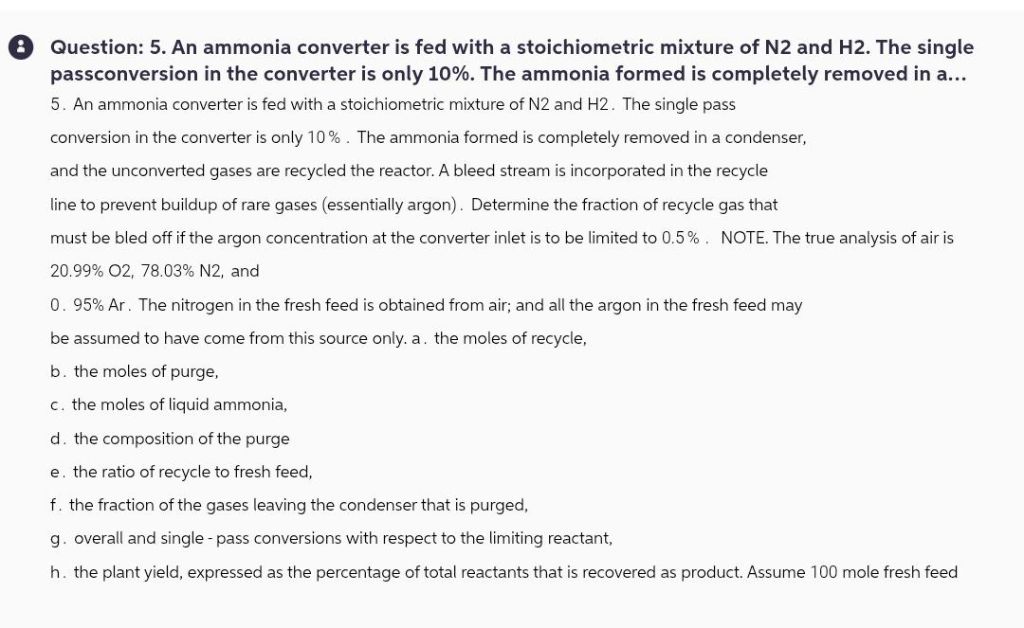
h. the plant yield, expressed as the percentage of total reactants that is recovered as product. Assume 100 mole fresh feed
© Question: 5. An ammonia converter is fed with a stoichiometric mixture of N2 and H2. The single
passconversion in the converter is only 10%. The ammonia formed is completely removed in a...
5. An ammonia converter is fed with a stoichiometric mixture of N2 and H2. The single pass
conversion in the converter is only 10% . The ammonia formed is completely removed in a condenser,
and the unconverted gases are recycled the reactor. A bleed stream is incorporated in the recycle
line to prevent buildup of rare gases (essentially argon) . Determine the fraction of recycle gas that
must be bled off if the argon concentration at the converter inlet is to be limited to 0.5% . NOTE. The true analysis of air is
20.99% 02, 78.03% N2, and
0. 95% Ar. The nitrogen in the fresh feed is obtained from air; and all the argon in the fresh feed may
be assumed to have come from this source only. a. the moles of recycle,
b. the moles of purge,
c. the moles of liquid ammonia,
d. the composition of the purge
e. the ratio of recycle to fresh feed,
f. the fraction of the gases leaving the condenser that is purged,
g. overall and single - pass conversions with respect to the limiting reactant,
h. the plant yield, expressed as the percentage of total reactants that is recovered as product. Assume 100 mole fresh feed