Give step-by-step solution with explanation and final answer:QUESTION THREE (25 MARKS) a) Define the current
account and explain what is meant by a current account
surplus and current account deficit. (6 marks) b) Using
foreign exchange market discussion, explain why an
increase in Malaysia's income (Y) leads to a
depreciation of the RM under a floating exchange rate
system. (7 marks) c) In 2024-2025, several Asian
economies including Malaysia experienced currency
depreciation against the US dollar due to rising US
interest rates. Using the IS-LM-BP framework in an
open economy, explain how a sharp increase in the US
interest rate can affect: i. Malaysia's net exports (4
marks) ii. capital flows (4 marks) iii. overall output (Y
). (4 marks) Support your explanation with the
mechanisms described in foreign exchange markets
and balance of payments.
Question:
Give step-by-step solution with explanation and final answer:QUESTION THREE (25 MARKS) a) Define the current
account and explain what is meant by a current account
surplus and current account deficit. (6 marks) b) Using
foreign exchange market discussion, explain why an
increase in Malaysia's income (Y) leads to a
depreciation of the RM under a floating exchange rate
system. (7 marks) c) In 2024-2025, several Asian
economies including Malaysia experienced currency
depreciation against the US dollar due to rising US
interest rates. Using the IS-LM-BP framework in an
open economy, explain how a sharp increase in the US
interest rate can affect: i. Malaysia's net exports (4
marks) ii. capital flows (4 marks) iii. overall output (Y
). (4 marks) Support your explanation with the
mechanisms described in foreign exchange markets
and balance of payments.
This is AI generated Response.
Asked by: Rahul
Created at: 2026-01-10 17:02:40
Final Answer:
RenderedRaw Text
Did you like this answer?
# Question 3 Solution (25 Marks Total)
---
## a) **Define the current account and explain what is meant by a current account surplus and current account deficit.6 marks)****Definition:- The ** account** is component of a balance of payments. records all transactions goods and services income (such dividends and interest and current transfers (like remittances) between residents of a country and the rest of the world.
**Current Account Surplus:**
- A **current account surplus** occurs when a country’s total exports of goods, services, income, and transfers exceed its total imports. This means the country is a net lender to the rest of the world.
**Current Account Deficit:**
- A **current account deficit** happens when a country’s total imports of goods, services, income, and transfers exceed its total exports. This means the country is a net borrower from the rest of the world.
---
## b) **Using foreign exchange market discussion, explain why an increase in Malaysia’s income (Y) leads to a depreciation of the RM under a floating exchange rate system. (7 marks)**
**Explanation:**
1. **Increase in National Income (Y):**
- When Malaysia’s income (Y) increases, people and firms have more purchasing power.
2. **Effect on Imports:**
- Higher income typically leads to increased demand for imported goods and services.
3. **Demand for Foreign Currency:**
- To pay for these imports, Malaysians convert more Ringgit (RM) into foreign currencies (e.g., USD).
4. **Foreign Exchange Market:**
- The increased demand for foreign currency increases the supply of RM in the forex market.
5. **Depreciation Pressure:**
- With a floating exchange rate, the higher supply of RM (relative to demand) causes its value to fall.
6. **Result:**
- The RM depreciates because it takes more RM to buy the same amount of foreign currency.
**Summary:**
An increase in Malaysia’s income raises demand for imports, leading to higher demand for foreign currency and greater supply of RM, causing the RM to depreciate under a floating exchange rate system.
---
## c) **IS–LM–BP framework: Impact of a sharp increase in US interest rates (2024–2025 context)**
### i. **Malaysia’s net exports (4 marks)**
- **Stronger USD:** Higher US interest rates attract global capital, causing USD to appreciate and RM to depreciate.
- **Effect on Exports:** Malaysian goods become cheaper abroad → exports rise.
- **Effect on Imports:** US goods become more expensive in Malaysia → imports fall.
- **Net Exports:** Net exports increase, improving Malaysia’s current account balance.
### ii. **Capital flows (4 marks)**
- **Interest Rate Differential:** Higher US rates make US assets more attractive.
- **Capital Outflow:** Investors shift funds from Malaysia to the US.
- **Financial Account:** Outflow of capital from Malaysia (negative capital flows).
- **BP Curve:** Moves toward a deficit unless offset by other factors.
### iii. **Overall output (Y) (4 marks)**
- **IS–LM–BP Mechanism:**
- **Capital Outflows:** Cause depreciation of RM, which could boost net exports (IS shifts right).
- **Financial Tightening:** Outflows may increase Malaysian interest rates to defend the RM, dampening investment and output (LM shifts left).
- **Net Effect:** If capital outflows and financial tightening are strong, overall output (Y) may decrease.
---
### **Summary Table**
| Mechanism | Effect of Higher US Rate | Transmission to Malaysia |
|-------------------|----------------------------------------------|----------------------------------|
| Net Exports | USD up, RM down → Exports up, Imports down | Net Exports increase |
| Capital Flows | US assets more attractive | Capital outflows from Malaysia |
| Output (Y) | Capital outflows & financial tightening | Output may decrease |
---
## **Foreign Exchange and Balance of Payments Mechanisms**
- **Exchange Rates:** Driven by capital flows and trade balances.
- **Balance of Payments:** Current account and capital/financial account must balance. A deficit in one is offset by a surplus in the other.
- **Interest Rate Differentials:** Key driver of short-term capital flows, affecting exchange rates and output via the IS-LM-BP framework.
---
### **Final Answers Summary**
1. **Current account:** Records trade in goods/services, income, and transfers. Surplus = exports > imports; deficit = imports > exports.
2. **Income rise → RM depreciation:** More imports → higher demand for foreign currency → RM depreciates under floating rates.
3. **Higher US rates:**
- Net exports up (cheaper RM)
- Capital outflows from Malaysia
- Output (Y) may fall due to capital outflows and higher domestic rates.
---
Let me know if you need further breakdowns or diagrams!
VIPSolutions focuses on clear, step‑by‑step explanations so you can learn quickly. Whether you need an AI‑generated walkthrough or a short hint to get unstuck, each solution is organized for fast reading and easy review later.
Search similar questions, compare approaches, and bookmark the best answers for revision. Our goal is simple: quick, reliable study help that feels natural—not noisy.
 VIPSolutions
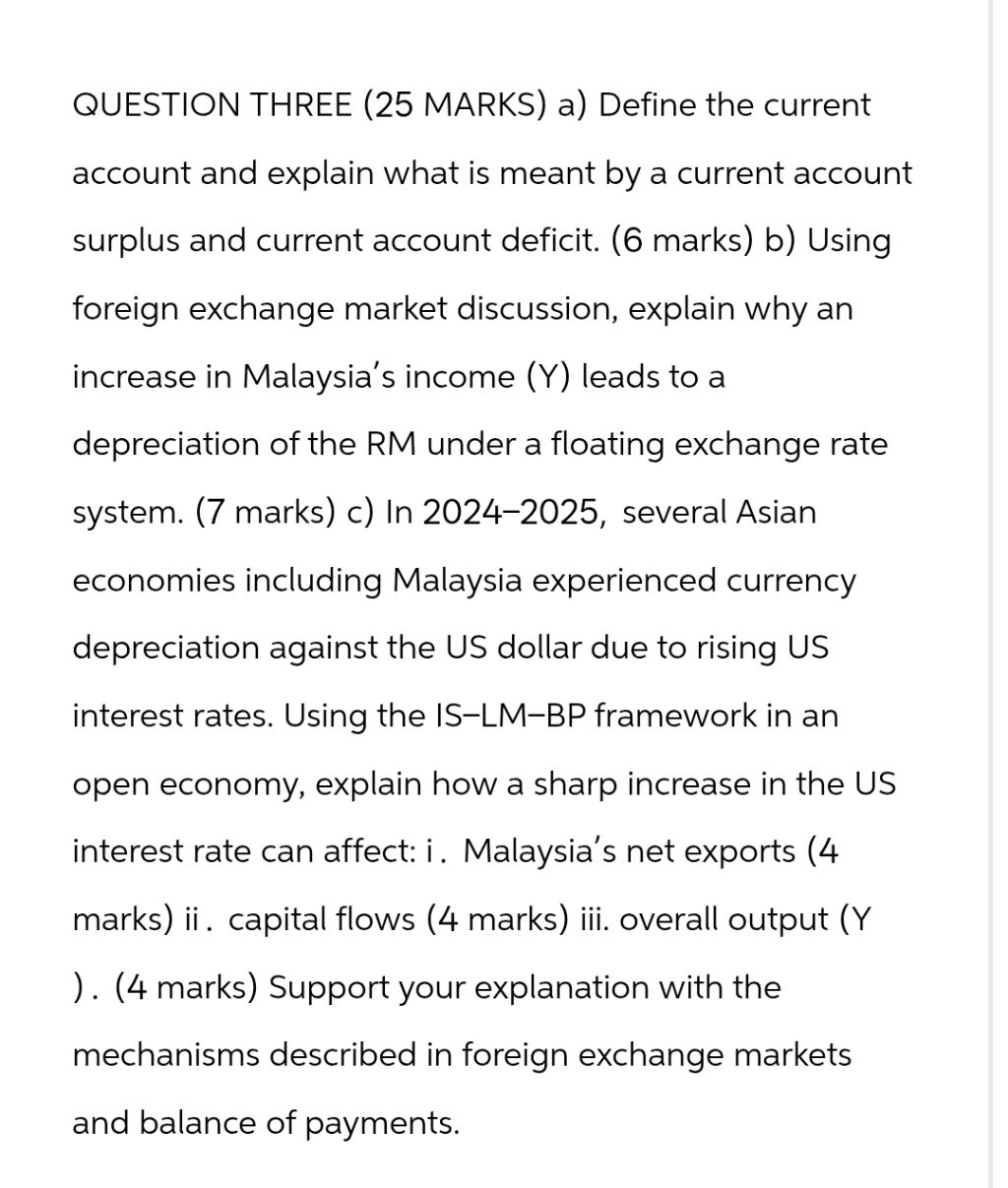 QUESTION THREE (25 MARKS) a) Define the current
account and explain what is meant by a current account
surplus and current account deficit. (6 marks) b) Using
foreign exchange market discussion, explain why an
increase in Malaysia's income (Y) leads to a
depreciation of the RM under a floating exchange rate
system. (7 marks) c) In 2024-2025, several Asian
economies including Malaysia experienced currency
depreciation against the US dollar due to rising US
interest rates. Using the IS-LM-BP framework in an
open economy, explain how a sharp increase in the US
interest rate can affect: i. Malaysia's net exports (4
marks) ii. capital flows (4 marks) iii. overall output (Y
). (4 marks) Support your explanation with the
mechanisms described in foreign exchange markets
and balance of payments.
QUESTION THREE (25 MARKS) a) Define the current
account and explain what is meant by a current account
surplus and current account deficit. (6 marks) b) Using
foreign exchange market discussion, explain why an
increase in Malaysia's income (Y) leads to a
depreciation of the RM under a floating exchange rate
system. (7 marks) c) In 2024-2025, several Asian
economies including Malaysia experienced currency
depreciation against the US dollar due to rising US
interest rates. Using the IS-LM-BP framework in an
open economy, explain how a sharp increase in the US
interest rate can affect: i. Malaysia's net exports (4
marks) ii. capital flows (4 marks) iii. overall output (Y
). (4 marks) Support your explanation with the
mechanisms described in foreign exchange markets
and balance of payments.