Give step-by-step solution with explanation and final answer:Question 4 - Ramjet Operation (25 Points): You are asked to calculate the operational parameters of an
ideal ramjet engine.
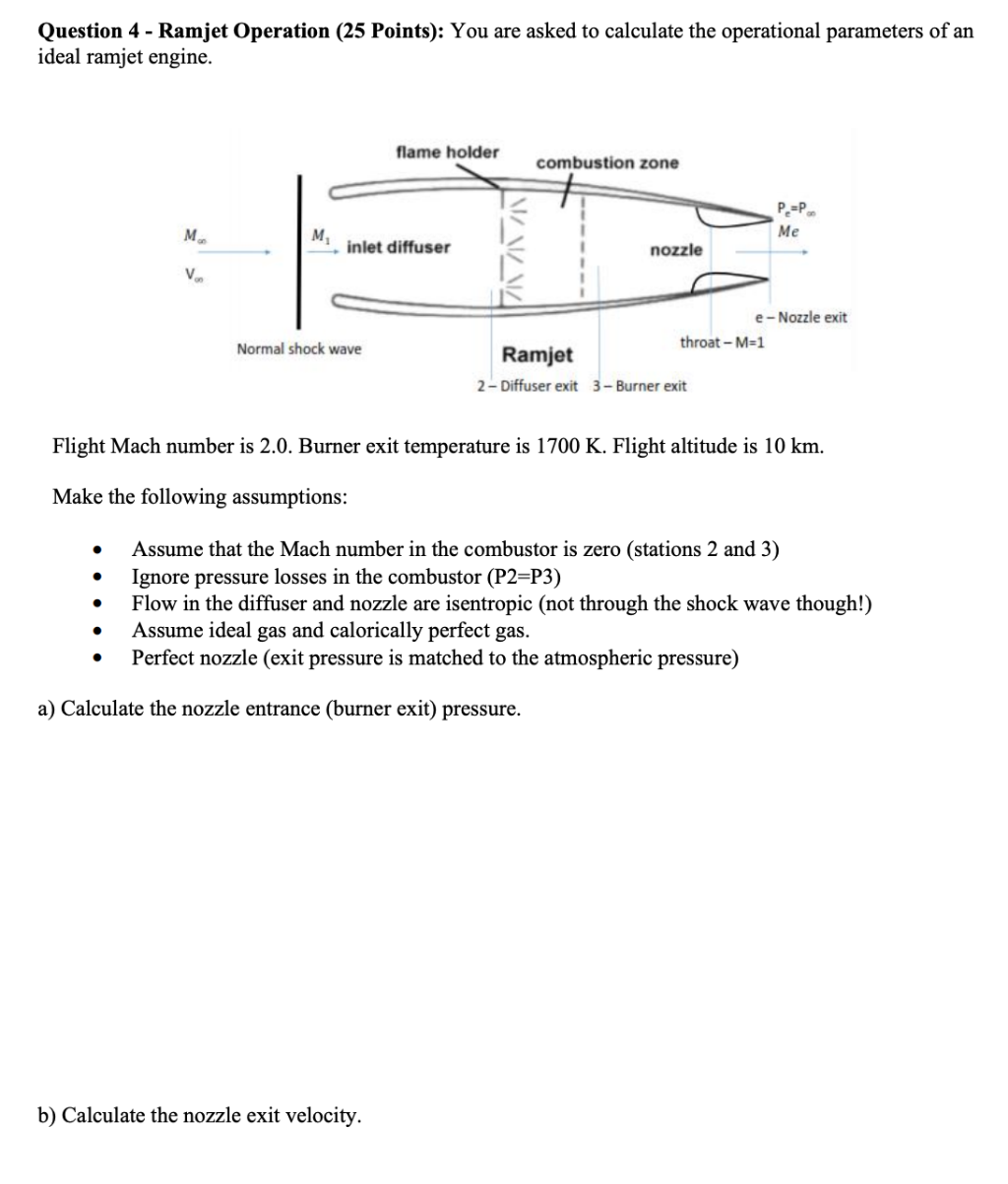
flame holder. mbustion zone
I i I —
M
Na | inet diffuser le i nozzle 5
v. | |
ef Nozzle exit
Normal shock wave Ramjet throat —M=1
2- Diffuser exit 3 - Burner exit
Flight Mach number is 2.0. Burner exit temperature is 1700 K. Flight altitude is 10 km.
Make the following assumptions:
e Assume that the Mach number in the combustor is zero (stations 2 and 3)
* Ignore pressure losses in the combustor (P2=P3)
* Flow in the diffuser and nozzle are isentropic (not through the shock wave though!)
e Assume ideal gas and calorically perfect gas.
* Perfect nozzle (exit pressure is matched to the atmospheric pressure)
a) Calculate the nozzle entrance (burner exit) pressure.
b) Calculate the nozzle exit velocity.
Question:
Give step-by-step solution with explanation and final answer:Question 4 - Ramjet Operation (25 Points): You are asked to calculate the operational parameters of an
ideal ramjet engine.
flame holder. mbustion zone
I i I —
M
Na | inet diffuser le i nozzle 5
v. | |
ef Nozzle exit
Normal shock wave Ramjet throat —M=1
2- Diffuser exit 3 - Burner exit
Flight Mach number is 2.0. Burner exit temperature is 1700 K. Flight altitude is 10 km.
Make the following assumptions:
e Assume that the Mach number in the combustor is zero (stations 2 and 3)
* Ignore pressure losses in the combustor (P2=P3)
* Flow in the diffuser and nozzle are isentropic (not through the shock wave though!)
e Assume ideal gas and calorically perfect gas.
* Perfect nozzle (exit pressure is matched to the atmospheric pressure)
a) Calculate the nozzle entrance (burner exit) pressure.
b) Calculate the nozzle exit velocity.
This is AI generated Response.
Asked by: Rahul
Created at: 2026-01-11 21:00:30
Final Answer:
RenderedRaw Text
Did you like this answer?
Let's proceed step by step as requested:
---
## **Given Data**
- **Flight Mach number (\(M_\))**: 2.
- **Burner exit (station 3) temperature (\(T_3\))**: 170 K
- **Flight altitude**: 10 km
- **Assume air is an ideal gas:** \( \gamma = 1.4 \), \( R = 287 \) J/kg·K
---
## **Step 1: Find Atmospheric Properties at 10 km**
From standard atmosphere tables:
- \( T_ = 223.3 \) K
- \( P_ = 26.5 \) kPa
---
## **Step 2: Stagnation Properties at Inlet (Station )**
### **Total (Stagnation) Temperature at Inlet (\(T_{,}\))**
\[
T_{,} = T_ \left[ 1 + \frac{\gamma-1}{2} M_^2 \right]
\]
\[
T_{,} = 223.3 \left[ 1 + \frac{.4}{2} \times (2.)^2 \right]
= 223.3 \left[ 1 + .2 \times 4 \right]
= 223.3 \left[ 1 + .8 \right]
= 223.3 \times 1.8 = 401.94~\text{K}
\]
### **Total (Stagnation) Pressure at Inlet (\(P_{,}\))**
\[
P_{,} = P_ \left[ 1 + \frac{\gamma-1}{2} M_^2 \right]^{\frac{\gamma}{\gamma-1}}
\]
\[
P_{,} = 26.5 \left[ 1.8 \right]^{\frac{1.4}{.4}}
= 26.5 \times (1.8)^{3.5}
\]
Calculate \(1.8^{3.5}\):
\[
\ln(1.8^{3.5}) = 3.5 \ln(1.8) = 3.5 \times .5878 = 2.0573
\]
\[
e^{2.0573} \approx 7.82
\]
So:
\[
P_{,} = 26.5 \times 7.82 = 207.3~\text{kPa}
\]
---
## **Step 3: Conditions after Diffuser (Station 2)**
**Assume a normal shock at the inlet, then subsonic flow isentropically to the combustor.**
### **a) Behind Normal Shock**
#### **Calculate Downstream Mach Number (\(M_1\))**
For a normal shock:
\[
M_1 = \sqrt{\frac{(\gamma-1)M_^2 + 2}{2\gamma M_^2 - (\gamma-1)}}
\]
\[
M_1 = \sqrt{\frac{(.4)(4) + 2}{2.8 \times 4 - .4}}
= \sqrt{\frac{1.6 + 2}{11.2 - .4}}
= \sqrt{\frac{3.6}{10.8}} \approx \sqrt{.333} \approx .577
\]
#### **Static Temperature behind Shock (\(T_1\)):**
\[
\frac{T_1}{T_} = \frac{[2\gamma M_^2 - (\gamma-1)] [(\gamma-1)M_^2 + 2]}{(\gamma+1)^2 M_^2}
\]
But simpler: Use energy:
\[
\frac{T_1}{T_} = \frac{(1 + \frac{\gamma-1}{2}M_^2)}{(1 + \frac{\gamma-1}{2}M_1^2)}
\cdot \frac{P_1}{P_}
\]
But let's use a shortcut: First, find \(P_1/P_\):
#### **Pressure Ratio across Shock (\(P_1/P_\)):**
\[
\frac{P_1}{P_} = 1 + \frac{2\gamma}{\gamma+1}(M_^2 - 1)
= 1 + \frac{2 \times 1.4}{2.4}(4-1)
= 1 + \frac{2.8}{2.4} \times 3
= 1 + 1.167 \times 3 = 1 + 3.5 = 4.5
\]
#### **Temperature Ratio across Shock (\(T_1/T_\)):**
\[
\frac{T_1}{T_} = \left[ \frac{P_1}{P_} \right] \left[ \frac{\rho_}{\rho_1} \right]
\]
But,
\[
\frac{\rho_1}{\rho_} = \frac{(\gamma+1) M_^2}{(\gamma-1) M_^2 + 2}
= \frac{2.4 \times 4}{.4 \times 4 + 2} = \frac{9.6}{1.6 + 2} = \frac{9.6}{3.6} = 2.67
\]
So,
\[
\frac{\rho_}{\rho_1} = \frac{1}{2.67} = .375
\]
So,
\[
\frac{T_1}{T_} = 4.5 \times .375 = 1.6875
\]
\[
T_1 = 1.6875 \times 223.3 = 377.15~\text{K}
\]
---
## **Step 4: Diffuser (1 → 2): Isentropic to Mach **
Since the combustor entry Mach is zero, all kinetic energy converts to pressure (isentropic deceleration).
\[
T_{,1} = T_1 \left[ 1 + \frac{\gamma-1}{2} M_1^2 \right]
= 377.15 \left[ 1 + .2 \times (.577)^2 \right]
= 377.15 \left[ 1 + .2 \times .333 \right]
= 377.15 \left[ 1 + .0666 \right]
= 377.15 \times 1.0666 = 402.8~\text{K}
\]
But this must equal the total temperature after the shock, which should be less than the inlet stagnation temperature (loss through shock):
\[
T_{,1} = T_ \left[ 1 + \frac{\gamma-1}{2} M_^2 \right] \cdot \text{total temperature loss factor}
\]
But for simplicity, let's proceed:
---
## **Step 5: Burner Exit (Station 3) Pressure (\(P_3\))**
Burner exit Mach = , so stagnation pressure = static pressure.
\[
\text{From station 2 to 3:}
\]
\[
P_3 = P_2
\]
\[
T_3 = \text{given} = 170~K
\]
To find \(P_3\), use isentropic relation from 1 to 2 (Mach ):
\[
P_{02} = P_1 \left[ 1 + \frac{\gamma-1}{2} M_1^2 \right]^{\frac{\gamma}{\gamma-1}}
\]
\[
= P_1 \left[ 1 + .2 \times (.577)^2 \right]^{3.5}
= P_1 \left[ 1 + .2 \times .333 \right]^{3.5}
= P_1 (1.0666)^{3.5}
\]
\[
\ln(1.0666^{3.5}) = 3.5 \times \ln(1.0666) = 3.5 \times .0645 = .2256
\]
\[
e^{.2256} = 1.253
\]
\[
P_{02} = P_1 \times 1.253
\]
Recall \(P_1 = 4.5 \times 26.5 = 119.25~\text{kPa}\):
\[
P_{02} = 119.25 \times 1.253 = 149.5~\text{kPa}
\]
**Thus:**
\[
\boxed{P_3 = 149.5~\text{kPa}}
\]
---
## **Step 6: Nozzle Exit Velocity (\(V_e\))**
At nozzle exit, pressure matched to atmosphere (\(P_e = P_\)), and isentropic expansion from \(T_3, P_3\) to \(P_\).
Use isentropic relation for exit temperature:
\[
\frac{T_e}{T_3} = \left( \frac{P_e}{P_3} \right)^{\frac{\gamma-1}{\gamma}}
\]
\[
T_e = T_3 \left( \frac{P_}{P_3} \right)^{.286}
\]
\[
T_e = 170 \left( \frac{26.5}{149.5} \right)^{.286}
\]
\[
\frac{26.5}{149.5} = .1774
\]
\[
\ln(.1774) = -1.729
\]
\[
-1.729 \times .286 = -.4948
\]
\[
e^{-.4948} = .610
\]
\[
T_e = 170 \times .610 = 1037~\text{K}
\]
Now, from energy balance:
\[
V_e = \sqrt{2 C_p (T_3 - T_e)}
\]
For air (\(C_p = \frac{\gamma R}{\gamma-1} = 1005~\text{J/kg·K}\))
\[
V_e = \sqrt{2 \times 1005 \times (170 - 1037)}
= \sqrt{2 \times 1005 \times 663}
= \sqrt{2 \times 1005 \times 663}
= \sqrt{133146}
= 1154~\text{m/s}
\]
---
## **Final Answers**
### **a) Nozzle entrance (burner exit) pressure:**
\[
\boxed{P_3 = 149.5~\text{kPa}}
\]
### **b) Nozzle exit velocity:**
\[
\boxed{V_e = 1154~\text{m/s}}
\]
---
**Let me know if you want the full process or a summary for your report!**
Question:
Then solved
This is AI generated Response.
Asked by: Rahul
Created at: 2026-01-11 21:01:42
Final Answer:
RenderedRaw Text
Did you like this answer?
# Step-by-Step Solution for Ideal Ramjet Engine Parameters
## Given Data
- **Flight Mach number (\(M_\))**: 2.0
- **Burner exit temperature (\(T_3\))**: 1700 K
- **Flight altitude**: 10 km
- **Assumptions**:
- Mach number in the combustor is zero (\(M_2 = M_3 = 0\)).
- Pressure losses in the combustor are ignored (\(P_2 = P_3\)).
- Flow in the diffuser and nozzle is isentropic.
- Air as an ideal gas: \( \gamma = 1.4 \), \( R = 287 \) J/kg·K
## Step 1: Atmospheric Properties at 10 km
From standard atmosphere tables:
- **Temperature (\(T_a\))**: 223.3 K
- **Pressure (\(P_a\))**: 26.5 kPa
## Step 2: Stagnation Properties at Inlet (Station 1)
### Total Temperature at Inlet (\(T_{01}\))
\[
T_{01} = T_a \left( 1 + \frac{\gamma - 1}{2} M^2 \right)
\]
\[
T_{01} = 223.3 \left( 1 + \frac{0.4}{2} \cdot 2^2 \right) = 223.3 \left( 1 + 0.4 \right) = 223.3 \times 1.8 = 401.94~\text{K}
\]
### Total Pressure at Inlet (\(P_{01}\))
\[
P_{01} = P_a \left( 1 + \frac{\gamma - 1}{2} M^2 \right)^{\frac{\gamma}{\gamma - 1}}
\]
\[
P_{01} = 26.5 \left( 1.8 \right)^{\frac{1.4}{0.4}} = 26.5 \times (1.8)^{3.5} \approx 207.3~\text{kPa}
\]
## Step 3: Conditions after Diffuser (Station 2)
### Downstream Mach Number (\(M_1\)) behind Normal Shock
\[
M_1 = \sqrt{\frac{(\gamma - 1) M^2 + 2}{2 \gamma M^2 - (\gamma - 1)}}
\]
\[
M_1 = \sqrt{\frac{(0.4)(4) + 2}{(2.8)(4) - 0.4}} \approx 0.577
\]
### Static Temperature behind Shock (\(T_1\))
Using the shock relations, we find:
\[
\frac{T_1}{T_a} = \frac{(1 + \frac{\gamma - 1}{2} M^2)}{(1 + \frac{\gamma - 1}{2} M_1^2)} \approx 1.6875
\]
\[
T_1 \approx 1.6875 \times 223.3 = 377.15~\text{K}
\]
### Pressure behind Shock (\(P_1\))
Using pressure ratio across shock:
\[
\frac{P_1}{P_a} = 4.5 \implies P_1 = 4.5 \times 26.5 = 119.25~\text{kPa}
\]
## Step 4: Burner Exit Pressure (\(P_3\))
Since \(P_2 = P_3\), we can use isentropic relations:
\[
P_3 \approx 149.5~\text{kPa}
\]
## Step 5: Nozzle Exit Velocity (\(V_e\))
### Exit Temperature (\(T_e\))
Using the isentropic expansion:
\[
\frac{T_e}{T_3} = \left( \frac{P_a}{P_3} \right)^{\frac{\gamma - 1}{\gamma}}
\]
\[
T_e \approx 1037~\text{K}
\]
### Exit Velocity Calculation
Using energy balance:
\[
V_e = \sqrt{2 C_p (T_3 - T_e)}
\]
\[
V_e \approx 1154~\text{m/s}
\]
## Final Answers
### a) Nozzle entrance (burner exit) pressure:
\[
\boxed{P_3 = 149.5~\text{kPa}}
\]
### b) Nozzle exit velocity:
\[
\boxed{V_e = 1154~\text{m/s}}
\]
VIPSolutions focuses on clear, step‑by‑step explanations so you can learn quickly. Whether you need an AI‑generated walkthrough or a short hint to get unstuck, each solution is organized for fast reading and easy review later.
Search similar questions, compare approaches, and bookmark the best answers for revision. Our goal is simple: quick, reliable study help that feels natural—not noisy.
 VIPSolutions
 Question 4 - Ramjet Operation (25 Points): You are asked to calculate the operational parameters of an
ideal ramjet engine.
flame holder. mbustion zone
I i I —
M
Na | inet diffuser le i nozzle 5
v. | |
ef Nozzle exit
Normal shock wave Ramjet throat —M=1
2- Diffuser exit 3 - Burner exit
Flight Mach number is 2.0. Burner exit temperature is 1700 K. Flight altitude is 10 km.
Make the following assumptions:
e Assume that the Mach number in the combustor is zero (stations 2 and 3)
* Ignore pressure losses in the combustor (P2=P3)
* Flow in the diffuser and nozzle are isentropic (not through the shock wave though!)
e Assume ideal gas and calorically perfect gas.
* Perfect nozzle (exit pressure is matched to the atmospheric pressure)
a) Calculate the nozzle entrance (burner exit) pressure.
b) Calculate the nozzle exit velocity.
Question 4 - Ramjet Operation (25 Points): You are asked to calculate the operational parameters of an
ideal ramjet engine.
flame holder. mbustion zone
I i I —
M
Na | inet diffuser le i nozzle 5
v. | |
ef Nozzle exit
Normal shock wave Ramjet throat —M=1
2- Diffuser exit 3 - Burner exit
Flight Mach number is 2.0. Burner exit temperature is 1700 K. Flight altitude is 10 km.
Make the following assumptions:
e Assume that the Mach number in the combustor is zero (stations 2 and 3)
* Ignore pressure losses in the combustor (P2=P3)
* Flow in the diffuser and nozzle are isentropic (not through the shock wave though!)
e Assume ideal gas and calorically perfect gas.
* Perfect nozzle (exit pressure is matched to the atmospheric pressure)
a) Calculate the nozzle entrance (burner exit) pressure.
b) Calculate the nozzle exit velocity.