 VIPSolutions
Give step-by-step solution with explanation and final answer:oa ris ames err Ce ET SS OE Te se wed clos 5 regis bd ac 5% SR ph ema [Ee vot eve M = 30 kg;'m = 1,2 kg; k = 3500 N/m; by = 0,25 m; hu = 1 m; 0 = 40° 1 x n wt 1k Ng 1m 023m el Fh dh
Question:
Give step-by-step solution with explanation and final answer: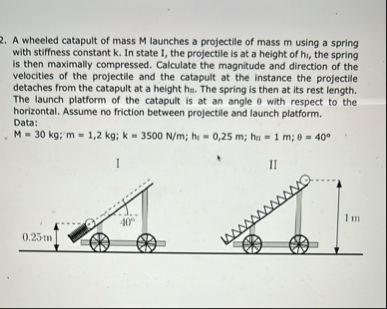 oa ris ames err
Ce ET SS OE Te
se wed clos 5 regis bd ac 5%
SR ph ema
[Ee vot eve
M = 30 kg;'m = 1,2 kg; k = 3500 N/m; by = 0,25 m; hu = 1 m; 0 = 40°
1 x n
wt 1k
Ng 1m
023m el Fh dh
oa ris ames err
Ce ET SS OE Te
se wed clos 5 regis bd ac 5%
SR ph ema
[Ee vot eve
M = 30 kg;'m = 1,2 kg; k = 3500 N/m; by = 0,25 m; hu = 1 m; 0 = 40°
1 x n
wt 1k
Ng 1m
023m el Fh dh
This is AI generated Response.
Asked by: Rahul
Created at: 2026-01-15 05:03:59
Asked by: Rahul
Created at: 2026-01-15 05:03:59
Final Answer:
Rendered
Raw Text
Did you like this answer?
Let's break down the solution step by step.
---
## **Step 1: Data and Variables**
Given:
- Mass of catapult, \( M = 30\, \text{kg} \)
- Mass of projectile, \( m = 1.2\, \text{kg} \)
- Spring constant, \( k = 350\, \text{N/m} \)
- Initial height, \( h_i = .25\, \text{m} \)
- Final height, \( h_f = 1\, \text{m} \)
- Initial angle, \( \theta = 40^\circ \)
- Gravity, \( g = 9.8\, \text{m/s}^2 \)
---
## **Step 2: Conservation of Energy**
**Initial State (I):**
- Projectile and catapult at rest (total kinetic energy = )
- Spring compressed (potential energy in spring)
- Projectile at height \( h_i \)
**Final State (II):**
- Spring at rest length (no spring energy)
- Projectile and catapult moving (kinetic energy)
- Projectile at height \( h_f \)
**Energy Conservation Equation:**
\[
E_{\text{initial}} = E_{\text{final}}
\]
\[
\frac{1}{2} k x^2 + mgh_i = \frac{1}{2} m v_p^2 + \frac{1}{2} M v_c^2 + mgh_f
\]
where:
- \( x \) is the spring compression,
- \( v_p \) is the velocity of the projectile,
- \( v_c \) is the velocity of the catapult.
---
## **Step 3: Conservation of Momentum**
Since there is **no external force horizontally**:
\[
M v_{c,x} + m v_{p,x} =
\]
Let’s define positive \( x \) as the direction along the incline.
---
## **Step 4: Geometry and Kinematics**
The spring launches the projectile at angle \( \theta \), so:
- Projectile velocity: \( v_p \) at angle \( \theta \) above horizontal.
- Catapult velocity: \( v_c \) (horizontal since it moves on wheels).
### Velocity Components:
- Projectile: \( v_{p,x} = v_p \cos\theta \), \( v_{p,y} = v_p \sin\theta \)
- Catapult: \( v_{c,x} \) (horizontal), \( v_{c,y} = \)
---
## **Step 5: Find Spring Compression, \( x \)**
From the geometry:
- The spring is compressed along the incline: the vertical change is \( h_f - h_i = 1 - .25 = .75\, \text{m} \).
- Along the incline, the compression \( x = \frac{.75}{\sin\theta} \).
\[
x = \frac{.75}{\sin 40^\circ} = \frac{.75}{.6428} \approx 1.167\, \text{m}
\]
---
## **Step 6: Solve Conservation Equations**
### **Conservation of Energy:**
\[
\frac{1}{2} k x^2 + mgh_i = \frac{1}{2} m v_p^2 + \frac{1}{2} M v_c^2 + mgh_f
\]
Calculate each term:
- \( \frac{1}{2} k x^2 = .5 \times 350 \times (1.167)^2 \approx 2383\, \text{J} \)
- \( mgh_i = 1.2 \times 9.8 \times .25 = 2.94\, \text{J} \)
- \( mgh_f = 1.2 \times 9.8 \times 1 = 11.76\, \text{J} \)
Plug in:
\[
2383 + 2.94 = .5 \times 1.2 \times v_p^2 + .5 \times 30 \times v_c^2 + 11.76
\]
\[
2385.94 - 11.76 = .6 v_p^2 + 15 v_c^2
\]
\[
2374.18 = .6 v_p^2 + 15 v_c^2 \tag{1}
\]
---
### **Conservation of Momentum (Horizontal):**
\[
M v_{c,x} + m v_{p,x} =
\]
\[
30 v_c + 1.2 v_p \cos 40^\circ =
\]
\[
v_c = -\frac{1.2}{30} v_p \cos 40^\circ = -.04 v_p \times .766 = -.03064 v_p
\]
---
### **Substitute \( v_c \) into Energy Equation:**
\[
2374.18 = .6 v_p^2 + 15 (.03064 v_p)^2
\]
\[
2374.18 = .6 v_p^2 + 15 \times .000939 v_p^2
\]
\[
2374.18 = .6 v_p^2 + .014085 v_p^2
\]
\[
2374.18 = .614085 v_p^2
\]
\[
v_p^2 = \frac{2374.18}{.614085} \approx 3865.6
\]
\[
v_p \approx \sqrt{3865.6} \approx 62.18\, \text{m/s}
\]
---
### **Find \( v_c \):**
\[
v_c = -.03064 \times 62.18 \approx -1.906\, \text{m/s}
\]
---
## **Step 7: Final Answers**
### **Projectile:**
- **Magnitude:** \( v_p \approx 62.2\, \text{m/s} \)
- **Direction:** \( 40^\circ \) above the horizontal
### **Catapult:**
- **Magnitude:** \( v_c \approx 1.91\, \text{m/s} \)
- **Direction:** Opposite to projectile's horizontal component (to the left, if the projectile goes right)
---
## **Summary Table**
| Object | Velocity Magnitude (m/s) | Direction |
|-------------|-------------------------|-----------------------------------|
| Projectile | 62.2 | \( 40^\circ \) above horizontal |
| Catapult | 1.91 | Horizontal, opposite to projectile|
---
### **Boxed Final Answers**
\[
\boxed{
\begin{array}{l}
\text{Projectile Velocity: } 62.2\, \text{m/s} \text{ at } 40^\circ \text{ above horizontal} \\
\text{Catapult Velocity: } 1.91\, \text{m/s} \text{ in opposite horizontal direction}
\end{array}
}
\]
📢 Instructions:
- Ask anything relatd to above question only.
- For new Question goto :