 VIPSolutions
Give step-by-step solution with explanation and final answer:8. A horizontal pipeline is attached to the wall of reservoir (see fig. 2). The pipeline has different profiles. The water level in the upper reservoir is in the height H = 1.5 m above the pipeline axis. From the lower end of the pipeline water flows out to the open space. Diameters and lengths of pipeline reaches are: D1=0.24m, L1=3m, D2=0.1m, (2=1 m, D3=0.12 m, 13 = 2 m. Calculate discharge in the pipeline. Resolve the problem: a) Neglecting losses (i.e. consider the liquid to be ideal) b) Considering losses for water of temperature 10°C. Steel pipeline consider being after usage (slightly rusted). 2 1 3 Figure 2
Question:
Give step-by-step solution with explanation and final answer: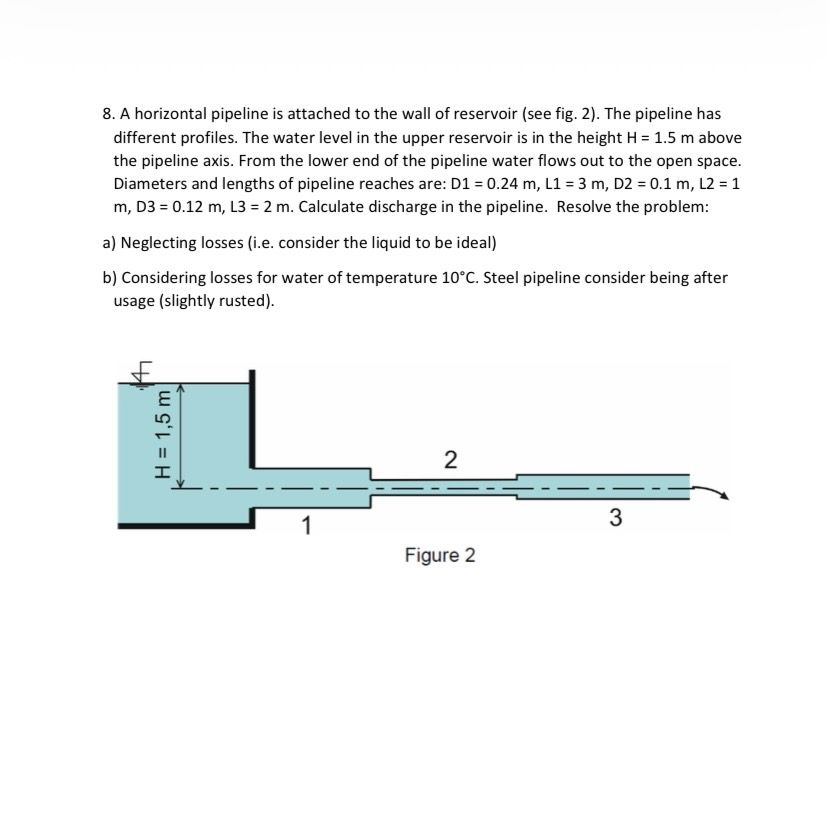 8. A horizontal pipeline is attached to the wall of reservoir (see fig. 2). The pipeline has
different profiles. The water level in the upper reservoir is in the height H = 1.5 m above
the pipeline axis. From the lower end of the pipeline water flows out to the open space.
Diameters and lengths of pipeline reaches are: D1=0.24m, L1=3m, D2=0.1m, (2=1
m, D3=0.12 m, 13 = 2 m. Calculate discharge in the pipeline. Resolve the problem:
a) Neglecting losses (i.e. consider the liquid to be ideal)
b) Considering losses for water of temperature 10°C. Steel pipeline consider being after
usage (slightly rusted).
2
1 3
Figure 2
8. A horizontal pipeline is attached to the wall of reservoir (see fig. 2). The pipeline has
different profiles. The water level in the upper reservoir is in the height H = 1.5 m above
the pipeline axis. From the lower end of the pipeline water flows out to the open space.
Diameters and lengths of pipeline reaches are: D1=0.24m, L1=3m, D2=0.1m, (2=1
m, D3=0.12 m, 13 = 2 m. Calculate discharge in the pipeline. Resolve the problem:
a) Neglecting losses (i.e. consider the liquid to be ideal)
b) Considering losses for water of temperature 10°C. Steel pipeline consider being after
usage (slightly rusted).
2
1 3
Figure 2
This is AI generated Response.
Asked by: Francis
Created at: 2026-01-15 13:09:23
Asked by: Francis
Created at: 2026-01-15 13:09:23
Final Answer:
Rendered
Raw Text
Did you like this answer?
Let's solve the problem step-by-step.
---
## **Given Data**
- **Reservoir height above pipeline:** \( H = 1.5 \) m
- **Pipeline sections:**
- Section 1: \( D_1 = .24 \) m, \( L_1 = 3 \) m
- Section 2: \( D_2 = .1 \) m, \( L_2 = 1 \) m
- Section 3: \( D_3 = .12 \) m, \( L_3 = 2 \) m
- **Water temperature:** \( T = 10^\circ C \) (for part b)
- **Assume:** Outlet discharges to atmospheric pressure.
---
# **a) Neglecting Losses (Ideal Fluid)**
### **Step 1: Apply Bernoulli's Equation**
Between the water surface (point ) and the outlet (point 3):
\[
P_ + \frac{1}{2}\rho v_^2 + \rho g z_ = P_3 + \frac{1}{2}\rho v_3^2 + \rho g z_3
\]
- \(P_ = P_3\) (both open to atmosphere)
- \(v_ \approx \) (large reservoir)
- \(z_ - z_3 = H\)
\[
\rho g H = \frac{1}{2}\rho v_3^2
\]
\[
g H = \frac{1}{2}v_3^2
\]
\[
v_3 = \sqrt{2gH}
\]
### **Step 2: Calculate Discharge**
\[
v_3 = \sqrt{2 \cdot 9.81 \cdot 1.5} = \sqrt{29.43} = 5.425\, \text{m/s}
\]
\[
Q = v_3 \cdot A_3
\]
\[
A_3 = \frac{\pi}{4} D_3^2 = \frac{\pi}{4} (.12)^2 = .0113\, \text{m}^2
\]
\[
Q = 5.425 \cdot .0113 = .0613\, \text{m}^3/\text{s}
\]
---
**Final answers for part (a):**
\[
\boxed{v_3 = 5.43\, \text{m/s}}
\]
\[
\boxed{Q = .0613\, \text{m}^3/\text{s}}
\]
---
# **b) Considering Losses (Real Fluid)**
### **Step 1: List the Losses**
- **Major (friction) losses:** For each pipe section
- **Minor losses:** Entrance, contraction/expansion, exit
### **Step 2: Friction Losses Formula**
\[
h_f = f \frac{L}{D} \frac{v^2}{2g}
\]
We'll need the **Darcy-Weisbach friction factor** \(f\).
### **Step 3: Continuity (Conservation of Mass)**
\[
Q = v_1 A_1 = v_2 A_2 = v_3 A_3
\]
From part (a): \(A_1 = .0452\, \text{m}^2\), \(A_2 = .00785\, \text{m}^2\), \(A_3 = .0113\, \text{m}^2\)
Let \(v_3 = v\). Then,
\[
v_1 = v \frac{A_3}{A_1}, \quad v_2 = v \frac{A_3}{A_2}, \quad v_3 = v
\]
### **Step 4: Bernoulli's Equation (Including Losses)**
\[
gH = \frac{v^2}{2} + \sum h_{loss}
\]
\[
gH = \frac{v^2}{2} + h_{f1} + h_{f2} + h_{f3} + h_{entrance} + h_{contraction} + h_{expansion} + h_{exit}
\]
#### **Minor Loss Coefficients**
- Entrance (sharp): \(K_{ent} = .5\)
- Sudden contraction: \(K_{contr} \approx .42 \left[1 - \left(\frac{A_2}{A_1}\right)\right]^2\)
- Sudden expansion: \(K_{exp} = \left(1 - \frac{A_2}{A_1}\right)^2\)
- Exit: \(K_{exit} = 1\)
#### **Pipe Friction Factor**
For slightly rusted steel pipe at 10°C, let's **estimate \(f = .025\)** for all sections as an average value (for turbulent flow and relative roughness).
---
### **Step 5: Write the Head Losses in Terms of \(v\)**
#### **Friction Losses**
\[
h_{f1} = f_1 \frac{L_1}{D_1} \frac{v_1^2}{2g}
\]
\[
h_{f2} = f_2 \frac{L_2}{D_2} \frac{v_2^2}{2g}
\]
\[
h_{f3} = f_3 \frac{L_3}{D_3} \frac{v^2}{2g}
\]
#### **Minor Losses**
\[
h_{ent} = K_{ent} \frac{v_1^2}{2g}
\]
\[
h_{contr} = K_{contr} \frac{v_2^2}{2g}
\]
\[
h_{exp} = K_{exp} \frac{v_3^2}{2g}
\]
\[
h_{exit} = K_{exit} \frac{v^2}{2g}
\]
#### **Calculate Areas**
\[
A_1 = .0452\, \text{m}^2, \; A_2 = .00785\, \text{m}^2, \; A_3 = .0113\, \text{m}^2
\]
\[
\frac{A_3}{A_1} = .25, \quad \frac{A_3}{A_2} = 1.44
\]
So,
\[
v_1 = .25v, \quad v_2 = 1.44v, \quad v_3 = v
\]
#### **Plug Values into Losses**
- **Friction:**
- \(h_{f1} = f \frac{L_1}{D_1} \frac{(.25v)^2}{2g} = .025 \cdot \frac{3}{.24} \cdot \frac{.0625v^2}{2g} = .025 \cdot 12.5 \cdot .0625 \frac{v^2}{2g} = .01953 \frac{v^2}{2g}\)
- \(h_{f2} = .025 \cdot \frac{1}{.1} \cdot (2.07v^2) \cdot \frac{1}{2g} = .025 \cdot 10 \cdot 2.07 \frac{v^2}{2g} = .5175 \frac{v^2}{2g}\)
(Since \(v_2 = 1.44v \Rightarrow v_2^2 = 2.07v^2\))
- \(h_{f3} = .025 \cdot \frac{2}{.12} \cdot \frac{v^2}{2g} = .025 \cdot 16.67 \frac{v^2}{2g} = .417 \frac{v^2}{2g}\)
- **Minor Losses:**
- Entrance: \(h_{ent} = .5 \frac{v_1^2}{2g} = .5 \cdot .0625 \frac{v^2}{2g} = .03125 \frac{v^2}{2g}\)
- Contraction: \(K_{contr} \approx .42[1 - (A_2/A_1)]^2\)
- \(A_2/A_1 = .1738 \Rightarrow K_{contr} = .42(1 - .1738)^2 = .42 \cdot .682 = .286\)
- \(h_{contr} = .286 \cdot (1.44^2) \frac{v^2}{2g} = .286 \cdot 2.07 \frac{v^2}{2g} = .592 \frac{v^2}{2g}\)
- Expansion: \(K_{exp} = (1 - \frac{A_3}{A_2})^2 = (1 - 1.44)^2 = .1936\)
- \(h_{exp} = .1936 \frac{v^2}{2g}\)
- Exit: \(h_{exit} = 1 \cdot \frac{v^2}{2g}\)
---
### **Step 6: Total Head Losses**
Sum all the coefficients:
\[
h_{tot} = [.01953 + .5175 + .417 + .03125 + .592 + .1936 + 1] \frac{v^2}{2g}
\]
\[
h_{tot} = 2.7709 \frac{v^2}{2g}
\]
---
### **Step 7: Full Energy Equation**
\[
gH = \frac{v^2}{2} + 2.7709 \frac{v^2}{2}
\]
\[
gH = (1 + 2.7709)\frac{v^2}{2}
\]
\[
gH = 3.7709 \frac{v^2}{2}
\]
\[
v^2 = \frac{2gH}{3.7709}
\]
\[
v = \sqrt{\frac{2 \cdot 9.81 \cdot 1.5}{3.7709}}
\]
\[
v = \sqrt{\frac{29.43}{3.7709}} = \sqrt{7.805} = 2.793\, \text{m/s}
\]
\[
Q = v \cdot A_3 = 2.793 \cdot .0113 = .0316\, \text{m}^3/\text{s}
\]
---
## **Final Answers**
### **a) Neglecting losses:**
\[
\boxed{Q = .0613\, \text{m}^3/\text{s}}
\]
### **b) Considering losses:**
\[
\boxed{Q = .0316\, \text{m}^3/\text{s}}
\]
---
**If you need more precise values (e.g. with more accurate friction factors or more minor losses), you can recalculate, but this method is standard for undergraduate fluid mechanics.**
📢 Instructions:
- Ask anything relatd to above question only.
- For new Question goto :