 VIPSolutions
Give step-by-step solution with explanation and final answer:QI (30%): Explain and compare the following terms (with sketches if necessary): a) “Compound Die” and “Progressive Die” in blanking b) “Cold Shut” and “Cold Shot” in sand casting ©) “Carburizing Flame” and “Oxidizing Flame” in oxyacetylene welding
Question:
Give step-by-step solution with explanation and final answer: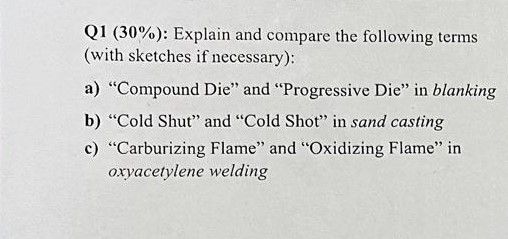 QI (30%): Explain and compare the following terms
(with sketches if necessary):
a) “Compound Die” and “Progressive Die” in blanking
b) “Cold Shut” and “Cold Shot” in sand casting
©) “Carburizing Flame” and “Oxidizing Flame” in
oxyacetylene welding
QI (30%): Explain and compare the following terms
(with sketches if necessary):
a) “Compound Die” and “Progressive Die” in blanking
b) “Cold Shut” and “Cold Shot” in sand casting
©) “Carburizing Flame” and “Oxidizing Flame” in
oxyacetylene welding
This is AI generated Response.
Asked by: Rahul
Created at: 2026-01-15 23:44:18
Asked by: Rahul
Created at: 2026-01-15 23:44:18
Final Answer:
Rendered
Raw Text
Did you like this answer?
# Q1 (30%): Explanations and Comparisons
---
## a) **Compound Die vs. Progressive Die** in *Blanking*
### **Compound Die**
- **Definition:** A compound die is a type of die in which two or more operations (such as blanking and piercing) are performed simultaneously at a single station in one stroke of the press.
- **Application:** Used for simple components where multiple features are made in one operation.
- **Key Point:** All operations occur at one station.
**Sketch:**
```
[ Press Ram ]
|
[Compound Die: Blanking + Piercing]
|
[Workpiece: All features made in one stroke]
```
### **Progressive Die**
- **Definition:** A progressive die consists of multiple stations, each performing a different operation on the workpiece as it moves through the die. The strip advances with each stroke, completing the part after passing through all stations.
- **Application:** Used for complex parts requiring multiple, sequential operations.
- **Key Point:** Operations are distributed across several stations; part is completed progressively.
**Sketch:**
```
[Station 1: Piercing] -> [Station 2: Bending] -> [Station 3: Blanking]
(Workpiece moves step-by-step through each station)
```
### **Comparison Table:**
| Feature | Compound Die | Progressive Die |
|---------------------|-----------------------|-------------------------------|
| Operations per stroke | Multiple (simultaneous) | Multiple (sequential, stepwise) |
| Complexity | Simple to moderate | Moderate to complex |
| Application | Simple shapes | Complex shapes |
---
## b) **Cold Shut vs. Cold Shot** in *Sand Casting*
### **Cold Shut**
- **Definition:** A cold shut is a casting defect where two streams of molten metal do not fuse properly, resulting in a weak, incomplete joint.
- **Appearance:** Appears as a line or seam on the surface of the casting.
- **Cause:** Occurs due to low pouring temperature or slow metal flow.
### **Cold Shot**
- **Definition:** A cold shot is a defect where small globules of solidified metal get trapped inside the casting.
- **Appearance:** Appears as small, round inclusions within the casting.
- **Cause:** Caused by splashing or turbulent metal flow during pouring.
### **Comparison Table:**
| Feature | Cold Shut | Cold Shot |
|-----------------|------------------------------------|--------------------------------|
| Nature | Incomplete fusion (seam/line) | Entrapment of solid globules |
| Location | Surface (seam/line) | Inside casting (round spots) |
| Cause | Poor fusion of metal fronts | Turbulent metal flow |
---
## c) **Carburizing Flame vs. Oxidizing Flame** in *Oxyacetylene Welding*
### **Carburizing Flame (Reducing Flame)**
- **Definition:** Flame with excess acetylene (C₂H₂), resulting in a feathered inner cone.
- **Characteristics:**
- Inner cone is longer and more luminous.
- Temperature is lower than oxidizing flame.
- Adds carbon to the weld (suitable for welding high-carbon steels).
- **Appearance:** Inner white cone (acetylene feather) is visible.
### **Oxidizing Flame**
- **Definition:** Flame with excess oxygen, resulting in a short, pointed inner cone.
- **Characteristics:**
- Inner cone is smaller and sharply defined.
- Temperature is higher.
- Removes carbon from the weld (suitable for welding brass, copper).
- **Appearance:** Short, sharp inner cone; outer envelope is bluish.
### **Comparison Table:**
| Feature | Carburizing Flame | Oxidizing Flame |
|----------------|-----------------------------|-------------------------------|
| Gas Ratio | Excess acetylene | Excess oxygen |
| Inner Cone | Long, feathered | Short, sharp |
| Use | High-carbon steels | Brass, copper, zinc alloys |
---
## **Summary Table**
| Term 1 | Term 2 | Key Difference |
|---------------------|---------------------|--------------------------------------|
| Compound Die | Progressive Die | Single vs. multiple stations |
| Cold Shut | Cold Shot | Poor fusion vs. trapped globules |
| Carburizing Flame | Oxidizing Flame | Excess acetylene vs. excess oxygen |
---
**Final Note:**
Use the correct die or flame type based on the material and desired result, and recognize these sand casting defects to improve product quality.
Question:
Then solved
This is AI generated Response.
Asked by: Rahul
Created at: 2026-01-15 23:49:08
Asked by: Rahul
Created at: 2026-01-15 23:49:08
Final Answer:
Rendered
Raw Text
Did you like this answer?
# QI (30%): Explanations and Comparisons
---
## a) **Compound Die vs. Progressive Die** in *Blanking*
### **Compound Die**
- **Definition:** A die where multiple operations (e.g., blanking and piercing) occur simultaneously at one station during a single press stroke.
- **Application:** Suitable for simple components requiring multiple features in one operation.
- **Key Point:** All operations take place in one station.
**Sketch:**
```
[ Press Ram ]
|
[Compound Die: Blanking + Piercing]
|
[Workpiece: All features made in one stroke]
```
### **Progressive Die**
- **Definition:** A die with multiple stations, each performing different operations as the workpiece advances through the die.
- **Application:** Ideal for complex parts needing sequential operations.
- **Key Point:** Operations are executed across various stations, completing the part progressively.
**Sketch:**
```
[Station 1: Piercing] -> [Station 2: Bending] -> [Station 3: Blanking]
(Workpiece moves step-by-step through each station)
```
### **Comparison Table:**
| Feature | Compound Die | Progressive Die |
|---------------------|-----------------------------|--------------------------------|
| Operations per stroke| Multiple (simultaneous) | Multiple (sequential) |
| Complexity | Simple to moderate | Moderate to complex |
| Application | Simple shapes | Complex shapes |
---
## b) **Cold Shut vs. Cold Shot** in *Sand Casting*
### **Cold Shut**
- **Definition:** A defect where two streams of molten metal fail to fuse, resulting in weak joints.
- **Appearance:** A line or seam on the casting surface.
- **Cause:** Low pouring temperature or slow metal flow.
### **Cold Shot**
- **Definition:** A defect where small solidified metal globules are trapped within the casting.
- **Appearance:** Small, round inclusions within the casting.
- **Cause:** Turbulent metal flow or splashing during pouring.
### **Comparison Table:**
| Feature | Cold Shut | Cold Shot |
|-----------------|------------------------------------|--------------------------------|
| Nature | Incomplete fusion (seam/line) | Entrapment of solid globules |
| Location | Surface (seam/line) | Inside casting (round spots) |
| Cause | Poor fusion of metal fronts | Turbulent metal flow |
---
## c) **Carburizing Flame vs. Oxidizing Flame** in *Oxyacetylene Welding*
### **Carburizing Flame (Reducing Flame)**
- **Definition:** A flame with excess acetylene (C₂H₂), producing a longer, feathered inner cone.
- **Characteristics:**
- Inner cone is luminous and elongated.
- Lower temperature than oxidizing flame.
- Adds carbon to the weld (suitable for high-carbon steels).
- **Appearance:** Visible inner white cone (acetylene feather).
### **Oxidizing Flame**
- **Definition:** A flame with excess oxygen, resulting in a short, pointed inner cone.
- **Characteristics:**
- Inner cone is smaller and sharply defined.
- Higher temperature.
- Removes carbon from the weld (suitable for brass, copper).
- **Appearance:** Short, sharp inner cone with a bluish outer envelope.
### **Comparison Table:**
| Feature | Carburizing Flame | Oxidizing Flame |
|----------------|-----------------------------|--------------------------------|
| Gas Ratio | Excess acetylene | Excess oxygen |
| Inner Cone | Long, feathered | Short, sharp |
| Use | High-carbon steels | Brass, copper, zinc alloys |
---
## **Summary Table**
| Term 1 | Term 2 | Key Difference |
|---------------------|---------------------|--------------------------------------|
| Compound Die | Progressive Die | Single vs. multiple stations |
| Cold Shut | Cold Shot | Poor fusion vs. trapped globules |
| Carburizing Flame | Oxidizing Flame | Excess acetylene vs. excess oxygen |
---
**Final Note:**
Selecting the appropriate die or flame type is crucial for material behavior and desired outcomes, while recognizing casting defects is essential for enhancing product quality.
📢 Instructions:
- Ask anything relatd to above question only.
- For new Question goto :