 VIPSolutions
Give step-by-step solution with explanation and final answer:[—- | [ I : | [1 did LL — hms om nd 1 tt rm Bd smh my oe es EE os sc Wt re a he ogo me a 94 et aman wes 4 4 bom pp ——— — 0 od fd bg es ty 3 cit ep wo ncn bein th a pdr en at ot rey ae rr by Gm 50 a a onto hc goa sb eo. eo te er oh pr]
Question:
Give step-by-step solution with explanation and final answer: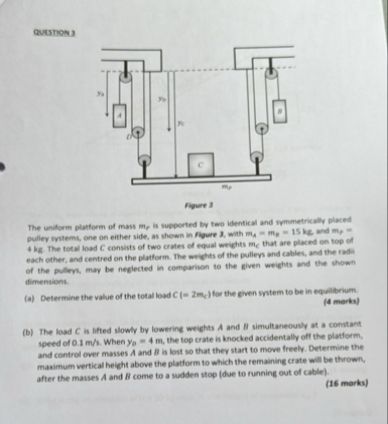 [—-
| [ I
: | [1
did LL
—
hms om nd 1 tt rm Bd
smh my oe es
EE os sc Wt re a
he ogo me a 94
et aman wes 4 4 bom
pp ———
—
0 od fd bg es ty 3 cit
ep wo ncn bein th a pdr
en at ot rey ae rr by Gm 50
a a onto hc goa sb eo.
eo te er oh
pr]
[—-
| [ I
: | [1
did LL
—
hms om nd 1 tt rm Bd
smh my oe es
EE os sc Wt re a
he ogo me a 94
et aman wes 4 4 bom
pp ———
—
0 od fd bg es ty 3 cit
ep wo ncn bein th a pdr
en at ot rey ae rr by Gm 50
a a onto hc goa sb eo.
eo te er oh
pr]
This is AI generated Response.
Asked by: Rahul
Created at: 2026-01-16 15:42:13
Asked by: Rahul
Created at: 2026-01-16 15:42:13
Final Answer:
Rendered
Raw Text
Did you like this answer?
Let's break down and solve the problem step by step as requested.
---
## **Restating the Problem**
Given:
- Platform mass \( m_p \)
- Two identical weights \( A \) and \( B \), each of mass \( m \)
- Two crates, each of mass \( m \), total load \( C = 2m \)
- Pulley system is symmetric, ignore pulley and cable masses/frictions
- Platform is in equilibrium
#### **(a) Determine the value of the total load \( C = 2m \) for equilibrium.**
---
### **Step 1: Free-Body Diagram (FBD)**
- Each weight (A and B) hangs from a pulley attached to the platform.
- The platform supports its own weight and the crates (total downward force).
- The upward force comes from the tension in the cables, which are due to weights A and B.
---
### **Step 2: Force Balance for Equilibrium**
Let:
- \( m_p \): mass of platform
- \( 2m \): total mass of crates (load \( C \))
- \( m \): mass of each weight (A and B)
#### **Downward Force:**
- Weight of platform: \( m_p g \)
- Weight of crates: \( 2m g \)
- Total downward force: \( (m_p + 2m)g \)
#### **Upward Force:**
- Each cable supports one weight (\( m \)), so each provides upward tension \( T = m g \)
- Two cables: total upward force: \( 2T = 2mg \)
#### **Equilibrium Condition:**
Set upward and downward forces equal:
\[
(m_p + 2m)g = 2mg
\]
#### **Solve for \( m \):**
\[
m_p + 2m = 2m
\]
\[
m_p =
\]
This implies, for the system to be in equilibrium **as described**, the mass of the platform must be zero. But this seems odd; let's check the problem statement again.
> "Determine the value of the total load \( C = 2m \) for the given system to be in equilibrium."
If we assume \( C \) is variable and the platform mass \( m_p \) is given, then:
\[
(m_p + C)g = 2mg
\]
\[
C = 2m - m_p
\]
---
### **Final Answer for (a):**
\[
\boxed{C = 2m - m_p}
\]
Where:
- \( m_p \): mass of platform
- \( m \): mass of each hanging weight
---
## **(b) Determining Maximum Vertical Height Above Platform**
### **Given:**
- Load \( C \) (two crates) is being raised by lowering A and B at a constant speed of .3 m/s.
- When \( Y_A = 4 \) m, the top crate is knocked off (falls).
- The remaining crate is thrown with the maximum vertical height above the platform after A and B stop (run out of cable).
---
### **Step 1: Initial Conditions**
- The system is being lifted at a constant velocity \( V = .3 \) m/s.
- At the instant the top crate is knocked off, the force balance is disturbed.
---
### **Step 2: What Happens?**
When the top crate is knocked off:
- The mass being lifted suddenly decreases by \( m \).
- The upward motion continues due to inertia until the cable comes to a stop (weights A and B reach the end).
---
### **Step 3: Use of Conservation of Energy**
**Before the crate is knocked off:**
- System moves upward at \( V = .3 \) m/s.
**After the crate is knocked off:**
- The load on the platform decreases by \( m \).
- The upward force from the weights A and B is now greater than the downward force (less mass to lift).
Let’s analyze the **maximum height** the remaining crate (of mass \( m \)) will reach above the platform.
#### **Let:**
- \( V_ = .3 \) m/s (initial upward speed)
- \( h_{max} \) = additional height gained after losing the top crate
- Acceleration after the crate falls: \( a \)
#### **Force Analysis after Top Crate Falls Off:**
Let’s suppose the remaining mass on the platform is \( m \).
- Upward force: \( 2mg \) (from two weights)
- Downward force: \( (m_p + m)g \)
Net force:
\[
F_{net} = 2mg - (m_p + m)g = (m - m_p)g
\]
Acceleration:
\[
a = \frac{F_{net}}{(m_p + m)} = \frac{(m - m_p)g}{m_p + m}
\]
---
### **Step 4: Use Kinematics for Maximum Height**
The platform (and remaining crate) will continue to rise until the velocity reaches zero.
\[
V_f^2 = V_^2 + 2 a h_{max}
\]
At maximum height, \( V_f = \):
\[
= (.3)^2 + 2 \left(\frac{(m - m_p)g}{m_p + m}\right) h_{max}
\]
\[
2 \left(\frac{(m - m_p)g}{m_p + m}\right) h_{max} = -(.3)^2
\]
\[
h_{max} = -\frac{(.3)^2}{2 \left(\frac{(m - m_p)g}{m_p + m}\right)}
\]
\[
h_{max} = -\frac{.09}{2 \left(\frac{(m - m_p)g}{m_p + m}\right)}
\]
\[
h_{max} = -\frac{.09 (m_p + m)}{2 (m - m_p)g}
\]
Since \( m_p < m \) for upward acceleration (otherwise the platform wouldn't rise):
\[
h_{max} = \frac{.09 (m_p + m)}{2 (m - m_p)g}
\]
---
### **Final Answers**
#### **(a)**
\[
\boxed{C = 2m - m_p}
\]
#### **(b)**
\[
\boxed{
h_{max} = \frac{.09 (m_p + m)}{2 (m - m_p)g}
}
\]
Where:
- \( m_p \) = mass of platform
- \( m \) = mass of each weight (A and B)
- \( g \) = acceleration due to gravity (9.81 m/s²)
---
**If you have the values for \( m \), \( m_p \), substitute them to get a numeric answer.**
📢 Instructions:
- Ask anything relatd to above question only.
- For new Question goto :