 VIPSolutions
Give step-by-step solution with explanation and final answer:1. Show how you might carry out the following transformations. Hore 'H8 9% © may be required. You may use any inorganic and organic reagents. Show all reagents, resonance structures, formal charges, and arrows showing electron flow. 10P ()10P (€)10P) D) CoH. Cathe PEL el CH; CHIE oF H qosiok H (Syhexan3-ol ms cl (R)-3-methoxyhexane b) TEETER = 2Hs. CaHs HO _— oe ZY CoH: - CH; : No Plry Cit (Shexan-3-ol (§)3-methoxyhexane e © a NNN Bg 0 Hexen iol member 2 pra )
Question:
Give step-by-step solution with explanation and final answer: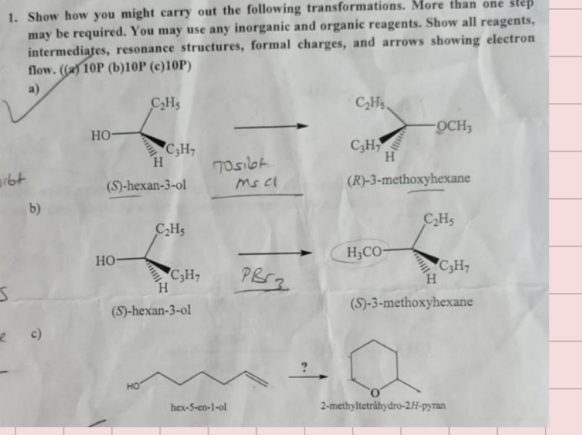 1. Show how you might carry out the following transformations. Hore 'H8 9% ©
may be required. You may use any inorganic and organic reagents. Show all reagents,
resonance structures, formal charges, and arrows showing electron
flow. 10P ()10P (€)10P)
D)
CoH. Cathe
PEL el
CH; CHIE
oF H qosiok H
(Syhexan3-ol ms cl (R)-3-methoxyhexane
b) TEETER =
2Hs. CaHs
HO _— oe
ZY CoH: - CH;
: No Plry Cit
(Shexan-3-ol (§)3-methoxyhexane
e ©
a NNN Bg
0
Hexen iol member 2 pra
)
1. Show how you might carry out the following transformations. Hore 'H8 9% ©
may be required. You may use any inorganic and organic reagents. Show all reagents,
resonance structures, formal charges, and arrows showing electron
flow. 10P ()10P (€)10P)
D)
CoH. Cathe
PEL el
CH; CHIE
oF H qosiok H
(Syhexan3-ol ms cl (R)-3-methoxyhexane
b) TEETER =
2Hs. CaHs
HO _— oe
ZY CoH: - CH;
: No Plry Cit
(Shexan-3-ol (§)3-methoxyhexane
e ©
a NNN Bg
0
Hexen iol member 2 pra
)
This is AI generated Response.
Asked by: Rahul
Created at: 2026-01-21 02:57:14
Asked by: Rahul
Created at: 2026-01-21 02:57:14
Final Answer:
Rendered
Raw Text
Did you like this answer?
Let's solve each part step-by-step with explanations:
---
## **Part (a)**
### **Transformation**
\[
(S)\text{-hexan-3-ol} \longrightarrow (R)\text{-3-methoxyhexane}
\]
### **Step-by-Step Solution**
1. **Convert Alcohol to Tosylate:**
- Reagent: Tosyl chloride (TsCl), pyridine
- Mechanism: The alcohol reacts with TsCl to form a tosylate (a good leaving group) **without** inversion of configuration.
- Intermediate: (S)-3-tosyloxyhexane
2. **Nucleophilic Substitution with Methoxide:**
- Reagent: Sodium methoxide (NaOCH₃) or Methanol (CH₃O⁻)
- Mechanism: The methoxide ion attacks the carbon (SN2 mechanism), **inverting** the configuration from S to R.
- Product: (R)-3-methoxyhexane
### **Explanation**
- **SN2 reactions** at a stereocenter result in **inversion** of configuration.
- The tosylate step does not change the configuration.
- Thus, overall S → R.
---
## **Part (b)**
### **Transformation**
\[
(S)\text{-hexan-3-ol} \longrightarrow (S)\text{-3-methoxyhexane}
\]
### **Step-by-Step Solution**
1. **Convert Alcohol to Bromide:**
- Reagent: PBr₃
- Mechanism: PBr₃ converts the alcohol to an alkyl bromide **with inversion** of configuration (S → R).
- Intermediate: (R)-3-bromohexane
2. **Nucleophilic Substitution with Methoxide:**
- Reagent: Sodium methoxide (NaOCH₃)
- Mechanism: SN2 reaction with methoxide, **inverting** configuration again (R → S).
- Product: (S)-3-methoxyhexane
### **Explanation**
- Two inversions (one with PBr₃, one with SN2) restore the original configuration.
---
## **Part (c)**
### **Transformation**
\[
\text{hex-5-en-1-ol} \longrightarrow \text{2-methyltetrahydro-2H-pyran}
\]
### **Step-by-Step Solution**
1. **Acid-Catalyzed Cyclization (Prins Cyclization):**
- Reagent: Acid (H⁺, e.g., H₂SO₄)
- Mechanism:
- Protonation of the alcohol forms a good leaving group.
- An intramolecular attack by the alkene leads to a 6-membered ring (tetrahydropyran).
- Rearrangement leads to a methyl group at C-2.
### **Explanation**
- The acid catalyzes the cyclization, forming the tetrahydropyran ring with a methyl group at position 2.
---
## **Summary Table**
| Part | Reagents & Steps | Stereochemical Outcome | Product |
|------|--------------------------------------------|-----------------------------|-------------------------------|
| a | 1. TsCl, pyridine 2. NaOCH₃ | Inversion (S → R) | (R)-3-methoxyhexane |
| b | 1. PBr₃ 2. NaOCH₃ | Double inversion (S → R → S)| (S)-3-methoxyhexane |
| c | H⁺ (acid catalysis) | Cyclization | 2-methyltetrahydro-2H-pyran |
---
## **Final Answers**
**(a)** Use TsCl/pyridine, then NaOCH₃ (SN2) to get (R)-3-methoxyhexane.
**(b)** Use PBr₃ (inverts to R), then NaOCH₃ (SN2, inverts back to S) to get (S)-3-methoxyhexane.
**(c)** Use acid catalysis (H⁺) to cyclize hex-5-en-1-ol into 2-methyltetrahydro-2H-pyran.
---
If you need arrow-pushing mechanisms or more details for any step, let me know!
📢 Instructions:
- Ask anything relatd to above question only.
- For new Question goto :