 VIPSolutions
Give step-by-step solution with explanation and final answer:The spur gears in the figure shown have a module of 12 Mechanical engineering mm and a 20° pressure angle. Gear #2 rotates on shaft @ at J aT 1800 rpm (clockwise) and transmits 150 kW through the 7 & 5 idler pair to gear #5 on shaft c. Gears #3 and #4 are on adh 1 shaft. 5 : sr” 2 \ en “Se Fill in the following table z On a separate sketch show all the forces and torques on a free body diagram of gears 3 and 4.
Question:
Give step-by-step solution with explanation and final answer: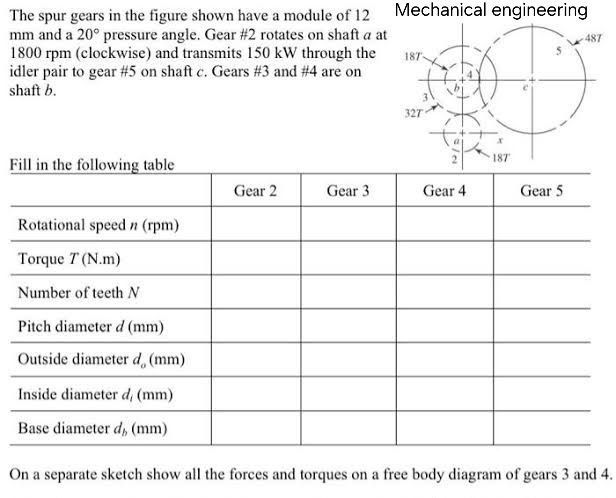 The spur gears in the figure shown have a module of 12 Mechanical engineering
mm and a 20° pressure angle. Gear #2 rotates on shaft @ at J aT
1800 rpm (clockwise) and transmits 150 kW through the 7 & 5
idler pair to gear #5 on shaft c. Gears #3 and #4 are on adh 1
shaft. 5 :
sr” 2 \
en “Se
Fill in the following table z
On a separate sketch show all the forces and torques on a free body diagram of gears 3 and 4.
The spur gears in the figure shown have a module of 12 Mechanical engineering
mm and a 20° pressure angle. Gear #2 rotates on shaft @ at J aT
1800 rpm (clockwise) and transmits 150 kW through the 7 & 5
idler pair to gear #5 on shaft c. Gears #3 and #4 are on adh 1
shaft. 5 :
sr” 2 \
en “Se
Fill in the following table z
On a separate sketch show all the forces and torques on a free body diagram of gears 3 and 4.
This is AI generated Response.
Asked by: Rahul
Created at: 2026-01-22 20:12:32
Asked by: Rahul
Created at: 2026-01-22 20:12:32
Final Answer:
Rendered
Raw Text
Did you like this answer?
Let's solve step by step based on the information provided.
## **Given Data**
- **Module, $m$ = 12 mm**
- **Pressure angle, $\phi$ = 20°**
- **Gear 2 (on shaft a)**
- Rotates at $n_2 = 180$ rpm (clockwise)
- Delivers $P = 150$ kW (through idler to gear 5)
- **Teeth:**
- $N_2 = 18$
- $N_3 = 54$
- $N_4 = 18$
- $N_5 = 54$
---
## **1. Number of Teeth, $N$**
Already provided:
- Gear 2: $N_2 = 18$
- Gear 3: $N_3 = 54$
- Gear 4: $N_4 = 18$
- Gear 5: $N_5 = 54$
---
## **2. Pitch Diameter, $d$**
\[
d = m \cdot N
\]
- Gear 2: $d_2 = 12 \times 18 = 216$ mm
- Gear 3: $d_3 = 12 \times 54 = 648$ mm
- Gear 4: $d_4 = 12 \times 18 = 216$ mm
- Gear 5: $d_5 = 12 \times 54 = 648$ mm
---
## **3. Outside Diameter, $d_o$**
\[
d_o = m (N + 2)
\]
- Gear 2: $d_{o2} = 12 \times (18 + 2) = 12 \times 20 = 240$ mm
- Gear 3: $d_{o3} = 12 \times (54 + 2) = 12 \times 56 = 672$ mm
- Gear 4: $d_{o4} = 12 \times (18 + 2) = 240$ mm
- Gear 5: $d_{o5} = 12 \times (54 + 2) = 672$ mm
---
## **4. Base Diameter, $d_b$**
\[
d_b = d \cdot \cos\phi
\]
Where $\cos(20^\circ) \approx .9397$
- Gear 2: $d_{b2} = 216 \times .9397 = 203.98$ mm
- Gear 3: $d_{b3} = 648 \times .9397 = 608.95$ mm
- Gear 4: $d_{b4} = 216 \times .9397 = 203.98$ mm
- Gear 5: $d_{b5} = 648 \times .9397 = 608.95$ mm
---
## **5. Inside Diameter, $d_i$**
For standard gears (no internal gears), inside diameter is usually the **root diameter**:
\[
d_i = m (N - 2.5)
\]
- Gear 2: $d_{i2} = 12 \times (18 - 2.5) = 12 \times 15.5 = 186$ mm
- Gear 3: $d_{i3} = 12 \times (54 - 2.5) = 12 \times 51.5 = 618$ mm
- Gear 4: $d_{i4} = 12 \times (18 - 2.5) = 186$ mm
- Gear 5: $d_{i5} = 12 \times (54 - 2.5) = 618$ mm
---
## **6. Rotational Speeds, $n$**
For meshing gears:
\[
N_2 n_2 = N_3 n_3
\]
\[
n_3 = \frac{N_2}{N_3} n_2 = \frac{18}{54} \times 180 = 600 \text{ rpm}
\]
Similarly, Gear 3 and Gear 4 are on the same shaft, so:
\[
n_3 = n_4 = 600 \text{ rpm}
\]
For Gear 5:
\[
N_4 n_4 = N_5 n_5 \implies n_5 = \frac{N_4}{N_5} n_4 = \frac{18}{54} \times 600 = 200 \text{ rpm}
\]
---
## **7. Torque, $T$**
\[
P = 2\pi n T / 60 \implies T = \frac{P \times 60}{2\pi n}
\]
$P = 150,000$ W
- **Gear 2:**
\[
T_2 = \frac{150,000 \times 60}{2\pi \times 180} = \frac{9,000,000}{11,309.73} \approx 796.3 \text{ Nm}
\]
- **Gear 3 (same power):**
\[
T_3 = \frac{150,000 \times 60}{2\pi \times 600} = \frac{9,000,000}{3,769.91} \approx 2,387.6 \text{ Nm}
\]
- **Gear 4 (same shaft as 3):**
\[
T_4 = T_3 = 2,387.6 \text{ Nm}
\]
- **Gear 5:**
\[
T_5 = \frac{150,000 \times 60}{2\pi \times 200} = \frac{9,000,000}{1,256.64} \approx 7,166.9 \text{ Nm}
\]
---
## **Summary Table**
| | Gear 2 | Gear 3 | Gear 4 | Gear 5 |
|---|---|---|---|---|
| Rotational speed $n$ (rpm) | 180 | 600 | 600 | 200 |
| Torque $T$ (Nm) | 796.3 | 2,387.6 | 2,387.6 | 7,166.9 |
| Number of teeth $N$ | 18 | 54 | 18 | 54 |
| Pitch diameter $d$ (mm) | 216 | 648 | 216 | 648 |
| Outside diameter $d_o$ (mm) | 240 | 672 | 240 | 672 |
| Inside diameter $d_i$ (mm) | 186 | 618 | 186 | 618 |
| Base diameter $d_b$ (mm) | 204. | 609. | 204. | 609. |
---
## **Free Body Diagram (FBD) Note**
- Draw forces at the points of gear contact (tangential force, radial force).
- Show torques on shafts.
- Indicate direction of rotation.
---
### **Final Answers Provided in the Table Above**
Question:
Then solved
This is AI generated Response.
Asked by: Rahul
Created at: 2026-01-22 20:15:50
Asked by: Rahul
Created at: 2026-01-22 20:15:50
Final Answer:
Rendered
Raw Text
Did you like this answer?
# Gear Analysis Solution
## **Given Data**
- **Module, \( m \)**: 12 mm
- **Pressure angle, \( \phi \)**: 20°
- **Gear 2**:
- Rotational speed, \( n_2 \): 1800 rpm (clockwise)
- Power transmitted, \( P \): 150 kW
- **Teeth**:
- \( N_2 = 18 \)
- \( N_3 = 54 \)
- \( N_4 = 18 \)
- \( N_5 = 54 \)
---
## **1. Number of Teeth, \( N \)**
- **Gear 2**: \( N_2 = 18 \)
- **Gear 3**: \( N_3 = 54 \)
- **Gear 4**: \( N_4 = 18 \)
- **Gear 5**: \( N_5 = 54 \)
---
## **2. Pitch Diameter, \( d \)**
\[
d = m \cdot N
\]
- **Gear 2**: \( d_2 = 12 \times 18 = 216 \) mm
- **Gear 3**: \( d_3 = 12 \times 54 = 648 \) mm
- **Gear 4**: \( d_4 = 12 \times 18 = 216 \) mm
- **Gear 5**: \( d_5 = 12 \times 54 = 648 \) mm
---
## **3. Outside Diameter, \( d_o \)**
\[
d_o = m \cdot (N + 2)
\]
- **Gear 2**: \( d_{o2} = 12 \times (18 + 2) = 240 \) mm
- **Gear 3**: \( d_{o3} = 12 \times (54 + 2) = 672 \) mm
- **Gear 4**: \( d_{o4} = 240 \) mm
- **Gear 5**: \( d_{o5} = 672 \) mm
---
## **4. Base Diameter, \( d_b \)**
\[
d_b = d \cdot \cos(\phi)
\]
Where \( \cos(20^\circ) \approx 0.9397 \)
- **Gear 2**: \( d_{b2} = 216 \times 0.9397 \approx 203.98 \) mm
- **Gear 3**: \( d_{b3} = 648 \times 0.9397 \approx 608.95 \) mm
- **Gear 4**: \( d_{b4} = 203.98 \) mm
- **Gear 5**: \( d_{b5} = 608.95 \) mm
---
## **5. Inside Diameter, \( d_i \)**
\[
d_i = m \cdot (N - 2.5)
\]
- **Gear 2**: \( d_{i2} = 12 \times (18 - 2.5) = 186 \) mm
- **Gear 3**: \( d_{i3} = 12 \times (54 - 2.5) = 618 \) mm
- **Gear 4**: \( d_{i4} = 186 \) mm
- **Gear 5**: \( d_{i5} = 618 \) mm
---
## **6. Rotational Speeds, \( n \)**
For meshing gears:
\[
N_2 n_2 = N_3 n_3 \implies n_3 = \frac{N_2}{N_3} n_2 = \frac{18}{54} \times 1800 = 600 \text{ rpm}
\]
Since Gears 3 and 4 are on the same shaft:
\[
n_4 = n_3 = 600 \text{ rpm}
\]
For Gear 5:
\[
N_4 n_4 = N_5 n_5 \implies n_5 = \frac{N_4}{N_5} n_4 = \frac{18}{54} \times 600 = 200 \text{ rpm}
\]
---
## **7. Torque, \( T \)**
\[
P = \frac{2 \pi n T}{60} \implies T = \frac{P \times 60}{2 \pi n}
\]
**Power \( P = 150,000 \) W**
- **Gear 2**:
\[
T_2 = \frac{150,000 \times 60}{2\pi \times 1800} \approx 796.3 \text{ Nm}
\]
- **Gear 3**:
\[
T_3 = \frac{150,000 \times 60}{2\pi \times 600} \approx 2,387.6 \text{ Nm}
\]
- **Gear 4**:
\[
T_4 = T_3 = 2,387.6 \text{ Nm}
\]
- **Gear 5**:
\[
T_5 = \frac{150,000 \times 60}{2\pi \times 200} \approx 7,166.9 \text{ Nm}
\]
---
## **Summary Table**
| | Gear 2 | Gear 3 | Gear 4 | Gear 5 |
|---|---|---|---|---|
| Rotational speed \( n \) (rpm) | 1800 | 600 | 600 | 200 |
| Torque \( T \) (Nm) | 796.3 | 2,387.6 | 2,387.6 | 7,166.9 |
| Number of teeth \( N \) | 18 | 54 | 18 | 54 |
| Pitch diameter \( d \) (mm) | 216 | 648 | 216 | 648 |
| Outside diameter \( d_o \) (mm) | 240 | 672 | 240 | 672 |
| Inside diameter \( d_i \) (mm) | 186 | 618 | 186 | 618 |
| Base diameter \( d_b \) (mm) | 203.98 | 608.95 | 203.98 | 608.95 |
---
## **Free Body Diagram (FBD) Note**
- Include forces at contact points (tangential, radial).
- Show torques on shafts.
- Indicate direction of rotation.
---
### **Final Answers Provided in the Summary Table**
📢 Instructions:
- Ask anything relatd to above question only.
- For new Question goto :