Give step-by-step solution with explanation and final answer:ECO 211 - Assignment 1
1. Consider an economy called Tradeland that produces two goods, agriculture and
automobiles, using specialized resources.
a. Draw a PPF for Tradeland that has the proper shape. Label the PPF and axes
properly. Briefly explain the shape.
b. On anew graph, show the effect of new technology which improves agricultural
* production but not automotive production. Make sure to label both the original
and the new PPF.
c., Ona new graph, show the effect of population growth.
d., On a new graph, show the effect of an economy-wide labor strike which leads to a
temporary drop in employment and therefore a temporary reduction in production.
Explain briefly.
e. On anew graph, draw the PPF for Tradeland if resources were not specialized.
Briefly explain the difference between this PPF and the one in (a).
f. Suppose that Tradeland decides to trade with a nearby economy and both
i countries have resources that are not specialized. The trade partners produce at
{ their comparative advantage and therefore gains from trade are realized. Using
one graph with one PPF, label Tradeland’s production after specialization and
consumption after trade assuming that Tradeland has the comparative advantage
in producing agriculture. Explain briefly.
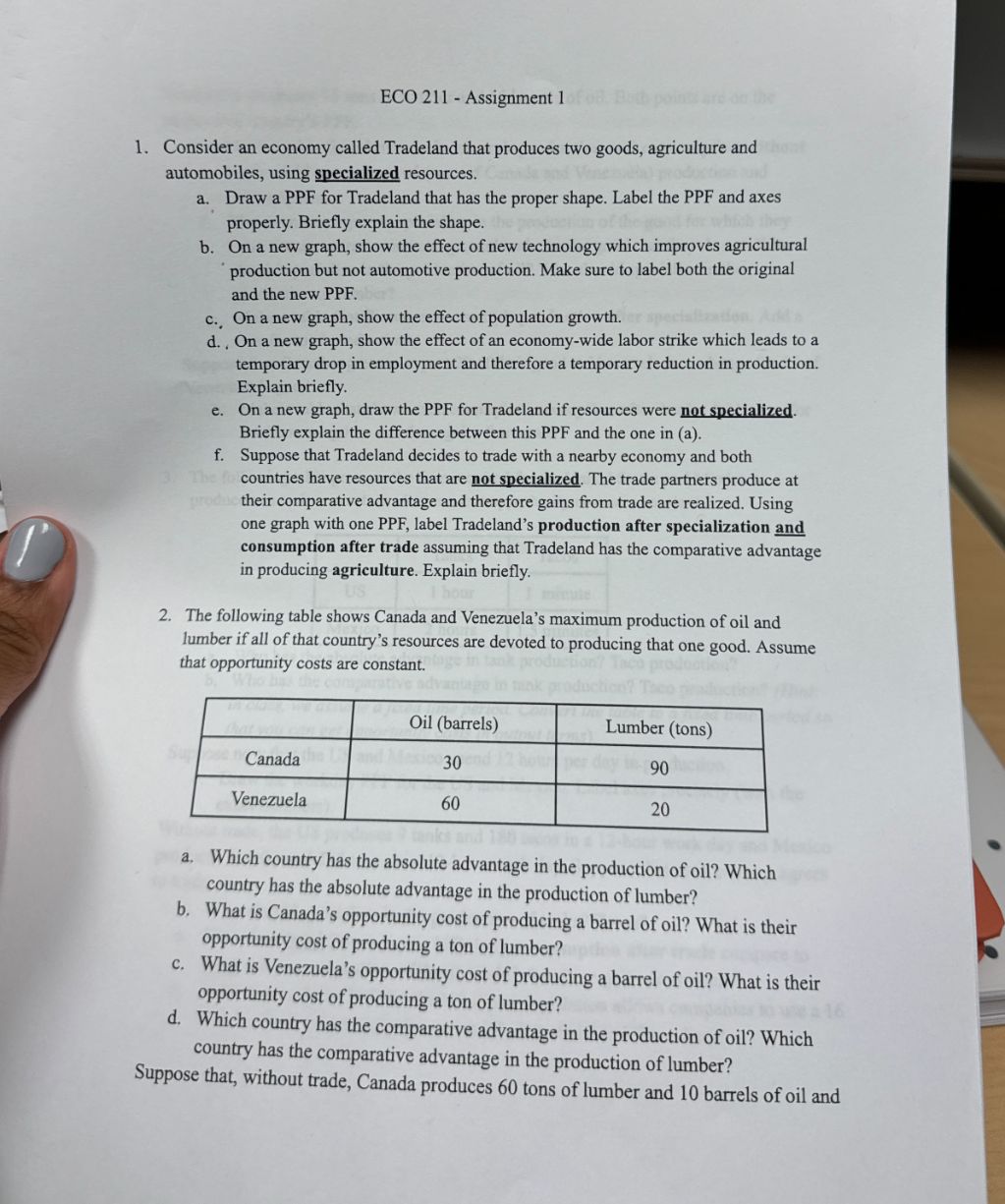
2. The following table shows Canada and Venezuela’s maximum production of oil and
lumber if all of that country’s resources are devoted to producing that one good. Assume
that opportunity costs are constant.
[| outwmy Lumber (an)
[=cut ot mann es ds oN |
WE dn
-
a. Which country has the absolute advantage in the production of oil? Which
country has the absolute advantage in the production of lumber?
b. What is Canada’s opportunity cost of producing a barrel of oil? What is their
opportunity cost of producing a ton of lumber?
c. Whatis Venezuela's opportunity cost of producing a barrel of 0il? What is their
opportunity cost of producing a ton of lumber? =
d. Whi : 3
y ich fog has the comparative advantage in the production of oil? Which
= fd : at the comparative advantage in the production of lumber?
se tha
Ippo: 4, without trade, Canada produces 60 tons of lumber and 10 barrels of oil and
Question:
Give step-by-step solution with explanation and final answer:ECO 211 - Assignment 1
1. Consider an economy called Tradeland that produces two goods, agriculture and
automobiles, using specialized resources.
a. Draw a PPF for Tradeland that has the proper shape. Label the PPF and axes
properly. Briefly explain the shape.
b. On anew graph, show the effect of new technology which improves agricultural
* production but not automotive production. Make sure to label both the original
and the new PPF.
c., Ona new graph, show the effect of population growth.
d., On a new graph, show the effect of an economy-wide labor strike which leads to a
temporary drop in employment and therefore a temporary reduction in production.
Explain briefly.
e. On anew graph, draw the PPF for Tradeland if resources were not specialized.
Briefly explain the difference between this PPF and the one in (a).
f. Suppose that Tradeland decides to trade with a nearby economy and both
i countries have resources that are not specialized. The trade partners produce at
{ their comparative advantage and therefore gains from trade are realized. Using
one graph with one PPF, label Tradeland’s production after specialization and
consumption after trade assuming that Tradeland has the comparative advantage
in producing agriculture. Explain briefly.
2. The following table shows Canada and Venezuela’s maximum production of oil and
lumber if all of that country’s resources are devoted to producing that one good. Assume
that opportunity costs are constant.
[| outwmy Lumber (an)
[=cut ot mann es ds oN |
WE dn
-
a. Which country has the absolute advantage in the production of oil? Which
country has the absolute advantage in the production of lumber?
b. What is Canada’s opportunity cost of producing a barrel of oil? What is their
opportunity cost of producing a ton of lumber?
c. Whatis Venezuela's opportunity cost of producing a barrel of 0il? What is their
opportunity cost of producing a ton of lumber? =
d. Whi : 3
y ich fog has the comparative advantage in the production of oil? Which
= fd : at the comparative advantage in the production of lumber?
se tha
Ippo: 4, without trade, Canada produces 60 tons of lumber and 10 barrels of oil and
This is AI generated Response.
Asked by: Rahul
Created at: 2026-01-22 20:33:20
Final Answer:
RenderedRaw Text
Did you like this answer?
Let's solve each part step by step:
---
## **1. Tradeland and the PPF**
### **a. Draw a PPF for Tradeland using specialized resources.**
- **Label:** Y-axis: Automobiles, X-axis: Agriculture.
- **Shape:** Bowed out (concave) from the origin due to specialized resources.
- **Explanation:** Specialized resources mean that opportunity costs increase as more of one good is produced. The PPF is concave because resources are not equally efficient in both goods.
---
### **b. Effect of technology improvement in agriculture only**
- **Draw:** The PPF will rotate outward from the agriculture axis, showing increased maximum output in agriculture, while the maximum for automobiles remains unchanged.
- **Label:** Original PPF, new PPF, axes.
- **Explanation:** Technology increases agricultural productivity, so more agriculture can be produced for any given amount of automobiles.
---
### **c. Effect of population growth**
- **Draw:** The entire PPF shifts outward, showing that more of both goods can be produced.
- **Explanation:** More labor/resources increase productive capacity in both sectors.
---
### **d. Effect of a temporary labor strike**
- **Draw:** The PPF temporarily shifts inward. Label the original and new (temporary) PPFs.
- **Explanation:** A strike reduces labor, so less of both goods can be produced temporarily.
---
### **e. PPF with non-specialized resources**
- **Draw:** The PPF is a straight line (linear) between the two intercepts.
- **Explanation:** Non-specialized resources mean constant opportunity costs.
---
### **f. Trade with another country (Tradeland has a comparative advantage in agriculture)**
- **Draw:** One PPF, mark Tradeland’s production point (after specializing in agriculture), and a point outside the PPF (after trade/consumption).
- **Explanation:** Tradeland specializes in agriculture, trades for automobiles, and ends up consuming more of both than it could produce on its own.
---
## **2. Canada vs. Venezuela: Oil and Lumber**
### **Table Recap:**
| | Oil (barrels) | Lumber (tons) |
|-------------|---------------|--------------|
| Canada | 30 | 90 |
| Venezuela | 60 | 20 |
---
### **a. Absolute Advantage**
- **Oil:** Venezuela (60 > 30)
- **Lumber:** Canada (90 > 20)
---
### **b. Canada's Opportunity Cost**
- **Opportunity cost of 1 barrel of oil:**
Canada: 90 tons lumber / 30 barrels oil = **3 tons lumber per barrel oil**
- **Opportunity cost of 1 ton of lumber:**
30 barrels oil / 90 tons lumber = **1/3 barrel oil per ton lumber**
---
### **c. Venezuela's Opportunity Cost**
- **Opportunity cost of 1 barrel of oil:**
20 tons lumber / 60 barrels oil = **1/3 ton lumber per barrel oil**
- **Opportunity cost of 1 ton of lumber:**
60 barrels oil / 20 tons lumber = **3 barrels oil per ton lumber**
---
### **d. Comparative Advantage**
- **Oil:**
Venezuela’s opportunity cost (1/3 ton lumber) < Canada’s (3 tons lumber)
**Venezuela has the comparative advantage in oil.**
- **Lumber:**
Canada’s opportunity cost (1/3 barrel oil) < Venezuela’s (3 barrels oil)
**Canada has the comparative advantage in lumber.**
---
### **Summary Table**
| Country | Absolute Advantage (Oil) | Absolute Advantage (Lumber) | Comparative Advantage (Oil) | Comparative Advantage (Lumber) |
|-------------|-------------------------|----------------------------|-----------------------------|-------------------------------|
| Canada | No | Yes | No | Yes |
| Venezuela | Yes | No | Yes | No |
---
## **Final Answers (Short Form)**
**1.**
a. PPF is concave due to specialized resources.
b. Technology in agriculture rotates PPF outward along agriculture axis.
c. Population growth shifts PPF outward.
d. Labor strike shifts PPF inward temporarily.
e. Non-specialized resources: PPF is straight line.
f. Tradeland specializes in agriculture, trades for automobiles, consumes more of both after trade.
**2.**
a. Venezuela (oil), Canada (lumber)
b. 1 barrel oil = 3 tons lumber (Canada); 1 ton lumber = 1/3 barrel oil (Canada)
c. 1 barrel oil = 1/3 ton lumber (Venezuela); 1 ton lumber = 3 barrels oil (Venezuela)
d. Venezuela (oil), Canada (lumber)
---
Let me know if you need any diagrams or further explanations!
VIPSolutions focuses on clear, step‑by‑step explanations so you can learn quickly. Whether you need an AI‑generated walkthrough or a short hint to get unstuck, each solution is organized for fast reading and easy review later.
Search similar questions, compare approaches, and bookmark the best answers for revision. Our goal is simple: quick, reliable study help that feels natural—not noisy.
 VIPSolutions
 ECO 211 - Assignment 1
1. Consider an economy called Tradeland that produces two goods, agriculture and
automobiles, using specialized resources.
a. Draw a PPF for Tradeland that has the proper shape. Label the PPF and axes
properly. Briefly explain the shape.
b. On anew graph, show the effect of new technology which improves agricultural
* production but not automotive production. Make sure to label both the original
and the new PPF.
c., Ona new graph, show the effect of population growth.
d., On a new graph, show the effect of an economy-wide labor strike which leads to a
temporary drop in employment and therefore a temporary reduction in production.
Explain briefly.
e. On anew graph, draw the PPF for Tradeland if resources were not specialized.
Briefly explain the difference between this PPF and the one in (a).
f. Suppose that Tradeland decides to trade with a nearby economy and both
i countries have resources that are not specialized. The trade partners produce at
{ their comparative advantage and therefore gains from trade are realized. Using
one graph with one PPF, label Tradeland’s production after specialization and
consumption after trade assuming that Tradeland has the comparative advantage
in producing agriculture. Explain briefly.
2. The following table shows Canada and Venezuela’s maximum production of oil and
lumber if all of that country’s resources are devoted to producing that one good. Assume
that opportunity costs are constant.
[| outwmy Lumber (an)
[=cut ot mann es ds oN |
WE dn
-
a. Which country has the absolute advantage in the production of oil? Which
country has the absolute advantage in the production of lumber?
b. What is Canada’s opportunity cost of producing a barrel of oil? What is their
opportunity cost of producing a ton of lumber?
c. Whatis Venezuela's opportunity cost of producing a barrel of 0il? What is their
opportunity cost of producing a ton of lumber? =
d. Whi : 3
y ich fog has the comparative advantage in the production of oil? Which
= fd : at the comparative advantage in the production of lumber?
se tha
Ippo: 4, without trade, Canada produces 60 tons of lumber and 10 barrels of oil and
ECO 211 - Assignment 1
1. Consider an economy called Tradeland that produces two goods, agriculture and
automobiles, using specialized resources.
a. Draw a PPF for Tradeland that has the proper shape. Label the PPF and axes
properly. Briefly explain the shape.
b. On anew graph, show the effect of new technology which improves agricultural
* production but not automotive production. Make sure to label both the original
and the new PPF.
c., Ona new graph, show the effect of population growth.
d., On a new graph, show the effect of an economy-wide labor strike which leads to a
temporary drop in employment and therefore a temporary reduction in production.
Explain briefly.
e. On anew graph, draw the PPF for Tradeland if resources were not specialized.
Briefly explain the difference between this PPF and the one in (a).
f. Suppose that Tradeland decides to trade with a nearby economy and both
i countries have resources that are not specialized. The trade partners produce at
{ their comparative advantage and therefore gains from trade are realized. Using
one graph with one PPF, label Tradeland’s production after specialization and
consumption after trade assuming that Tradeland has the comparative advantage
in producing agriculture. Explain briefly.
2. The following table shows Canada and Venezuela’s maximum production of oil and
lumber if all of that country’s resources are devoted to producing that one good. Assume
that opportunity costs are constant.
[| outwmy Lumber (an)
[=cut ot mann es ds oN |
WE dn
-
a. Which country has the absolute advantage in the production of oil? Which
country has the absolute advantage in the production of lumber?
b. What is Canada’s opportunity cost of producing a barrel of oil? What is their
opportunity cost of producing a ton of lumber?
c. Whatis Venezuela's opportunity cost of producing a barrel of 0il? What is their
opportunity cost of producing a ton of lumber? =
d. Whi : 3
y ich fog has the comparative advantage in the production of oil? Which
= fd : at the comparative advantage in the production of lumber?
se tha
Ippo: 4, without trade, Canada produces 60 tons of lumber and 10 barrels of oil and