 VIPSolutions
Give step-by-step solution with explanation and final answer:A, io fresno — Dison Hi swat bom ver rig » BE —— te ymin phot eerirover nye 1) stm sr te tt tds nr er eit robber mentee ® Mra wes ee Sa en 9 leh tml pwleterprotaiy = BT rime — —ee— Cc = i —fe——— Tanz = y 0 i | ee! |
Question:
Give step-by-step solution with explanation and final answer: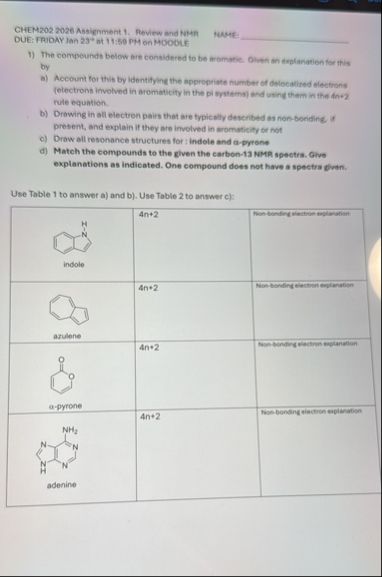 A, io
fresno —
Dison Hi swat bom ver rig
»
BE ——
te ymin phot eerirover
nye
1) stm sr te tt tds nr
er eit robber
mentee
® Mra wes ee Sa en 9
leh tml pwleterprotaiy =
BT rime
— —ee—
Cc
= i —fe———
Tanz =
y
0
i
| ee! |
A, io
fresno —
Dison Hi swat bom ver rig
»
BE ——
te ymin phot eerirover
nye
1) stm sr te tt tds nr
er eit robber
mentee
® Mra wes ee Sa en 9
leh tml pwleterprotaiy =
BT rime
— —ee—
Cc
= i —fe———
Tanz =
y
0
i
| ee! |
This is AI generated Response.
Asked by: Rahul
Created at: 2026-01-24 03:41:51
Asked by: Rahul
Created at: 2026-01-24 03:41:51
Final Answer:
Rendered
Raw Text
Did you like this answer?
Let's break down the steps and fill in the table as requested:
---
# Step-by-Step Solution
## a) **Account for Aromaticity with the 4n+2 Rule**
The compounds are aromatic if they follow Hückel's rule: they must have a planar, cyclic, conjugated π-system with **(4n+2) π electrons** (where n = , 1, 2, ...).
---
## b) **Identify Delocalized Electrons & Non-bonding Pairs**
Let's analyze each compound:
---
### **1. Indole**
- **Structure:** Bicyclic, with a benzene ring fused to a five-membered nitrogen-containing ring.
- **π Electrons:**
- Benzene ring: 6 π electrons.
- Five-membered ring: Double bond (2 π electrons) + lone pair on N can be delocalized (2 electrons).
- Total: 6 (benzene) + 2 (double bond) + 2 (N lone pair) = **10 π electrons**.
- **(4n+2) Rule:** 10 = 4(2) + 2; n = 2.
- **Non-bonding Electrons:** The lone pair on nitrogen is **involved** in aromaticity (delocalized).
---
### **2. Azulene**
- **Structure:** Fused 5- and 7-membered rings with alternating double bonds.
- **π Electrons:** 10 π electrons (from 5 double bonds).
- **(4n+2) Rule:** 10 = 4(2) + 2; n = 2.
- **Non-bonding Electrons:** No lone pairs directly involved in aromaticity.
---
### **3. α-Pyrone**
- **Structure:** Six-membered ring with an oxygen atom and three double bonds.
- **π Electrons:**
- 3 double bonds = 6 π electrons.
- Oxygen has two lone pairs; only **one lone pair** can be delocalized in the aromatic system (the other remains as a non-bonding lone pair).
- Total: 6 + 2 = **8 π electrons** if both lone pairs, but only one participates, so **6 π electrons**.
- **(4n+2) Rule:** 6 = 4(1) + 2; n = 1.
- **Non-bonding Electrons:** One lone pair on oxygen is **not involved** in aromaticity (remains non-bonding).
---
### **4. Adenine**
- **Structure:** Purine base, two fused rings with nitrogens.
- **π Electrons:**
- Counted as: 3 double bonds (6 π), plus 2 from lone pair on one N, plus 2 from another N = **10 π electrons**.
- **(4n+2) Rule:** 10 = 4(2) + 2; n = 2.
- **Non-bonding Electrons:** Some lone pairs on nitrogens are **not involved** in aromaticity.
---
## c) **Table Filled In**
| Compound | 4n+2 | Non-bonding electron explanation |
|------------|------|-------------------------------------------------|
| **indole** | 4n+2 | The lone pair on the five-membered ring N is delocalized and involved in aromaticity. |
| **azulene** | 4n+2 | No lone pairs are involved; all π electrons are from double bonds. |
| **α-pyrone** | 4n+2 | Only one lone pair on O is delocalized; the other lone pair remains non-bonding. |
| **adenine** | 4n+2 | Lone pairs on some N atoms are not involved in aromaticity and remain non-bonding. |
---
## **Final Answers**
### **Non-bonding electron explanations:**
- **Indole:** Lone pair on N is involved in aromaticity.
- **Azulene:** No lone pairs involved; all π electrons from double bonds.
- **α-Pyrone:** One of O's lone pairs is involved in aromaticity, the other is non-bonding.
- **Adenine:** Some N atom lone pairs are non-bonding.
---
### **Summary Table**
| Compound | 4n+2 | Non-bonding electron explanation |
|------------|------|-------------------------------------------------|
| Indole | Yes | Lone pair on N involved in aromaticity |
| Azulene | Yes | No lone pairs involved; only double bonds |
| α-Pyrone | Yes | One lone pair on O is non-bonding |
| Adenine | Yes | Some N lone pairs are non-bonding |
---
Let me know if you need the resonance structures or the NMR matching steps as well!
📢 Instructions:
- Ask anything relatd to above question only.
- For new Question goto :