 VIPSolutions
Give step-by-step solution with explanation and final answer:ger ® wu A sO; © I hy Cp ~ CHy LEA / Per, yr a @ =H | The compound's four rings, |, II, Il, and IV, are all fully conjugated polyenes 1. Analyze each ring and answer the following questions for each. : 1. How many electrons are in the conjugated system? 2. Use Huckel's rule. State whether the ring is aromatic or not. Show all work. IL lllustrate the Frost Circle method to determine whether ring lil is aromatic of
Question:
Give step-by-step solution with explanation and final answer: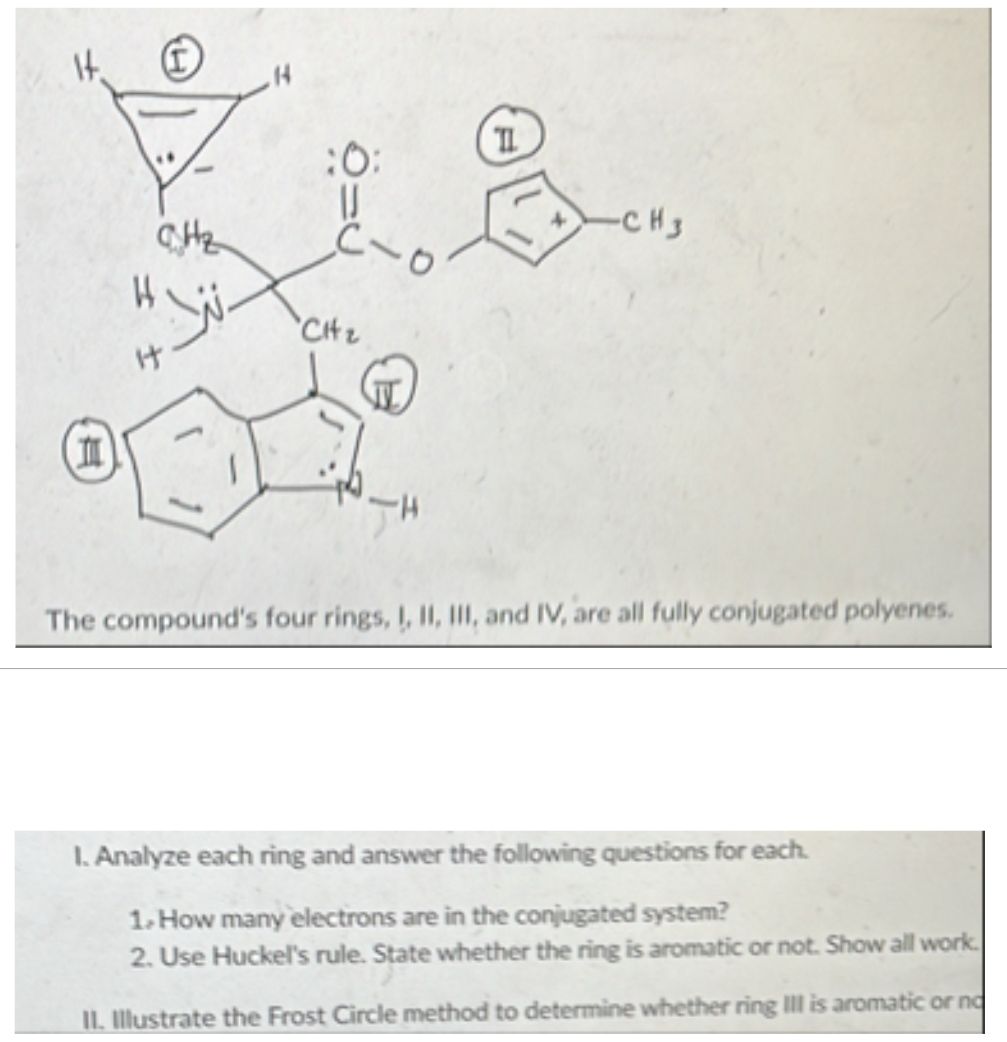 ger ® wu
A sO; ©
I hy
Cp ~ CHy
LEA /
Per, yr
a @
=H |
The compound's four rings, |, II, Il, and IV, are all fully conjugated polyenes
1. Analyze each ring and answer the following questions for each. :
1. How many electrons are in the conjugated system?
2. Use Huckel's rule. State whether the ring is aromatic or not. Show all work.
IL lllustrate the Frost Circle method to determine whether ring lil is aromatic of
ger ® wu
A sO; ©
I hy
Cp ~ CHy
LEA /
Per, yr
a @
=H |
The compound's four rings, |, II, Il, and IV, are all fully conjugated polyenes
1. Analyze each ring and answer the following questions for each. :
1. How many electrons are in the conjugated system?
2. Use Huckel's rule. State whether the ring is aromatic or not. Show all work.
IL lllustrate the Frost Circle method to determine whether ring lil is aromatic of
This is AI generated Response.
Asked by: Rahul
Created at: 2026-01-24 04:55:48
Asked by: Rahul
Created at: 2026-01-24 04:55:48
Final Answer:
Rendered
Raw Text
Did you like this answer?
Let's break down the analysis for each ring step by step.
---
# **I. Analyze Each Ring**
## **Ring I**
### 1. **Number of π Electrons**
- Ring I is a cyclopropyl anion. The lone pair on the carbon can be counted as 2 π electrons.
- No double bonds present, just the lone pair.
**Total π electrons = 2**
### 2. **Aromaticity (Hückel’s Rule)**
- Hückel’s rule: Aromatic if \(4n+2\) π electrons, where \(n\) is a non-negative integer.
- \(4n+2 = 2 \implies n = \) → Aromatic.
**Ring I is aromatic.**
---
## **Ring II**
### 1. **Number of π Electrons**
- Benzene ring with one methyl substituent.
- Each double bond has 2 π electrons, and there are 3 double bonds.
**Total π electrons = 6**
### 2. **Aromaticity (Hückel’s Rule)**
- \(4n+2 = 6 \implies n = 1\) → Aromatic.
**Ring II is aromatic.**
---
## **Ring III**
### 1. **Number of π Electrons**
- Five-membered ring, likely a cyclopentadienyl-type structure.
- Analyze the bonds: 2 double bonds (4 π electrons) and a lone pair on the nitrogen (counts as 2 π electrons if it is in the plane and conjugated).
**Total π electrons = 6**
### 2. **Aromaticity (Hückel’s Rule)**
- \(4n+2 = 6 \implies n = 1\) → Aromatic.
**Ring III is aromatic.**
---
## **Ring IV**
### 1. **Number of π Electrons**
- Cyclopentene-like ring.
- 2 double bonds (4 π electrons).
**Total π electrons = 4**
### 2. **Aromaticity (Hückel’s Rule)**
- \(4n+2 = 4 \implies n = .5\) → Not aromatic.
**Ring IV is NOT aromatic.**
---
# **Summary Table**
| Ring | π Electrons | Aromatic (Hückel’s Rule)? |
|------|-------------|---------------------------|
| I | 2 | Yes |
| II | 6 | Yes |
| III | 6 | Yes |
| IV | 4 | No |
---
# **II. Frost Circle for Ring III**
The Frost Circle method is a mnemonic for drawing the molecular orbital diagram of cyclic conjugated systems:
- Draw a circle.
- Inscribe the polygon (pentagon for 5-membered ring) with one vertex pointing down.
- Each vertex represents a molecular orbital.
- Fill the π electrons (6 for Ring III) from the bottom up.
For a 5-membered ring (like cyclopentadienyl anion or pyrrole-type systems):
- There are 5 molecular orbitals.
- The 6 π electrons fill the three lowest energy levels (fully paired), indicating aromatic stability.
**Conclusion:**
**Ring III is aromatic according to the Frost Circle because all bonding MOs are filled.**
---
## **Final Answers**
1. **Ring I:** 2 π electrons, aromatic
2. **Ring II:** 6 π electrons, aromatic
3. **Ring III:** 6 π electrons, aromatic (confirmed by Frost Circle)
4. **Ring IV:** 4 π electrons, not aromatic
---
## **Extra: Examples of Work**
**Hückel’s Rule Calculation:**
- \(4n+2 = \text{number of π electrons}\)
- Solve for \(n\): if integer, *aromatic*; if not, *not aromatic*.
**Frost Circle for Ring III:**
- Draw a pentagon in a circle, vertex pointing down.
- Fill 6 electrons, lowest three orbitals filled.
---
Let me know if you want to see the Frost Circle diagram for Ring III!
📢 Instructions:
- Ask anything relatd to above question only.
- For new Question goto :