Give step-by-step solution with explanation and final answer:3. Spherical dewar for storing liquid oxygen
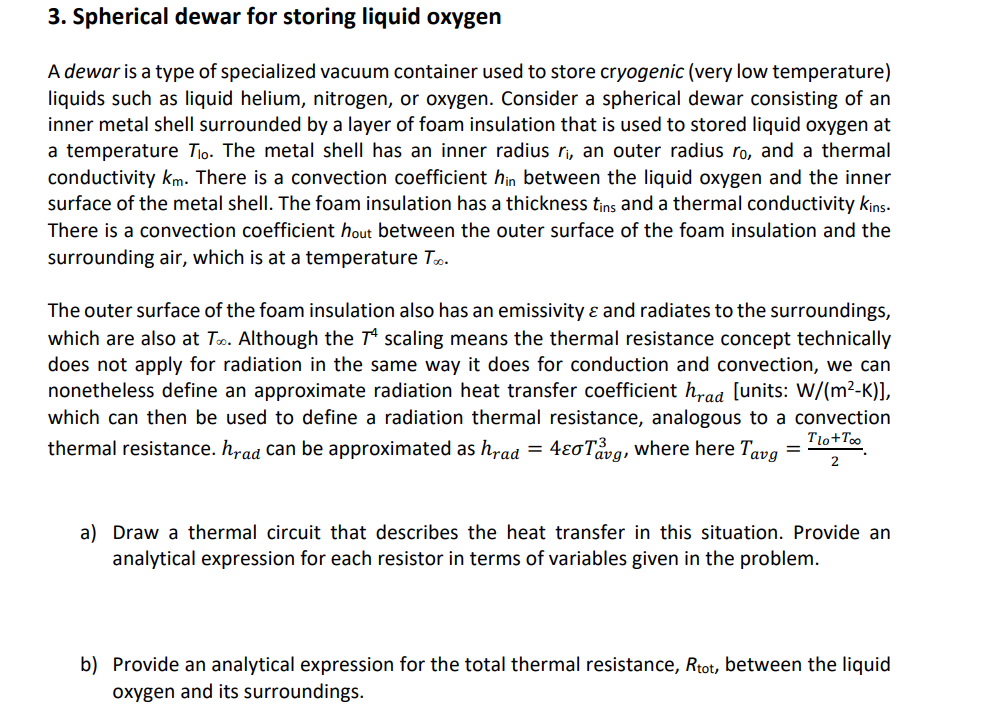
Adewar is a type of specialized vacuum container used to store cryogenic (very low temperature)
liquids such as liquid helium, nitrogen, or oxygen. Consider a spherical dewar consisting of an
inner metal shell surrounded by a layer of foam insulation that is used to stored liquid oxygen at
a temperature Tio. The metal shell has an inner radius ri, an outer radius ro, and a thermal
conductivity km. There is a convection coefficient hin between the liquid oxygen and the inner
surface of the metal shell. The foam insulation has a thickness tins and a thermal conductivity Kins.
There is a convection coefficient hou between the outer surface of the foam insulation and the
surrounding air, which is at a temperature T...
The outer surface of the foam insulation also has an emissivity € and radiates to the surroundings,
which are also at T.. Although the T* scaling means the thermal resistance concept technically
does not apply for radiation in the same way it does for conduction and convection, we can
nonetheless define an approximate radiation heat transfer coefficient h,,4 [units: W/(m?-K)],
which can then be used to define a radiation thermal resistance, analogous to a convection
thermal resistance. hq can be approximated as hyqq = 4£0T3,q, where here Ty,y = Tote
a) Draw a thermal circuit that describes the heat transfer in this situation. Provide an
analytical expression for each resistor in terms of variables given in the problem.
b) Provide an analytical expression for the total thermal resistance, Rit, between the liquid
oxygen and its surroundings.
Question:
Give step-by-step solution with explanation and final answer:3. Spherical dewar for storing liquid oxygen
Adewar is a type of specialized vacuum container used to store cryogenic (very low temperature)
liquids such as liquid helium, nitrogen, or oxygen. Consider a spherical dewar consisting of an
inner metal shell surrounded by a layer of foam insulation that is used to stored liquid oxygen at
a temperature Tio. The metal shell has an inner radius ri, an outer radius ro, and a thermal
conductivity km. There is a convection coefficient hin between the liquid oxygen and the inner
surface of the metal shell. The foam insulation has a thickness tins and a thermal conductivity Kins.
There is a convection coefficient hou between the outer surface of the foam insulation and the
surrounding air, which is at a temperature T...
The outer surface of the foam insulation also has an emissivity € and radiates to the surroundings,
which are also at T.. Although the T* scaling means the thermal resistance concept technically
does not apply for radiation in the same way it does for conduction and convection, we can
nonetheless define an approximate radiation heat transfer coefficient h,,4 [units: W/(m?-K)],
which can then be used to define a radiation thermal resistance, analogous to a convection
thermal resistance. hq can be approximated as hyqq = 4£0T3,q, where here Ty,y = Tote
a) Draw a thermal circuit that describes the heat transfer in this situation. Provide an
analytical expression for each resistor in terms of variables given in the problem.
b) Provide an analytical expression for the total thermal resistance, Rit, between the liquid
oxygen and its surroundings.
This is AI generated Response.
Asked by: Rahul
Created at: 2026-01-25 03:05:31
Final Answer:
RenderedRaw Text
Did you like this answer?
# 3. Spherical Dewar for Storing Liquid Oxygen — Solution
## (a) Thermal Circuit and Analytical Expressions
### **Thermal Circuit Description**
The heat transfer from the liquid oxygen to the surroundings occurs through several steps, each corresponding to a thermal resistance:
1. **Convection from liquid oxygen to inner shell:**
Resistance: \( R_{\text{conv,in}} \)
2. **Conduction through metal shell:**
Resistance: \( R_{\text{cond,metal}} \)
3. **Conduction through foam insulation:**
Resistance: \( R_{\text{cond,ins}} \)
4. **Convection from foam to air:**
Resistance: \( R_{\text{conv,out}} \)
5. **Radiation from foam to air:**
Resistance: \( R_{\text{rad}} \)
**Thermal circuit:**
All resistances are in series, except convection and radiation at the outer surface, which are in parallel.
#### **Thermal Circuit Diagram (Text Description):**
```
T_lo ----[R_conv,in]----[R_cond,metal]----[R_cond,ins]----*----> T_inf
|
[R_conv,out]
|
[R_rad]
```
*At the outer surface, \( R_{\text{conv,out}} \) and \( R_{\text{rad}} \) are in parallel.*
---
### **Analytical Expressions**
Let:
- \( r_i \): inner radius of metal shell
- \( r_ \): outer radius of metal shell (also inner radius of insulation)
- \( r_1 \): outer radius of insulation
- \( k_m \): thermal conductivity of metal
- \( k_{ins} \): thermal conductivity of insulation
- \( h_{in} \): convective coefficient (liquid oxygen to inner shell)
- \( h_{out} \): convective coefficient (foam to air)
- \( h_{rad} \): radiation heat transfer coefficient (foam to air)
- \( T_{lo} \): temperature of liquid oxygen
- \( T_{\infty} \): temperature of surroundings
#### 1. **Convection (liquid to inner shell):**
\[
R_{\text{conv,in}} = \frac{1}{4\pi r_i^2 h_{in}}
\]
#### 2. **Conduction (metal shell, spherical):**
\[
R_{\text{cond,metal}} = \frac{1}{4\pi k_m} \cdot \frac{r_ - r_i}{r_i r_}
\]
Or, more generally (for spherical shells):
\[
R_{\text{cond,metal}} = \frac{1}{4\pi k_m} \left( \frac{1}{r_i} - \frac{1}{r_} \right)
\]
#### 3. **Conduction (foam insulation, spherical):**
\[
R_{\text{cond,ins}} = \frac{1}{4\pi k_{ins}} \left( \frac{1}{r_} - \frac{1}{r_1} \right)
\]
#### 4. **Convection (foam to air):**
\[
R_{\text{conv,out}} = \frac{1}{4\pi r_1^2 h_{out}}
\]
#### 5. **Radiation (foam to air):**
\[
R_{\text{rad}} = \frac{1}{4\pi r_1^2 h_{rad}}
\]
where \( h_{rad} = 4\epsilon \sigma T_{avg}^3 \), and \( T_{avg} = \frac{T_{lo} + T_{\infty}}{2} \).
---
## (b) **Total Thermal Resistance \( R_{tot} \):**
At the outer surface, convection and radiation are in parallel, so their *combined resistance* is:
\[
\frac{1}{R_{\text{surf}}} = \frac{1}{R_{\text{conv,out}}} + \frac{1}{R_{\text{rad}}}
\]
\[
R_{\text{surf}} = \left( \frac{1}{R_{\text{conv,out}}} + \frac{1}{R_{\text{rad}}} \right)^{-1}
\]
### **Total resistance is then:**
\[
R_{tot} = R_{\text{conv,in}} + R_{\text{cond,metal}} + R_{\text{cond,ins}} + R_{\text{surf}}
\]
---
### **Summary of the Analytical Expression**
\[
\boxed{
R_{tot} = \frac{1}{4\pi r_i^2 h_{in}}
+ \frac{1}{4\pi k_m} \left( \frac{1}{r_i} - \frac{1}{r_} \right)
+ \frac{1}{4\pi k_{ins}} \left( \frac{1}{r_} - \frac{1}{r_1} \right)
+ \left[ \frac{1}{4\pi r_1^2 h_{out}} + \frac{1}{4\pi r_1^2 h_{rad}} \right]^{-1}
}
\]
where
- \( h_{rad} = 4 \epsilon \sigma T_{avg}^3 \)
- \( T_{avg} = \frac{T_{lo} + T_{\infty}}{2} \)
---
## **Summary Table**
| Resistance Type | Expression |
|------------------------|-----------------------------------------------------------------------------|
| **Convection (in)** | \( R_{\text{conv,in}} = \frac{1}{4\pi r_i^2 h_{in}} \) |
| **Conduction (metal)** | \( R_{\text{cond,metal}} = \frac{1}{4\pi k_m}\left(\frac{1}{r_i} - \frac{1}{r_}\right) \) |
| **Conduction (ins)** | \( R_{\text{cond,ins}} = \frac{1}{4\pi k_{ins}}\left(\frac{1}{r_} - \frac{1}{r_1}\right) \) |
| **Convection (out)** | \( R_{\text{conv,out}} = \frac{1}{4\pi r_1^2 h_{out}} \) |
| **Radiation** | \( R_{\text{rad}} = \frac{1}{4\pi r_1^2 h_{rad}} \) |
---
**This completes the step-by-step solution.**
Question:
Then solved
This is AI generated Response.
Asked by: Rahul
Created at: 2026-01-25 03:06:09
Final Answer:
RenderedRaw Text
Did you like this answer?
# 3. Spherical Dewar for Storing Liquid Oxygen — Solution
## (a) Thermal Circuit and Analytical Expressions
### **Thermal Circuit Description**
The heat transfer from the liquid oxygen to the surroundings occurs through several steps, each corresponding to a thermal resistance:
1. **Convection from liquid oxygen to inner shell:**
Resistance: \( R_{\text{conv,in}} \)
2. **Conduction through metal shell:**
Resistance: \( R_{\text{cond,metal}} \)
3. **Conduction through foam insulation:**
Resistance: \( R_{\text{cond,ins}} \)
4. **Convection from foam to air:**
Resistance: \( R_{\text{conv,out}} \)
5. **Radiation from foam to air:**
Resistance: \( R_{\text{rad}} \)
**Thermal circuit:**
All resistances are in series, except convection and radiation at the outer surface, which are in parallel.
#### **Thermal Circuit Diagram (Text Description):**
```
T_lo ----[R_conv,in]----[R_cond,metal]----[R_cond,ins]----*----> T_inf
|
[R_conv,out]
|
[R_rad]
```
*At the outer surface, \( R_{\text{conv,out}} \) and \( R_{\text{rad}} \) are in parallel.*
---
### **Analytical Expressions**
Let:
- \( r_i \): inner radius of metal shell
- \( r_o \): outer radius of metal shell (also inner radius of insulation)
- \( r_1 \): outer radius of insulation
- \( k_m \): thermal conductivity of metal
- \( k_{ins} \): thermal conductivity of insulation
- \( h_{in} \): convective coefficient (liquid oxygen to inner shell)
- \( h_{out} \): convective coefficient (foam to air)
- \( h_{rad} \): radiation heat transfer coefficient (foam to air)
- \( T_{lo} \): temperature of liquid oxygen
- \( T_{\infty} \): temperature of surroundings
#### 1. **Convection (liquid to inner shell):**
\[
R_{\text{conv,in}} = \frac{1}{4\pi r_i^2 h_{in}}
\]
#### 2. **Conduction (metal shell, spherical):**
\[
R_{\text{cond,metal}} = \frac{1}{4\pi k_m} \left( \frac{1}{r_i} - \frac{1}{r_o} \right)
\]
#### 3. **Conduction (foam insulation, spherical):**
\[
R_{\text{cond,ins}} = \frac{1}{4\pi k_{ins}} \left( \frac{1}{r_o} - \frac{1}{r_1} \right)
\]
#### 4. **Convection (foam to air):**
\[
R_{\text{conv,out}} = \frac{1}{4\pi r_1^2 h_{out}}
\]
#### 5. **Radiation (foam to air):**
\[
R_{\text{rad}} = \frac{1}{4\pi r_1^2 h_{rad}}
\]
where \( h_{rad} = 4\epsilon \sigma T_{avg}^3 \), and \( T_{avg} = \frac{T_{lo} + T_{\infty}}{2} \).
---
## (b) **Total Thermal Resistance \( R_{tot} \)**
At the outer surface, convection and radiation are in parallel, so their *combined resistance* is:
\[
\frac{1}{R_{\text{surf}}} = \frac{1}{R_{\text{conv,out}}} + \frac{1}{R_{\text{rad}}}
\]
\[
R_{\text{surf}} = \left( \frac{1}{R_{\text{conv,out}}} + \frac{1}{R_{\text{rad}}} \right)^{-1}
\]
### **Total resistance is then:**
\[
R_{tot} = R_{\text{conv,in}} + R_{\text{cond,metal}} + R_{\text{cond,ins}} + R_{\text{surf}}
\]
---
### **Summary of the Analytical Expression**
\[
\boxed{
R_{tot} = \frac{1}{4\pi r_i^2 h_{in}}
+ \frac{1}{4\pi k_m} \left( \frac{1}{r_i} - \frac{1}{r_o} \right)
+ \frac{1}{4\pi k_{ins}} \left( \frac{1}{r_o} - \frac{1}{r_1} \right)
+ \left[ \frac{1}{4\pi r_1^2 h_{out}} + \frac{1}{4\pi r_1^2 h_{rad}} \right]^{-1}
}
\]
where
- \( h_{rad} = 4 \epsilon \sigma T_{avg}^3 \)
- \( T_{avg} = \frac{T_{lo} + T_{\infty}}{2} \)
---
## **Summary Table**
| Resistance Type | Expression |
|------------------------|-----------------------------------------------------------------------------|
| **Convection (in)** | \( R_{\text{conv,in}} = \frac{1}{4\pi r_i^2 h_{in}} \) |
| **Conduction (metal)** | \( R_{\text{cond,metal}} = \frac{1}{4\pi k_m}\left(\frac{1}{r_i} - \frac{1}{r_o}\right) \) |
| **Conduction (ins)** | \( R_{\text{cond,ins}} = \frac{1}{4\pi k_{ins}}\left(\frac{1}{r_o} - \frac{1}{r_1}\right) \) |
| **Convection (out)** | \( R_{\text{conv,out}} = \frac{1}{4\pi r_1^2 h_{out}} \) |
| **Radiation** | \( R_{\text{rad}} = \frac{1}{4\pi r_1^2 h_{rad}} \) |
---
**This completes the step-by-step solution.**
VIPSolutions focuses on clear, step‑by‑step explanations so you can learn quickly. Whether you need an AI‑generated walkthrough or a short hint to get unstuck, each solution is organized for fast reading and easy review later.
Search similar questions, compare approaches, and bookmark the best answers for revision. Our goal is simple: quick, reliable study help that feels natural—not noisy.
 VIPSolutions
 3. Spherical dewar for storing liquid oxygen
Adewar is a type of specialized vacuum container used to store cryogenic (very low temperature)
liquids such as liquid helium, nitrogen, or oxygen. Consider a spherical dewar consisting of an
inner metal shell surrounded by a layer of foam insulation that is used to stored liquid oxygen at
a temperature Tio. The metal shell has an inner radius ri, an outer radius ro, and a thermal
conductivity km. There is a convection coefficient hin between the liquid oxygen and the inner
surface of the metal shell. The foam insulation has a thickness tins and a thermal conductivity Kins.
There is a convection coefficient hou between the outer surface of the foam insulation and the
surrounding air, which is at a temperature T...
The outer surface of the foam insulation also has an emissivity € and radiates to the surroundings,
which are also at T.. Although the T* scaling means the thermal resistance concept technically
does not apply for radiation in the same way it does for conduction and convection, we can
nonetheless define an approximate radiation heat transfer coefficient h,,4 [units: W/(m?-K)],
which can then be used to define a radiation thermal resistance, analogous to a convection
thermal resistance. hq can be approximated as hyqq = 4£0T3,q, where here Ty,y = Tote
a) Draw a thermal circuit that describes the heat transfer in this situation. Provide an
analytical expression for each resistor in terms of variables given in the problem.
b) Provide an analytical expression for the total thermal resistance, Rit, between the liquid
oxygen and its surroundings.
3. Spherical dewar for storing liquid oxygen
Adewar is a type of specialized vacuum container used to store cryogenic (very low temperature)
liquids such as liquid helium, nitrogen, or oxygen. Consider a spherical dewar consisting of an
inner metal shell surrounded by a layer of foam insulation that is used to stored liquid oxygen at
a temperature Tio. The metal shell has an inner radius ri, an outer radius ro, and a thermal
conductivity km. There is a convection coefficient hin between the liquid oxygen and the inner
surface of the metal shell. The foam insulation has a thickness tins and a thermal conductivity Kins.
There is a convection coefficient hou between the outer surface of the foam insulation and the
surrounding air, which is at a temperature T...
The outer surface of the foam insulation also has an emissivity € and radiates to the surroundings,
which are also at T.. Although the T* scaling means the thermal resistance concept technically
does not apply for radiation in the same way it does for conduction and convection, we can
nonetheless define an approximate radiation heat transfer coefficient h,,4 [units: W/(m?-K)],
which can then be used to define a radiation thermal resistance, analogous to a convection
thermal resistance. hq can be approximated as hyqq = 4£0T3,q, where here Ty,y = Tote
a) Draw a thermal circuit that describes the heat transfer in this situation. Provide an
analytical expression for each resistor in terms of variables given in the problem.
b) Provide an analytical expression for the total thermal resistance, Rit, between the liquid
oxygen and its surroundings.