 VIPSolutions
Give step-by-step solution with explanation and final answer:1. Draw a molecular orbital diagram to represent sigma bonding in [CoF¢]*- complex. 2. Label the molecular orbital diagram and allocate the electrons. 3. Determine if the complex is low spin or high spin and calculate the CFSE. 4. Which metal orbitals are utilized in forming molecular orbitals? 5. How many molecular orbitals are utilized in forming molecular orbitals 6. How many molecular orbitals will results from the overlap of the LGO’s with the metal orbitals? Will any of the metal’s d orbitals remain non-bonding, if yes, which ones? 7. What type of orbitals (bonding, nonbonding, antibonding) are the ‘crystal field’ orbitals.
Question:
Give step-by-step solution with explanation and final answer: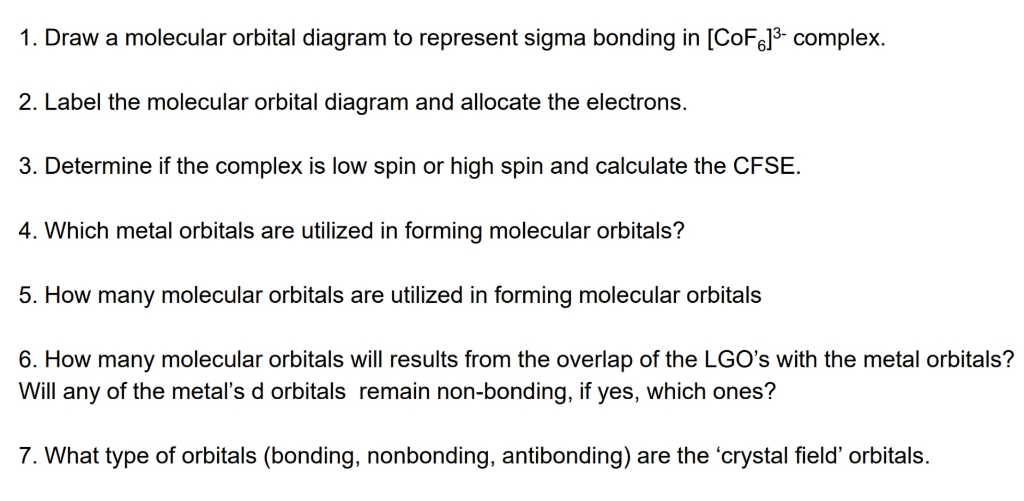 1. Draw a molecular orbital diagram to represent sigma bonding in [CoF¢]*- complex.
2. Label the molecular orbital diagram and allocate the electrons.
3. Determine if the complex is low spin or high spin and calculate the CFSE.
4. Which metal orbitals are utilized in forming molecular orbitals?
5. How many molecular orbitals are utilized in forming molecular orbitals
6. How many molecular orbitals will results from the overlap of the LGO’s with the metal orbitals?
Will any of the metal’s d orbitals remain non-bonding, if yes, which ones?
7. What type of orbitals (bonding, nonbonding, antibonding) are the ‘crystal field’ orbitals.
1. Draw a molecular orbital diagram to represent sigma bonding in [CoF¢]*- complex.
2. Label the molecular orbital diagram and allocate the electrons.
3. Determine if the complex is low spin or high spin and calculate the CFSE.
4. Which metal orbitals are utilized in forming molecular orbitals?
5. How many molecular orbitals are utilized in forming molecular orbitals
6. How many molecular orbitals will results from the overlap of the LGO’s with the metal orbitals?
Will any of the metal’s d orbitals remain non-bonding, if yes, which ones?
7. What type of orbitals (bonding, nonbonding, antibonding) are the ‘crystal field’ orbitals.
This is AI generated Response.
Asked by: Alok Kumar
Created at: 2026-01-25 03:48:10
Asked by: Alok Kumar
Created at: 2026-01-25 03:48:10
Final Answer:
Rendered
Raw Text
Did you like this answer?
Let's address each part step-by-step for the **[CoF₆]³⁻** complex:
---
## 1. Molecular Orbital Diagram for Sigma Bonding in [CoF₆]³⁻
- **Central atom:** Co³⁺ (Cobalt in +3 state; d⁶ configuration)
- **Ligand:** F⁻ (Fluoride ion, weak field, σ-donor)
- **Geometry:** Octahedral
### Construction
- The 6 F⁻ ligands provide 6 pairs of electrons for bonding (σ-donation).
- The metal uses its 4s, 4p, and 3d orbitals for bonding.
- Only the \( t_{2g} \) and \( e_g \) symmetry-adapted combinations of d orbitals participate.
```
Ligand group orbitals (LGOs): σ1 σ2 σ3 σ4 σ5 σ6
Metal orbitals: 4s 4p_x 4p_y 4p_z 3d_x2-y2 3d_z2 3d_xy 3d_xz 3d_yz
MO formation (Octahedral, Oh symmetry):
- σ LGOs combine with 4s, 4p, and eg (d_x2-y2, d_z2) orbitals → σ bonding and antibonding MOs.
- t2g (d_xy, d_xz, d_yz) remain non-bonding (do not participate in sigma bonding).
```
### **Molecular Orbital Diagram** (Text Representation)
```
σ* (antibonding, eg*)
|
-----
| |
| | (eg*: from 4s, 4p, d_x2-y2, d_z2)
-----
|
t2g (non-bonding: d_xy, d_xz, d_yz)
|
-----
| |
| | (eg: from 4s, 4p, d_x2-y2, d_z2)
-----
|
σ (bonding)
```
---
## 2. Label and Allocate Electrons
- **Co³⁺:** 3d⁶ configuration (6 d electrons)
- **6 F⁻ ligands:** Each donates 2 electrons = 12 electrons (for σ bonding)
- **Total electrons in bonding MOs:** 12 (from ligands) + 6 (from Co³⁺ d electrons in t2g) = 18 electrons
Electrons fill:
- Lower σ bonding MOs (from LGOs, 4s, 4p, eg)
- t2g (non-bonding) filled next (6 electrons: all paired)
- eg* (antibonding) is empty (no electrons)
---
## 3. High Spin or Low Spin? Calculate CFSE
- F⁻ is a **weak field ligand** → **High Spin** complex
- 3d⁶ high spin: Electron configuration in t2g and eg* is:
- t2g: 4 electrons (↑↓ ↑ ↑)
- eg*: 2 electrons (↑ ↑)
But in octahedral field splitting:
- **t2g**: 3 orbitals, eg: 2 orbitals
- For high spin \( d^6 \): t2g⁴ eg²
**CFSE (Crystal Field Stabilization Energy):**
\[
CFSE = [(\text{No. e⁻ in t2g}) \times (-.4\Delta_o)] + [(\text{No. e⁻ in eg}) \times (.6\Delta_o)]
\]
For high spin d⁶: t2g⁴ eg²
\[
CFSE = (4 \times -.4\Delta_o) + (2 \times .6\Delta_o) = -1.6\Delta_o + 1.2\Delta_o = -.4\Delta_o
\]
---
## 4. Which Metal Orbitals Are Used in Forming MOs?
- **4s, 4p, and eg (d_x2-y2, d_z2) orbitals** of Co³⁺ form bonding and antibonding MOs with ligand orbitals.
---
## 5. How Many MOs Are Formed?
- **6 ligand orbitals** (one from each F⁻) combine with the metal 4s, 4p, and eg orbitals.
- This results in **6 molecular orbitals** (3 bonding, 3 antibonding).
---
## 6. Which Metal d Orbitals Remain Non-Bonding?
- **t2g (d_xy, d_xz, d_yz)** orbitals do **not** participate in sigma bonding (remain non-bonding).
---
## 7. Nature of ‘Crystal Field’ Orbitals
- **t2g:** Non-bonding (in crystal field theory, these are the 'crystal field' orbitals)
- **eg:** Antibonding (since they interact directly with ligand σ orbitals)
---
## **Summary Table**
| Question | Answer |
|----------|--------|
| 1 | See MO diagram above (sigma bonding, octahedral) |
| 2 | MOs labeled, electrons allocated as above (t2g⁴ eg² for high-spin d⁶) |
| 3 | High spin, CFSE = –.4Δ₀ |
| 4 | Metal 4s, 4p, d_x2-y2, d_z2 (eg) used in MOs |
| 5 | 6 MOs formed from 6 ligand orbitals |
| 6 | t2g (d_xy, d_xz, d_yz) remain non-bonding |
| 7 | t2g = non-bonding (crystal field), eg = antibonding |
---
### **Final Answers**
1. Draw an MO diagram: See above (octahedral, sigma-bonding, t2g non-bonding, eg bonding/antibonding).
2. Label and allocate: t2g⁴ eg² (high spin), electrons from Co³⁺ and F⁻.
3. High spin; CFSE = –.4Δ₀.
4. 4s, 4p, d_x2-y2, d_z2 (eg) orbitals used.
5. 6 molecular orbitals formed (from 6 ligand orbitals).
6. t2g (d_xy, d_xz, d_yz) remain non-bonding.
7. Crystal field orbitals are non-bonding (t2g); eg are antibonding.
---
**If you need a hand-drawn MO diagram, let me know!**
📢 Instructions:
- Ask anything relatd to above question only.
- For new Question goto :