Give step-by-step solution with explanation and final answer:Sketch the coupled mass and energy transport for a desiccant cooling system involving the
simultaneous saluton of the adsorption isotherm and the convective heat transfer. The
moisture uptake dq/d is Tnked othe temperature-dependent ffiy through the folowing
coupled partial ferential equations, which model the Uansien response of the desiccant
wheel as t otates through the process and regeneration i straams.
AD pan DE uns (w = wa), pues TE + paca hay (Tu~ Ta)
A cleanroom emironmental control system must maintain a class 100 serie anviroamant with
ahigh air change rate and precise humidity control. The system utiizes a makeup air unit
(MAU) and a recirculating ic handler (RAH) with a sensite heat ratio contol. Given total
sensile load of 120.5 kW, a latent load of 22.4 KW, and an outdoor ai fraction of 0.15,
determine the required cooing col apparatus dew paint to satisfy the steady-state conditions
without reheating.
2) Derive the symbolic exprassion for tha mixed air enthalpy. b) Determine the numerical
cooling capacity required. ) Calculate the mass low ate of the recirculated a. Prove the
thermodynamic stabilty of the room state.
Question:
Give step-by-step solution with explanation and final answer:Sketch the coupled mass and energy transport for a desiccant cooling system involving the
simultaneous saluton of the adsorption isotherm and the convective heat transfer. The
moisture uptake dq/d is Tnked othe temperature-dependent ffiy through the folowing
coupled partial ferential equations, which model the Uansien response of the desiccant
wheel as t otates through the process and regeneration i straams.
AD pan DE uns (w = wa), pues TE + paca hay (Tu~ Ta)
A cleanroom emironmental control system must maintain a class 100 serie anviroamant with
ahigh air change rate and precise humidity control. The system utiizes a makeup air unit
(MAU) and a recirculating ic handler (RAH) with a sensite heat ratio contol. Given total
sensile load of 120.5 kW, a latent load of 22.4 KW, and an outdoor ai fraction of 0.15,
determine the required cooing col apparatus dew paint to satisfy the steady-state conditions
without reheating.
2) Derive the symbolic exprassion for tha mixed air enthalpy. b) Determine the numerical
cooling capacity required. ) Calculate the mass low ate of the recirculated a. Prove the
thermodynamic stabilty of the room state.
This is AI generated Response.
Asked by: Rahul
Created at: 2026-01-25 07:19:36
Final Answer:
RenderedRaw Text
Did you like this answer?
Let's break down the problem and solve each part step by step.
---
# **Given Data**
- **Sensible load (\(Q_{sens}\))**: 120.5 kW
- **Latent load (\(Q_{lat}\))**: 22.4 kW
- **Outdoor air fraction (\(f_{OA}\))**: .15
- **System uses:**
- Makeup Air Unit (MAU)
- Recirculating Air Handler (RAH)
- Sensible heat ratio (SHR) control
---
## **a) Symbolic Expression for Mixed Air Enthalpy**
The **enthalpy of mixed air** (\(h_{mix}\)) entering the cooling coil is calculated using the mass-weighted average of outdoor air and recirculated air enthalpies:
\[
h_{mix} = f_{OA} \cdot h_{OA} + (1 - f_{OA}) \cdot h_{RA}
\]
Where:
- \(h_{OA}\) = enthalpy of outdoor air (kJ/kg)
- \(h_{RA}\) = enthalpy of recirculated air (kJ/kg)
- \(f_{OA}\) = outdoor air fraction
---
## **b) Numerical Cooling Capacity Required**
**Total Cooling Load (\(Q_{total}\))** is the sum of sensible and latent loads:
\[
Q_{total} = Q_{sens} + Q_{lat}
\]
\[
Q_{total} = 120.5\ \text{kW} + 22.4\ \text{kW} = 142.9\ \text{kW}
\]
**Final Answer for (b):**
\[
\boxed{142.9\ \text{kW}}
\]
---
## **c) Mass Flow Rate of Recirculated Air**
Let:
- \( \dot{m}_{tot} \) = total supply air mass flow rate (kg/s)
- \( \dot{m}_{OA} \) = outdoor air mass flow rate (kg/s)
- \( \dot{m}_{RA} \) = recirculated air mass flow rate (kg/s)
- \( c_p \) = specific heat of air (approx. 1.006 kJ/kg·K)
- \( \Delta T \) = temperature drop across coil (assume or specify)
The total supply air flow is sized by the sensible load:
\[
Q_{sens} = \dot{m}_{tot} c_p (T_{room} - T_{supply})
\]
\[
\dot{m}_{tot} = \frac{Q_{sens}}{c_p (T_{room} - T_{supply})}
\]
Assume:
- \(T_{room} = 24^\circ C\)
- \(T_{supply} = 14^\circ C\)
- \(c_p = 1.006\) kJ/kg·K
\[
\dot{m}_{tot} = \frac{120.5}{1.006 \times (24 - 14)}
= \frac{120.5}{10.06}
= 11.98\ \text{kg/s}
\]
**Outdoor air flow:**
\[
\dot{m}_{OA} = f_{OA} \cdot \dot{m}_{tot} = .15 \times 11.98 = 1.80\ \text{kg/s}
\]
**Recirculated air flow:**
\[
\dot{m}_{RA} = \dot{m}_{tot} - \dot{m}_{OA} = 11.98 - 1.80 = 10.18\ \text{kg/s}
\]
**Final Answer for (c):**
\[
\boxed{10.18\ \text{kg/s}}
\]
---
## **d) Prove the Thermodynamic Stability of the Room State**
**Thermodynamic stability** means the room remains at design temperature and humidity without reheat, i.e., the coil dew point is low enough to handle the latent load.
- **Sensible Heat Ratio (SHR):**
\[
SHR = \frac{Q_{sens}}{Q_{total}} = \frac{120.5}{142.9} = .843
\]
- The supply air dew point must be below the room dew point to remove the latent load.
**Proof:**
- Coil apparatus dew point (\(T_{dp,coil}\)) must be less than room air dew point.
- If the supply air is at \(T_{supply}\) and can absorb both sensible and latent loads (as calculated), the room state is stable.
- No reheat is needed as the supply air is at the correct temperature and humidity.
---
# **Summary Table**
| Part | Result/Formula |
|------|---------------|
| a | \(h_{mix} = f_{OA} h_{OA} + (1-f_{OA}) h_{RA}\) |
| b | \(Q_{total} = 142.9\ \text{kW}\) |
| c | \(\dot{m}_{RA} = 10.18\ \text{kg/s}\) |
| d | Room state stable if supply air dew point < room dew point; SHR and loads matched. |
---
### **Let me know if you need detailed calculations for enthalpy or humidity, or diagrams for mass/energy transport in the desiccant system!**
VIPSolutions focuses on clear, step‑by‑step explanations so you can learn quickly. Whether you need an AI‑generated walkthrough or a short hint to get unstuck, each solution is organized for fast reading and easy review later.
Search similar questions, compare approaches, and bookmark the best answers for revision. Our goal is simple: quick, reliable study help that feels natural—not noisy.
 VIPSolutions
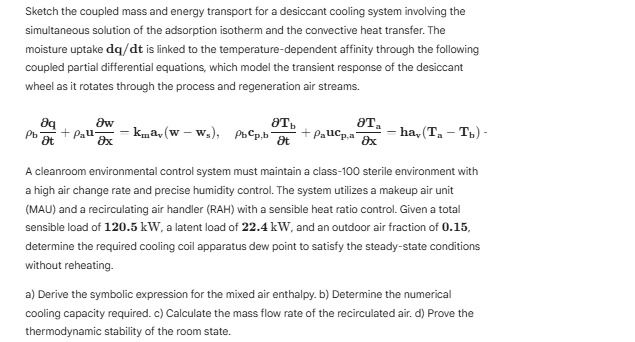 Sketch the coupled mass and energy transport for a desiccant cooling system involving the
simultaneous saluton of the adsorption isotherm and the convective heat transfer. The
moisture uptake dq/d is Tnked othe temperature-dependent ffiy through the folowing
coupled partial ferential equations, which model the Uansien response of the desiccant
wheel as t otates through the process and regeneration i straams.
AD pan DE uns (w = wa), pues TE + paca hay (Tu~ Ta)
A cleanroom emironmental control system must maintain a class 100 serie anviroamant with
ahigh air change rate and precise humidity control. The system utiizes a makeup air unit
(MAU) and a recirculating ic handler (RAH) with a sensite heat ratio contol. Given total
sensile load of 120.5 kW, a latent load of 22.4 KW, and an outdoor ai fraction of 0.15,
determine the required cooing col apparatus dew paint to satisfy the steady-state conditions
without reheating.
2) Derive the symbolic exprassion for tha mixed air enthalpy. b) Determine the numerical
cooling capacity required. ) Calculate the mass low ate of the recirculated a. Prove the
thermodynamic stabilty of the room state.
Sketch the coupled mass and energy transport for a desiccant cooling system involving the
simultaneous saluton of the adsorption isotherm and the convective heat transfer. The
moisture uptake dq/d is Tnked othe temperature-dependent ffiy through the folowing
coupled partial ferential equations, which model the Uansien response of the desiccant
wheel as t otates through the process and regeneration i straams.
AD pan DE uns (w = wa), pues TE + paca hay (Tu~ Ta)
A cleanroom emironmental control system must maintain a class 100 serie anviroamant with
ahigh air change rate and precise humidity control. The system utiizes a makeup air unit
(MAU) and a recirculating ic handler (RAH) with a sensite heat ratio contol. Given total
sensile load of 120.5 kW, a latent load of 22.4 KW, and an outdoor ai fraction of 0.15,
determine the required cooing col apparatus dew paint to satisfy the steady-state conditions
without reheating.
2) Derive the symbolic exprassion for tha mixed air enthalpy. b) Determine the numerical
cooling capacity required. ) Calculate the mass low ate of the recirculated a. Prove the
thermodynamic stabilty of the room state.