 VIPSolutions
Give step-by-step solution with explanation and final answer:\cids and bases J E om mo lecule below, and select the statements that apply. If it can Tose Hl draw its co and non-zero formal charges. r Ts HE AS + " Eo N Te fr H, 4 a oo E This molecule will not lose an H' O This molecule will not gain an H' ! fhis molecule could lose an H'. Its, This molecule could gain an H". Its bs ~ conjugate base is: * conjugate acid is: 3 = - gE __- =e ,: > | . | | pe | 4 = | 4 E | SP Rl li i Click and drag Click and drag pr BR cart | to start drawing a drawing a ? structure. structure. 5 Te 3 al RE wl wr a ea |
Question:
Give step-by-step solution with explanation and final answer: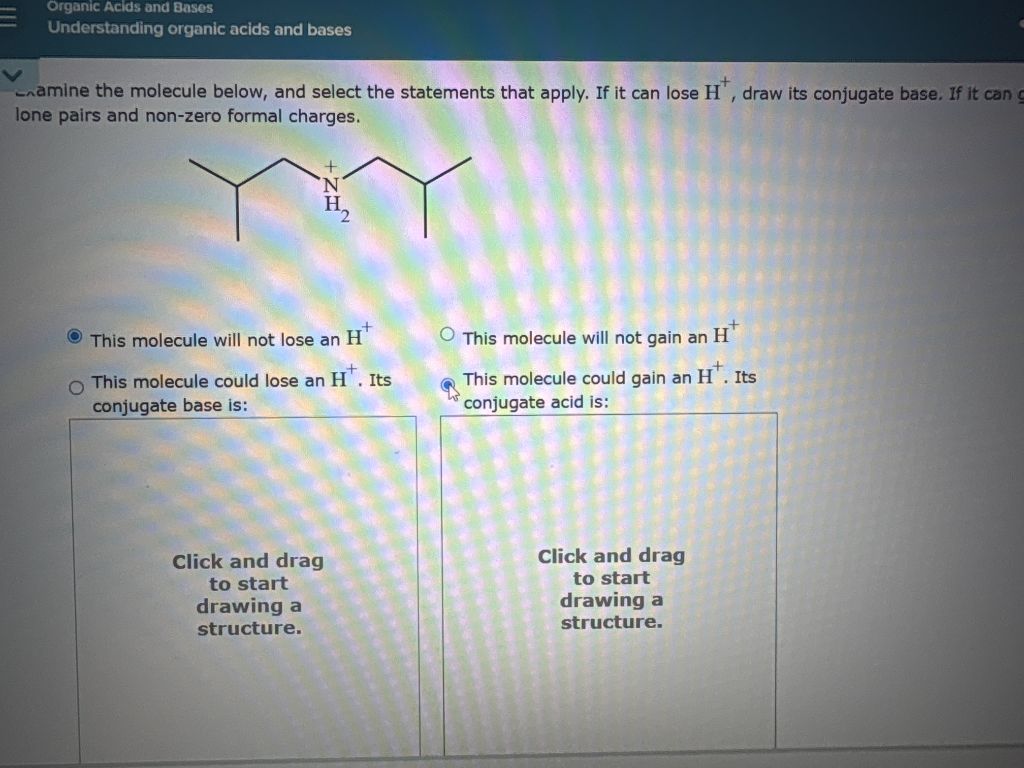 \cids and bases
J E om
mo lecule below, and select the statements that apply. If it can Tose Hl draw its co
and non-zero formal charges. r
Ts HE
AS + "
Eo N Te
fr H,
4 a
oo E
This molecule will not lose an H' O This molecule will not gain an H' !
fhis molecule could lose an H'. Its, This molecule could gain an H". Its bs
~ conjugate base is: * conjugate acid is: 3
= - gE __- =e
,: > |
. | |
pe | 4
= | 4
E | SP
Rl li i
Click and drag Click and drag pr
BR cart | to start
drawing a drawing a ?
structure. structure. 5
Te 3
al
RE wl wr a ea |
\cids and bases
J E om
mo lecule below, and select the statements that apply. If it can Tose Hl draw its co
and non-zero formal charges. r
Ts HE
AS + "
Eo N Te
fr H,
4 a
oo E
This molecule will not lose an H' O This molecule will not gain an H' !
fhis molecule could lose an H'. Its, This molecule could gain an H". Its bs
~ conjugate base is: * conjugate acid is: 3
= - gE __- =e
,: > |
. | |
pe | 4
= | 4
E | SP
Rl li i
Click and drag Click and drag pr
BR cart | to start
drawing a drawing a ?
structure. structure. 5
Te 3
al
RE wl wr a ea |
This is AI generated Response.
Asked by: Rahul
Created at: 2026-01-25 20:29:11
Asked by: Rahul
Created at: 2026-01-25 20:29:11
Final Answer:
Rendered
Raw Text
Did you like this answer?
Let's analyze the molecule step by step:
### 1. **Identify the Molecule**
The molecule is a **substituted amine** with the structure:
```
|
CH3-CH2-CH2-NH2+
|
CH3
```
- The nitrogen has a **positive charge** (NH₂⁺), which means it is already **protonated**.
- This means it is the **conjugate acid** form of an amine.
---
### 2. **Can the Molecule Lose H⁺?**
- If the molecule were to lose H⁺, it would form a neutral amine (by deprotonating the NH₂⁺ to NH).
- **Amines (R-NH₂)** are basic, and their conjugate acids (R-NH₃⁺) can lose a proton to become neutral.
- Here, the nitrogen already has three bonds and a positive charge (R-NH₂⁺), so losing a proton would give R-NH.
However, in this case, the nitrogen has a methyl substituent and two ethyl groups, so let's rewrite:
```
CH3-CH2-N⁺(CH3)-CH2-CH3
|
H2
```
But from the drawing, it seems to be a simple propylamine with a positive charge (so it's the conjugate acid).
---
### 3. **Can the Molecule Gain H⁺?**
- Since the nitrogen is already **protonated** (NH₂⁺), it cannot accept another proton. There is **no lone pair** left for another H⁺.
---
### 4. **Correct Answer**
- **This molecule will NOT gain an H⁺** (because it's already fully protonated).
- **This molecule COULD lose an H⁺** (because it is the conjugate acid form).
---
### 5. **Draw the Conjugate Base**
- Removing one H⁺ from the NH₂⁺ group gives you a neutral amine (NH).
#### **Original:**
```
CH3-CH2-CH2-NH2⁺
```
#### **Conjugate Base:**
```
CH3-CH2-CH2-NH
```
(The nitrogen loses a proton and becomes neutral.)
---
## **Final Answers**
**Select:**
- [ ] This molecule will not lose an H⁺
- [ ] This molecule will not gain an H⁺
- [x] This molecule could lose an H⁺. Its conjugate base is: (draw structure)
- [ ] This molecule could gain an H⁺. Its conjugate acid is: (draw structure)
**Conjugate Base Structure:**
```
CH3
|
CH3-CH2-NH
```
or, more simply, draw the original molecule, but change NH₂⁺ to NH.
---
### **Summary Table**
| Action | Structure after action |
|--------------------------------------|-----------------------------|
| Lose H⁺ (conjugate base) | CH3-CH2-CH2-NH |
| Gain H⁺ (conjugate acid) | **Not possible** |
---
**Explanation:**
The molecule shown is the conjugate acid of an amine (the nitrogen is already protonated and has a positive charge). It can lose a proton (H⁺) to become a neutral amine, but it cannot gain another proton since there is no lone pair left on nitrogen.
📢 Instructions:
- Ask anything relatd to above question only.
- For new Question goto :