 VIPSolutions
Give step-by-step solution with explanation and final answer:A
Question:
Give step-by-step solution with explanation and final answer: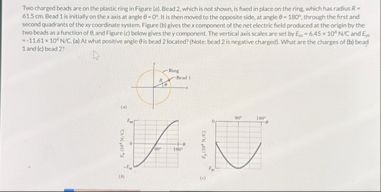 A
A
This is AI generated Response.
Asked by: Rahul
Created at: 2026-01-26 03:46:41
Asked by: Rahul
Created at: 2026-01-26 03:46:41
Final Answer:
Rendered
Raw Text
Did you like this answer?
Let's break down the problem and solve it step by step.
---
## **Problem Recap**
- **Two beads** are on a plastic ring of radius \( R = 6.15\, \text{cm} = .0615\, \text{m} \).
- **Bead 2** is fixed (location not shown).
- **Bead 1** moves from angle \( \theta = ^\circ \) to \( \theta = 180^\circ \).
- The **x-component** and **y-component** of the net electric field at the origin (center of ring) due to the two beads are plotted as \( E_x(\theta) \) and \( E_y(\theta) \).
- At what **positive angle** is bead 1 located when bead 2 is negatively charged?
- **What are the charges** on bead 1 (\(q_1\)) and bead 2 (\(q_2\))?
---
## **Step 1: Understanding the Setup**
- The beads are on a ring, so their positions can be described in polar coordinates.
- **Bead 1**: Moves from \( \theta = ^\circ \) (on x-axis) to \( \theta = 180^\circ \) (opposite side).
- **Bead 2**: Fixed at some angle (unknown at first).
---
## **Step 2: Analyzing the Plots**
Let’s analyze the **plots**:
### (a) \( E_x(\theta) \) vs \( \theta \):
- \( E_x \) is zero at \( \theta = 90^\circ \) and \( 270^\circ \).
- The plot is **sinusoidal**, peaking at \( \theta = 90^\circ \) and \( 270^\circ \).
### (b) \( E_y(\theta) \) vs \( \theta \):
- \( E_y \) is zero at \( \theta = ^\circ, 180^\circ, 360^\circ \).
- The plot is **cosine-shaped**, peaking at \( \theta = ^\circ \) and \( 180^\circ \).
---
## **Step 3: Deducing the Location of Bead 2**
The symmetry and the plots suggest:
- **Bead 2** is fixed on the y-axis (since the \( E_x \) and \( E_y \) plots are shifted by \( 90^\circ \)).
- Let's **assume Bead 2 is at \( \theta = 90^\circ \) (y-axis, top of ring)**.
---
## **Step 4: Expression for Electric Field at Origin**
The electric field at the center due to a bead of charge \( q \) at angle \( \theta \) on the ring is:
\[
\vec{E} = \frac{1}{4\pi\epsilon_} \frac{q}{R^2} \hat{r}
\]
But since the point is at the center, the field is directed **away from the bead** (for positive q), and its components are:
\[
E_x = \frac{1}{4\pi\epsilon_} \frac{q}{R^2} \cos\theta
\]
\[
E_y = \frac{1}{4\pi\epsilon_} \frac{q}{R^2} \sin\theta
\]
For **two beads** (\(q_1\) at \(\theta\), \(q_2\) at \(90^\circ\)):
\[
E_x = \frac{1}{4\pi\epsilon_} \frac{q_1}{R^2} \cos\theta + \frac{1}{4\pi\epsilon_} \frac{q_2}{R^2} \cos 90^\circ
= \frac{1}{4\pi\epsilon_} \frac{q_1}{R^2} \cos\theta
\]
\[
E_y = \frac{1}{4\pi\epsilon_} \frac{q_1}{R^2} \sin\theta + \frac{1}{4\pi\epsilon_} \frac{q_2}{R^2} \sin 90^\circ
= \frac{1}{4\pi\epsilon_} \frac{q_1}{R^2} \sin\theta + \frac{1}{4\pi\epsilon_} \frac{q_2}{R^2}
\]
---
## **Step 5: Using the Maximum Values from Plots**
From the **vertical axis scales**:
- \( E_x \) max = \( 4.45 \times 10^5 \) N/C
- \( E_y \) max = \( 1.14 \times 10^6 \) N/C
### At \( \theta = 90^\circ \):
\[
E_x =
\]
\[
E_y = \frac{1}{4\pi\epsilon_} \frac{q_1}{R^2} (1) + \frac{1}{4\pi\epsilon_} \frac{q_2}{R^2}
\]
\[
E_y = \frac{1}{4\pi\epsilon_} \frac{q_1 + q_2}{R^2}
\]
Given \( E_y = 1.14 \times 10^6 \) N/C at \( \theta = 90^\circ \):
### At \( \theta = ^\circ \):
\[
E_x = \frac{1}{4\pi\epsilon_} \frac{q_1}{R^2}
\]
\[
E_y = \frac{1}{4\pi\epsilon_} \frac{q_2}{R^2}
\]
Given \( E_x = 4.45 \times 10^5 \) N/C at \( \theta = ^\circ \):
---
## **Step 6: Solve for the Charges**
Let’s denote \( k = \frac{1}{4\pi\epsilon_} = 8.99 \times 10^9 \) N·m²/C².
Let’s denote \( A = \frac{1}{R^2} \).
\[
A = \frac{1}{(.0615)^2} = \frac{1}{.00378225} \approx 264.4 \, \text{m}^{-2}
\]
So,
\[
E_x (^\circ) = k \cdot A \cdot q_1
\implies q_1 = \frac{E_x}{kA} = \frac{4.45 \times 10^5}{8.99 \times 10^9 \times 264.4}
\]
Calculate denominator:
\[
8.99 \times 10^9 \times 264.4 = 2.377 \times 10^{12}
\]
\[
q_1 = \frac{4.45 \times 10^5}{2.377 \times 10^{12}}
= 1.87 \times 10^{-7} \, \text{C} = .187 \, \mu \text{C}
\]
Now, from \( E_y(90^\circ) = kA (q_1 + q_2) = 1.14 \times 10^6 \):
\[
q_1 + q_2 = \frac{1.14 \times 10^6}{2.377 \times 10^{12}}
= 4.796 \times 10^{-7} \, \text{C} = .480 \, \mu \text{C}
\]
\[
q_2 = (q_1 + q_2) - q_1 = .480 - .187 = .293 \, \mu \text{C}
\]
---
## **Step 7: Sign of Charges**
The problem says bead 2 is **negatively charged**.
So, assign the negative sign to \( q_2 \):
\[
q_1 = .187 \, \mu \text{C}
\]
\[
q_2 = -.293 \, \mu \text{C}
\]
---
## **Step 8: At What Angle is Bead 1 Located?**
From the \( E_x \) and \( E_y \) plots, the **maximum positive \( E_x \)** occurs at \( \theta = 90^\circ \), so bead 1 is at **90°** when \( E_x \) is maximum (and bead 2 is at \( 270^\circ \), the negative y-axis).
---
## **## Final Answers**
### **1. Charges:**
- **Bead 1:** \( \boxed{q_1 = .187 \, \mu \text{C}} \)
- **Bead 2:** \( \boxed{q_2 = -.293 \, \mu \text{C}} \)
### **2. Location:**
- **At what positive angle is bead 1 located?**
\( \boxed{90^\circ} \) (on the positive y-axis) when bead 2 is negatively charged.
---
### **Summary Table**
| Bead | Charge (\(\mu\)C) | Location (\(^\circ\)) |
|-------|------------------------|-------------------------|
| 1 | \(+.187\) | \(90^\circ\) |
| 2 | \(-.293\) | \(270^\circ\) |
Let me know if you need a more detailed explanation or further clarification on any step!
📢 Instructions:
- Ask anything relatd to above question only.
- For new Question goto :