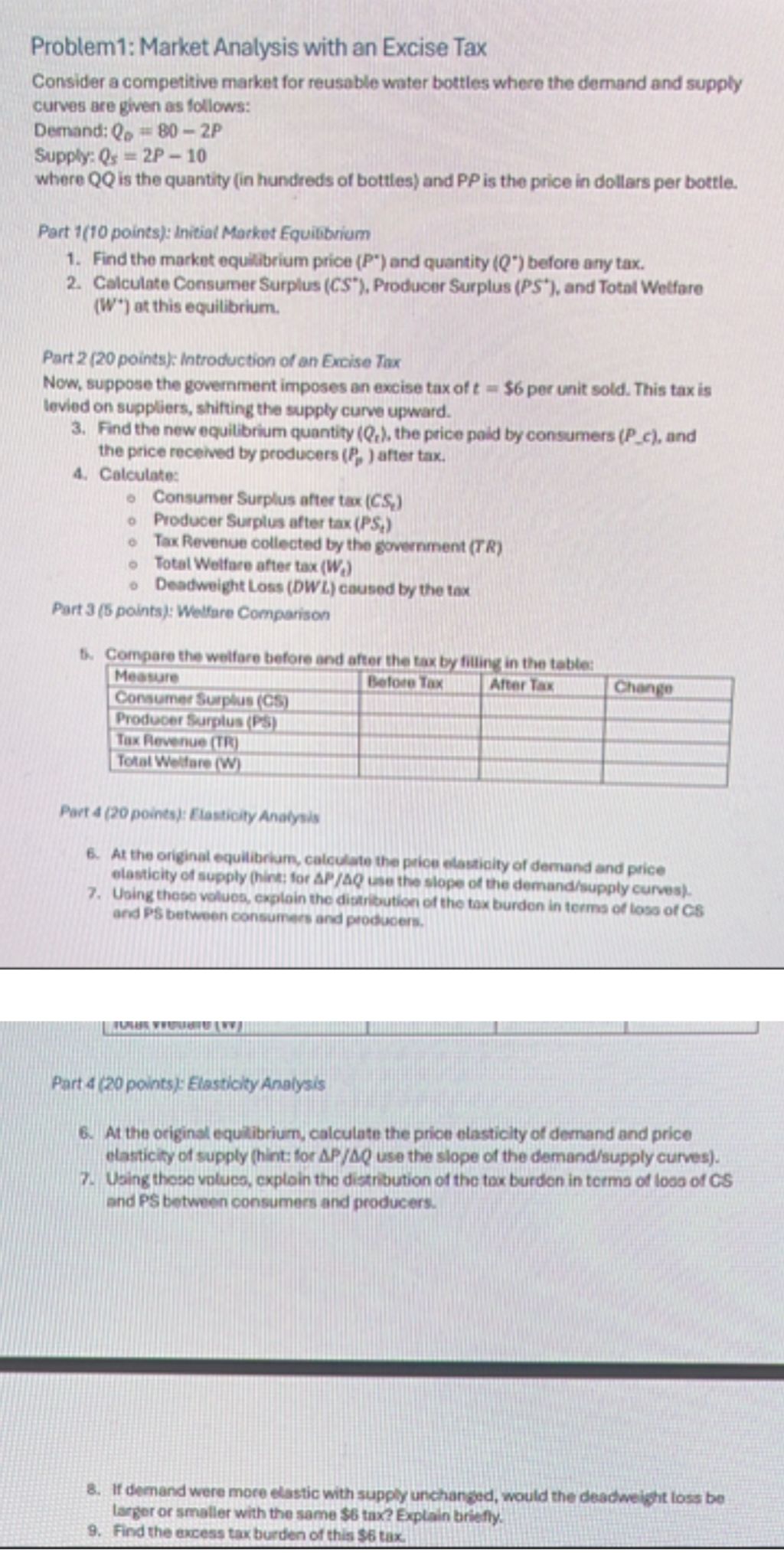
Give step-by-step solution with explanation and final answer:Problem: Market Analysis with an Excise Tax
Consider a competitive market for reusable water bottles where the demand and supply
curves ee given as follows:
Demand: Qp += 80 ~ 2P
Supply: Qs = 2P = 10
whore QQ is the quantity (in hundreds of bottles) and PP is the price in dollars per bottle.
Part 1(10 points): Initial Market Equilibrium
1. Find the market equilibrium price (P*) and quantity (Q*) before any tax.
2. Calculate Consumer Surplus (CS*), Producer Surplus (PS*), and Total Welfare
(W*) at this equilibrium.
Part 2 (20 points): Introduction of an Excise Tax
Now, suppose the government imposes an excise tax of t = $6 per unit sold. This tax is
loviod on suppliers, shifting the supply curve upward.
3 Find the new equilibrium quantity (Q,), the price pad by consumers (P_c), and
the price received by producers (F), ) after tax.
4. Coleulate:
° Consumer Surplus after tax (CS)
o Producer Surplus after tax (PS,)
° Tax Revenue collected by the government (TR)
© Total Welfare after tax (W,)
© Deadweight Loss (DWL) caused by the tax
Part 3 (5 points): Weltare Comparison
Compare the welfare before snd after the tax by filling in the table:
Measure nn) BtO00 Ya Altar Tax
Conaumar Surphis (C8) Eb ETI FD
poovos Swplie (0) || TRI TT i
YoxRovenve (TR) ALELISISIILIGN SNE .
LL MRMBHETEENE [01 ELTO 0 RIT I
Pact 4 (20 points): Elasticity Analysis
[8 Al the original equilibrium, calculate the prios elasticity of demand snd price
fiamiclty of supply (hint: Sor AP/AQ sw the slope of the demand/supply curves).
7. Lali thoos vouoa, explain the distribution of the tax burdon in forms of loss of 5
0d PS betweon consurmees and producers.
J A 1 0 EF AS
Part 4 (20 points): Elasticity Analysis
6. A the original equilibrium, calculate the price elasticity of demand and price
elasticity of supply (hint: for AP/AQ use the slope of the demand/supply curves).
| Uding theo volues, explain the distribution of the tax burdon in terms of loss of CS
and PS between consumers and producers.
TPP TS ———————r
a If deenand were more elastic with supply unchanged, would the deadweight (oss bo
larger or smaller with the same $6 tax? Explain briefly.
9. Find the excess tax burden of this $6 tax. s
Question:
Give step-by-step solution with explanation and final answer:
This is AI generated Response. Asked by: Rahul Created at: 2026-01-26 06:30:46
Did you like this answer?
👍 0
👎 0
Let's solve the problem step-by-step, as requested.
---
# **Problem 1: Market Analysis with an Excise Tax**
### **Given:**
- **Demand:** \( Q_D = 80 - 2P \)
- **Supply:** \( Q_S = 2P - 10 \)
- \( Q \) is in hundreds of bottles, \( P \) is in dollars per bottle.
---
## **Part 1: Initial Market Equilibrium**
### **1. Find Equilibrium Price (\( P^* \)) and Quantity (\( Q^* \))**
Set \( Q_D = Q_S \):
\[
80 - 2P = 2P - 10
\]
\[
80 + 10 = 2P + 2P
\]
\[
90 = 4P
\]
\[
P^* = 22.5
\]
Plug \( P^* \) into either curve to get \( Q^* \):
\[
Q^* = 80 - 2(22.5) = 80 - 45 = 35
\]
(So, **\( Q^* = 35 \) hundreds = 350 bottles**)
---
### **2. Calculate Consumer Surplus (CS), Producer Surplus (PS), and Total Welfare (W)**
#### **Find intercepts:**
- **Demand:** \( Q_D = \implies 80 - 2P = \implies P = 40 \)
- **Supply:** \( Q_S = \implies 2P - 10 = \implies P = 5 \)
#### **Formulas:**
- **CS:** Area above \( P^* \) and below demand curve
\[
CS = \frac{1}{2} (Q^*) (P_{max} - P^*)
\]
- **PS:** Area below \( P^* \) and above supply curve
\[
PS = \frac{1}{2} (Q^*) (P^* - P_{min})
\]
- **Total Welfare:** \( W = CS + PS \)
#### **Calculations:**
- **CS:**
\[
CS = \frac{1}{2} \times 35 \times (40 - 22.5) = \frac{1}{2} \times 35 \times 17.5 = 306.25
\]
- **PS:**
\[
PS = \frac{1}{2} \times 35 \times (22.5 - 5) = \frac{1}{2} \times 35 \times 17.5 = 306.25
\]
- **Total Welfare:**
\[
W = 306.25 + 306.25 = 612.5
\]
---
## **Part 2: Introduction of an Excise Tax (\( t = \$6 \))**
The new supply curve shifts up by $6:
\[
Q_S = 2(P - 6) - 10 = 2P - 12 - 10 = 2P - 22
\]
Set new supply equal to demand for equilibrium:
\[
80 - 2P = 2P - 22
\]
\[
80 + 22 = 2P + 2P
\]
\[
102 = 4P \implies P_c = 25.5
\]
- **Price received by producers:** \( P_p = P_c - 6 = 25.5 - 6 = 19.5 \)
- **Quantity after tax:** \( Q_t = 80 - 2 \times 25.5 = 80 - 51 = 29 \)
---
### **4. Calculate After-Tax Values**
- **Consumer Surplus after tax (\( CS_2 \)):**
\[
CS_2 = \frac{1}{2} \times 29 \times (40 - 25.5) = \frac{1}{2} \times 29 \times 14.5 = 210.25
\]
- **Producer Surplus after tax (\( PS_2 \)):**
\[
PS_2 = \frac{1}{2} \times 29 \times (19.5 - 5) = \frac{1}{2} \times 29 \times 14.5 = 210.25
\]
- **Tax Revenue (\( TR \)):**
\[
TR = t \times Q_t = 6 \times 29 = 174
\]
- **Total Welfare after tax (\( W_2 \)):**
\[
W_2 = CS_2 + PS_2 + TR = 210.25 + 210.25 + 174 = 594.5
\]
- **Deadweight Loss (\( DWL \)):**
\[
DWL = W - W_2 = 612.5 - 594.5 = 18
\]
---
## **Part 3: Welfare Comparison Table**
| Measure | Before Tax | After Tax | Change |
|-------------------|------------|-----------|----------|
| Consumer Surplus | 306.25 | 210.25 | -96 |
| Producer Surplus | 306.25 | 210.25 | -96 |
| Tax Revenue | | 174 | +174 |
| Total Welfare | 612.5 | 594.5 | -18 |
---
## **Part 4: Elasticity Analysis**
### **6. Price Elasticity at Equilibrium**
Recall:
- \( Q^* = 35 \), \( P^* = 22.5 \)
- Demand curve slope = \(-2\); Supply curve slope = \(2\)
#### **Elasticity of Demand:**
\[
E_d = \frac{dQ}{dP} \cdot \frac{P^*}{Q^*} = (-2) \cdot \frac{22.5}{35} = -1.29
\]
#### **Elasticity of Supply:**
\[
E_s = \frac{dQ}{dP} \cdot \frac{P^*}{Q^*} = 2 \cdot \frac{22.5}{35} = 1.29
\]
---
### **7. Tax Burden Distribution**
- Both elasticities are equal in magnitude.
- Thus, the tax burden (loss in CS and PS) is **shared equally** between consumers and producers.
---
### **8. Effect of More Elastic Demand**
- **If demand is more elastic:** Deadweight loss **increases** because the reduction in quantity traded is larger for a given tax.
---
### **9. Excess Tax Burden (DWL)**
\[
\boxed{DWL = 18}
\]
---
## **Summary Table**
| Measure | Before Tax | After Tax | Change |
|-------------------|------------|-----------|----------|
| Consumer Surplus | 306.25 | 210.25 | -96 |
| Producer Surplus | 306.25 | 210.25 | -96 |
| Tax Revenue | | 174 | +174 |
| Total Welfare | 612.5 | 594.5 | -18 |
| Deadweight Loss | | 18 | +18 |
---
## **Final Answers**
- **Equilibrium price and quantity (before tax):** \( P^* = \$22.5 \), \( Q^* = 35 \) (hundreds)
- **Equilibrium after tax:** \( Q_t = 29 \), \( P_c = \$25.5 \), \( P_p = \$19.5 \)
- **Consumer Surplus before/after:** 306.25 / 210.25
- **Producer Surplus before/after:** 306.25 / 210.25
- **Tax Revenue:** 174
- **Total Welfare before/after:** 612.5 / 594.5
- **Deadweight Loss:** 18
Let me know if you need the graph or any particular step explained in more detail!
📢 Instructions:
Ask anything relatd to above question only.
For new Question goto :
🚀 Submit (-0.25 Credits🪙)
Study Help, Fast Answers
VIPSolutions focuses on clear, step‑by‑step explanations so you can learn quickly. Whether you need an AI‑generated walkthrough or a short hint to get unstuck, each solution is organized for fast reading and easy review later.
Search similar questions, compare approaches, and bookmark the best answers for revision. Our goal is simple: quick, reliable study help that feels natural—not noisy.
 VIPSolutions
 Problem: Market Analysis with an Excise Tax
Consider a competitive market for reusable water bottles where the demand and supply
curves ee given as follows:
Demand: Qp += 80 ~ 2P
Supply: Qs = 2P = 10
whore QQ is the quantity (in hundreds of bottles) and PP is the price in dollars per bottle.
Part 1(10 points): Initial Market Equilibrium
1. Find the market equilibrium price (P*) and quantity (Q*) before any tax.
2. Calculate Consumer Surplus (CS*), Producer Surplus (PS*), and Total Welfare
(W*) at this equilibrium.
Part 2 (20 points): Introduction of an Excise Tax
Now, suppose the government imposes an excise tax of t = $6 per unit sold. This tax is
loviod on suppliers, shifting the supply curve upward.
3 Find the new equilibrium quantity (Q,), the price pad by consumers (P_c), and
the price received by producers (F), ) after tax.
4. Coleulate:
° Consumer Surplus after tax (CS)
o Producer Surplus after tax (PS,)
° Tax Revenue collected by the government (TR)
© Total Welfare after tax (W,)
© Deadweight Loss (DWL) caused by the tax
Part 3 (5 points): Weltare Comparison
Compare the welfare before snd after the tax by filling in the table:
Measure nn) BtO00 Ya Altar Tax
Conaumar Surphis (C8) Eb ETI FD
poovos Swplie (0) || TRI TT i
YoxRovenve (TR) ALELISISIILIGN SNE .
LL MRMBHETEENE [01 ELTO 0 RIT I
Pact 4 (20 points): Elasticity Analysis
[8 Al the original equilibrium, calculate the prios elasticity of demand snd price
fiamiclty of supply (hint: Sor AP/AQ sw the slope of the demand/supply curves).
7. Lali thoos vouoa, explain the distribution of the tax burdon in forms of loss of 5
0d PS betweon consurmees and producers.
J A 1 0 EF AS
Part 4 (20 points): Elasticity Analysis
6. A the original equilibrium, calculate the price elasticity of demand and price
elasticity of supply (hint: for AP/AQ use the slope of the demand/supply curves).
| Uding theo volues, explain the distribution of the tax burdon in terms of loss of CS
and PS between consumers and producers.
TPP TS ———————r
a If deenand were more elastic with supply unchanged, would the deadweight (oss bo
larger or smaller with the same $6 tax? Explain briefly.
9. Find the excess tax burden of this $6 tax. s
Problem: Market Analysis with an Excise Tax
Consider a competitive market for reusable water bottles where the demand and supply
curves ee given as follows:
Demand: Qp += 80 ~ 2P
Supply: Qs = 2P = 10
whore QQ is the quantity (in hundreds of bottles) and PP is the price in dollars per bottle.
Part 1(10 points): Initial Market Equilibrium
1. Find the market equilibrium price (P*) and quantity (Q*) before any tax.
2. Calculate Consumer Surplus (CS*), Producer Surplus (PS*), and Total Welfare
(W*) at this equilibrium.
Part 2 (20 points): Introduction of an Excise Tax
Now, suppose the government imposes an excise tax of t = $6 per unit sold. This tax is
loviod on suppliers, shifting the supply curve upward.
3 Find the new equilibrium quantity (Q,), the price pad by consumers (P_c), and
the price received by producers (F), ) after tax.
4. Coleulate:
° Consumer Surplus after tax (CS)
o Producer Surplus after tax (PS,)
° Tax Revenue collected by the government (TR)
© Total Welfare after tax (W,)
© Deadweight Loss (DWL) caused by the tax
Part 3 (5 points): Weltare Comparison
Compare the welfare before snd after the tax by filling in the table:
Measure nn) BtO00 Ya Altar Tax
Conaumar Surphis (C8) Eb ETI FD
poovos Swplie (0) || TRI TT i
YoxRovenve (TR) ALELISISIILIGN SNE .
LL MRMBHETEENE [01 ELTO 0 RIT I
Pact 4 (20 points): Elasticity Analysis
[8 Al the original equilibrium, calculate the prios elasticity of demand snd price
fiamiclty of supply (hint: Sor AP/AQ sw the slope of the demand/supply curves).
7. Lali thoos vouoa, explain the distribution of the tax burdon in forms of loss of 5
0d PS betweon consurmees and producers.
J A 1 0 EF AS
Part 4 (20 points): Elasticity Analysis
6. A the original equilibrium, calculate the price elasticity of demand and price
elasticity of supply (hint: for AP/AQ use the slope of the demand/supply curves).
| Uding theo volues, explain the distribution of the tax burdon in terms of loss of CS
and PS between consumers and producers.
TPP TS ———————r
a If deenand were more elastic with supply unchanged, would the deadweight (oss bo
larger or smaller with the same $6 tax? Explain briefly.
9. Find the excess tax burden of this $6 tax. s