This is AI generated Response.
Asked by: Rahul
Created at: 2026-01-28 03:19:16
Final Answer:
RenderedRaw Text
Did you like this answer?
Let's go through both problems step by step:
---
## **Part 1: Compound A**
### **a. Condensed Structure**
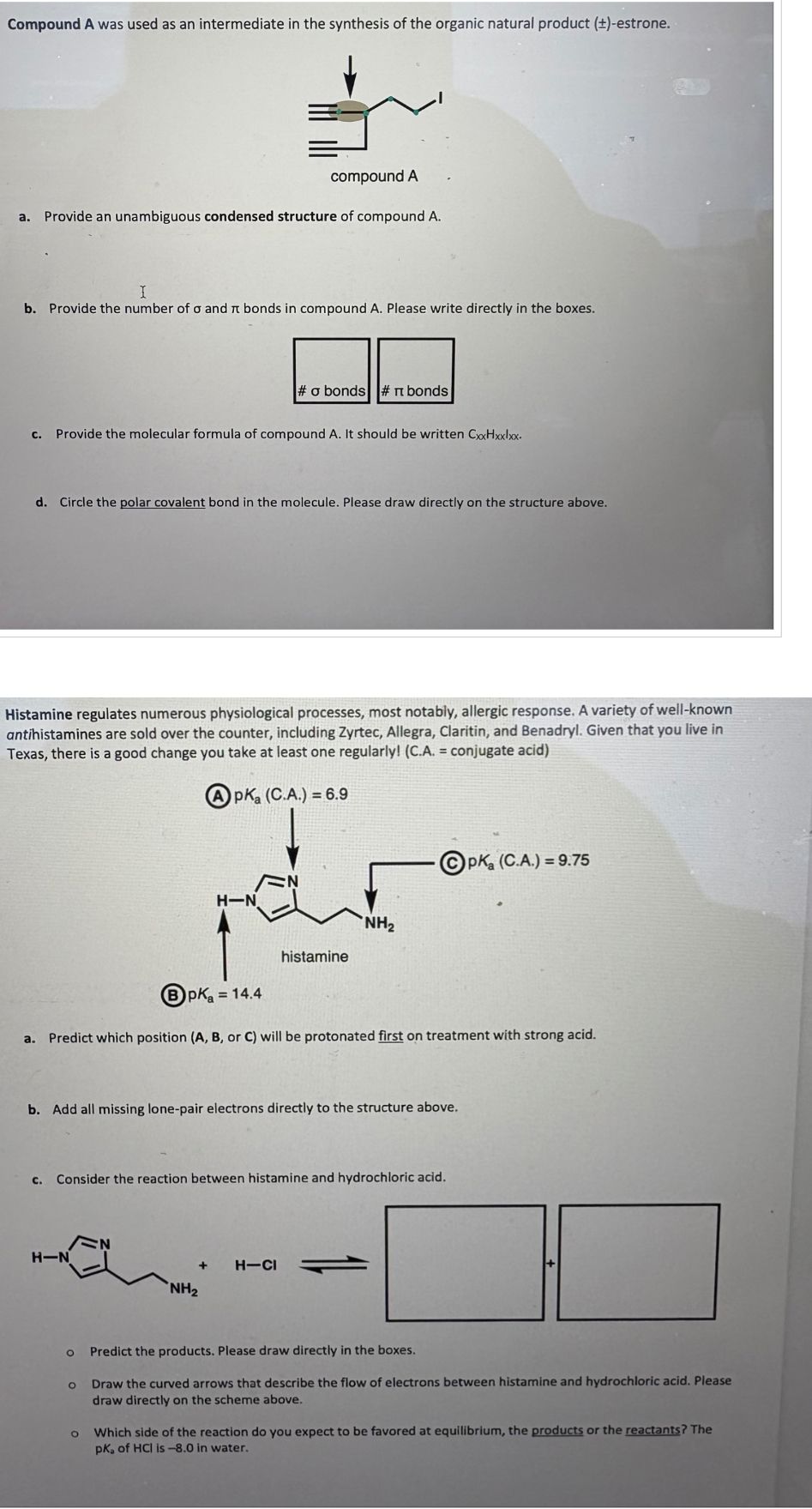
Let's interpret the structure of compound A:
- It contains a benzene ring (not shown, so not aromatic).
- The left side has two triple bonds (alkyne) in a row, attached to a carbon chain.
**Condensed structure:**
- The structure is: CH≡C–C≡C–CH₂–CH₂–CH₃
So, the condensed structure is:
**HC≡C–C≡C–CH₂CH₂CH₃**
---
### **b. Number of σ and π Bonds**
- **Each single bond** is 1 σ bond.
- **Each triple bond** is 1 σ + 2 π bonds.
- **Each double bond** is 1 σ + 1 π bond.
**Counting:**
- There are two triple bonds: each triple bond has 1 σ and 2 π (so 2×(1σ+2π) = 2σ + 4π)
- There are 3 single bonds between the remaining carbons (CH₂–CH₂–CH₃): 3 σ bonds
- Each terminal hydrogen bond: 3 hydrogens (on the propyl group) and 1 at the terminal alkyne = 4 more σ bonds
**Let's count bonds more carefully:**
- C1≡C2: triple → 1σ, 2π
- C2–C3: single → 1σ
- C3≡C4: triple → 1σ, 2π
- C4–C5: single → 1σ
- C5–C6: single → 1σ
- C6–C7: single → 1σ
- Hydrogens:
- C1: 1 H (terminal alkyne)
- C5: 2 H (CH₂)
- C6: 2 H (CH₂)
- C7: 3 H (CH₃)
- Total: 1+2+2+3 = 8 σ bonds
Now sum up:
- **σ bonds:** 1 (C1≡C2) + 1 (C2–C3) + 1 (C3≡C4) + 1 (C4–C5) + 1 (C5–C6) + 1 (C6–C7) = 6 σ (C–C)
+ 8 (C–H) = **14 σ bonds**
- **π bonds:** 2 (C1≡C2) + 2 (C3≡C4) = **4 π bonds**
---
### **c. Molecular Formula**
Let's count the atoms:
- Carbon: 7 (from the chain)
- Hydrogen: 8 (as counted above)
- Oxygen/Halogen: None
**Molecular formula:**
**C₇H₈**
---
### **d. Circle the Polar Covalent Bond**
A polar covalent bond is between atoms of significantly different electronegativities. In this molecule, all bonds are C–C or C–H, which are not significantly polar.
**But** if we assume the terminal alkyne hydrogen (C≡C–H), the C–H bond of terminal alkyne is slightly more polar due to the higher s-character of the carbon.
**Circle the C≡C–H bond** as the most polar covalent in this molecule.
---
## **Part 2: Histamine**
### **a. First Protonation Site**
Given pKa values:
- A (pKa = 6.9)
- B (pKa = 14.4)
- C (pKa = 9.75)
**Lower pKa = stronger base = more likely to be protonated.**
But since these are **conjugate acid pKa's**, the **lower pKa means the site is more basic (will be protonated first)**.
- **A (pKa 6.9) < C (9.75) < B (14.4)**
So: **Site A** will be protonated first.
---
### **b. Add Lone-Pair Electrons**
- The imidazole nitrogens (both) have lone pairs.
- The terminal NH₂ group has two lone pairs.
- Draw these directly on the structure as dots.
---
### **c. Reaction with HCl**
#### **Predict the Products**
- Histamine gets protonated at the most basic site (site A, the imidazole nitrogen).
- HCl donates a proton to histamine.
**Product 1:** Protonated histamine (with a + charge on the imidazole N at site A)
**Product 2:** Cl⁻
#### **Curved Arrows**
- Lone pair on imidazole nitrogen attacks the H of HCl.
- Bond between H-Cl breaks, electrons go to Cl.
#### **Favored Side at Equilibrium**
- Compare pKa's:
- Protonated histamine (site A): pKa = 6.9
- HCl: pKa = –8.
Equilibrium favors the **weaker acid** (higher pKa), so it will favor the **products** (protonated histamine and Cl⁻).
---
## **Summary Table**
| Part | Answer |
|---|---|
| 1a | Condensed: HC≡C–C≡C–CH₂CH₂CH₃ |
| 1b | 14 σ bonds, 4 π bonds |
| 1c | C₇H₈ |
| 1d | C≡C–H bond (circled) |
| 2a | Site A (pKa 6.9) |
| 2b | Lone pairs on both imidazole N's and both NH₂ N's |
| 2c | Products: protonated histamine at imidazole N, Cl⁻; Equilibrium favors products |
---
If you need the molecular structures drawn or further clarifications, let me know!
VIPSolutions focuses on clear, step‑by‑step explanations so you can learn quickly. Whether you need an AI‑generated walkthrough or a short hint to get unstuck, each solution is organized for fast reading and easy review later.
Search similar questions, compare approaches, and bookmark the best answers for revision. Our goal is simple: quick, reliable study help that feels natural—not noisy.
 VIPSolutions
 Compound A was used as an intermediate in the synthesis of the organic natural product ()-estrone.
B-
Y ~ I =
compound A 4
a. Provide an unambiguous condensed structure of compound A. gr
o i pe
~ b. Provide the number of g and rt bonds in compound A. Please write directly in the boxes.
1 S 3
h 4
Provide the molecular formula of compound A. t should be written CaM,
Ee ghd
BE } Jas
To RP
\. Circle the polar covalent bond in the molecule. Please draw directly on
BEST Td nek
Histamine regulates numerous physiological processes, most notably, allergic response. A variety of well-known
antihistamines are sold over the counter, including Zyrtec, Allegra, Claritin, and Benadryl. Given that you live in
Texas, there is a good change you take at least one regularly! (C.A. = conjugate acid)
@®pKa (CA) =69
| ; ©pk: (CA)=9.75 To
/=N | =
FSI 2 - &
NH; ET
histamine : = =
Bg @®pka=144 a
f a. Predict which position (A, B, or C) will be protonated first on treatment with strong. acid. Le
a La
Ni er
b. Add all missing lone-pair electrons directly to the structure above. i is =
ARE Sie
€. Consider the reaction between histamine and hydrochloricacid.
L=NGE | H—Cl ———
Compound A was used as an intermediate in the synthesis of the organic natural product ()-estrone.
B-
Y ~ I =
compound A 4
a. Provide an unambiguous condensed structure of compound A. gr
o i pe
~ b. Provide the number of g and rt bonds in compound A. Please write directly in the boxes.
1 S 3
h 4
Provide the molecular formula of compound A. t should be written CaM,
Ee ghd
BE } Jas
To RP
\. Circle the polar covalent bond in the molecule. Please draw directly on
BEST Td nek
Histamine regulates numerous physiological processes, most notably, allergic response. A variety of well-known
antihistamines are sold over the counter, including Zyrtec, Allegra, Claritin, and Benadryl. Given that you live in
Texas, there is a good change you take at least one regularly! (C.A. = conjugate acid)
@®pKa (CA) =69
| ; ©pk: (CA)=9.75 To
/=N | =
FSI 2 - &
NH; ET
histamine : = =
Bg @®pka=144 a
f a. Predict which position (A, B, or C) will be protonated first on treatment with strong. acid. Le
a La
Ni er
b. Add all missing lone-pair electrons directly to the structure above. i is =
ARE Sie
€. Consider the reaction between histamine and hydrochloricacid.
L=NGE | H—Cl ———