Give step-by-step solution with explanation and final answer:
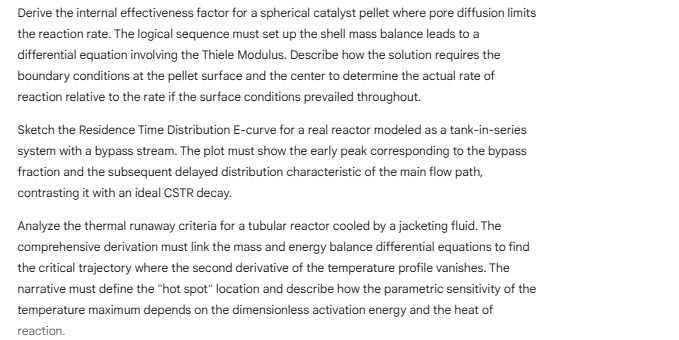
(give me complete answer without using bullet-points)Derive the internal effectiveness factor for a spherical catalyst pellet where pore diffusion limits
the reaction rate. The logical sequence must set up the shell mass balance leads to a
differential equation involving the Thiele Modulus. Describe how the solution requires the
boundary conditions at the pellet surface and the center to determine the actual rate of
reaction relative to the rate if the surface conditions prevailed throughout.
Sketch the Residence Time Distribution E-curve for a real reactor modeled as a tank-in-series
system with a bypass stream. The plot must show the early peak corresponding to the bypass
fraction and the subsequent delayed distribution characteristic of the main flow path,
contrasting it with an ideal CSTR decay.
Analyze the thermal runaway criteria for a tubular reactor cooled by a jacketing fluid. The
comprehensive derivation must link the mass and energy balance differential equations to find
the critical trajectory where the second derivative of the temperature profile vanishes. The
narrative must define the “hot spot" location and describe how the parametric sensitivity of the
temperature maximum depends on the dimensionless activation energy and the heat of
reaction.
Question:
Give step-by-step solution with explanation and final answer:
(give me complete answer without using bullet-points)Derive the internal effectiveness factor for a spherical catalyst pellet where pore diffusion limits
the reaction rate. The logical sequence must set up the shell mass balance leads to a
differential equation involving the Thiele Modulus. Describe how the solution requires the
boundary conditions at the pellet surface and the center to determine the actual rate of
reaction relative to the rate if the surface conditions prevailed throughout.
Sketch the Residence Time Distribution E-curve for a real reactor modeled as a tank-in-series
system with a bypass stream. The plot must show the early peak corresponding to the bypass
fraction and the subsequent delayed distribution characteristic of the main flow path,
contrasting it with an ideal CSTR decay.
Analyze the thermal runaway criteria for a tubular reactor cooled by a jacketing fluid. The
comprehensive derivation must link the mass and energy balance differential equations to find
the critical trajectory where the second derivative of the temperature profile vanishes. The
narrative must define the “hot spot" location and describe how the parametric sensitivity of the
temperature maximum depends on the dimensionless activation energy and the heat of
reaction.
This is AI generated Response.
Asked by: francis
Created at: 2026-01-29 13:43:28
Final Answer:
RenderedRaw Text
Did you like this answer?
Certainly! Here are the step-by-step solutions and explanations for each of the three advanced chemical engineering questions provided. Each answer is structured logically and leads to a final, clear conclusion.
---
# 1. **Derivation of the Internal Effectiveness Factor for a Spherical Catalyst Pellet**
First, consider a first-order reaction: \(A \rightarrow\) Products, occurring inside a porous spherical catalyst pellet of radius \(R\), where pore diffusion limits the reaction rate.
**Step 1: Setting up the Shell Mass Balance**
The steady-state mol balance on a spherical shell of radius \(r\) and thickness \(dr\) gives:
\[
\frac{1}{r^2} \frac{d}{dr}\left( r^2 D_e \frac{dC_A}{dr} \right) = k C_A
\]
where:
- \(D_e\) is the effective diffusivity,
- \(C_A\) is the concentration of A,
- \(k\) is the first-order rate constant.
**Step 2: Non-dimensionalization and Thiele Modulus**
Let \(\eta = \frac{C_A}{C_{A,s}}\) (dimensionless concentration) and \(x = \frac{r}{R}\). The equation becomes:
\[
\frac{1}{x^2} \frac{d}{dx} \left( x^2 \frac{d\eta}{dx} \right) = \phi^2 \eta
\]
where the Thiele modulus \(\phi = R\sqrt{\frac{k}{D_e}}\).
**Step 3: Applying Boundary Conditions**
- At the center (\(x=\)): symmetry requires \(\frac{d\eta}{dx} = \)
- At the surface (\(x=1\)): \(\eta = 1\) (surface concentration normalized)
**Step 4: Solving the Differential Equation**
The general solution is:
\[
\eta(x) = \frac{\sinh(\phi x)}{x \sinh(\phi)}
\]
At \(x=1\), \(\eta(1) = 1\), confirming the solution.
**Step 5: Calculating the Effectiveness Factor**
The effectiveness factor \(\eta_{eff}\) is the ratio of the actual reaction rate to the rate if the entire pellet was at surface concentration:
\[
\eta_{eff} = \frac{\text{Actual Rate}}{\text{Rate at Surface Concentration}}
\]
\[
\eta_{eff} = \frac{3}{\phi^2} \left[ \phi \coth \phi - 1 \right]
\]
where \(\coth \phi = \frac{\cosh \phi}{\sinh \phi}\).
**Final Answer:**
The internal effectiveness factor for a spherical catalyst pellet is:
\[
\boxed{
\eta_{eff} = \frac{3}{\phi^2} \left[ \phi \coth \phi - 1 \right]
}
\]
where \(\phi = R \sqrt{\frac{k}{D_e}}\) is the Thiele modulus.
---
# 2. **Sketching the Residence Time Distribution (RTD) E-curve for a Tank-in-Series with Bypass**
For a tank-in-series model with a bypass, the RTD E-curve displays both immediate (bypass) and delayed (main reactor) flow.
**Step 1: Model Description**
- Total flow splits: a fraction \(\alpha\) bypasses the tank, and the rest (\(1-\alpha\)) enters an ideal CSTR (Continuous Stirred-Tank Reactor).
- The CSTR has a mean residence time \(\tau\).
**Step 2: E-curve Equation**
The E-curve is the sum of the bypass and the CSTR:
\[
E(t) = \alpha \delta(t) + (1-\alpha) \frac{1}{\tau} e^{-t/\tau}
\]
where \(\delta(t)\) is the Dirac delta function (instantaneous passage).
**Step 3: Sketch and Features**
- At \(t = \), a sharp spike of height \(\alpha\) represents the bypass.
- For \(t > \), an exponential decay for the main flow path, scaled by \(1-\alpha\).
- Compared to an ideal CSTR (\(\alpha = \)), which is just an exponential decay, the bypass introduces an immediate peak.
**Final Explanation:**
The plot will show an initial spike at \(t = \) (height \(\alpha\)), followed by an exponential decay starting at \(t = \) with area \(1-\alpha\). This demonstrates both the early peak from bypass and the delayed distribution from the main flow path, in contrast to the smooth decay of an ideal CSTR.
---
# 3. **Thermal Runaway Criteria for a Tubular Reactor Cooled by a Jacketing Fluid**
**Step 1: Mass and Energy Balances**
For a differential length \(dz\) of a tubular reactor:
- **Mass balance:** \( \frac{dC_A}{dz} = -\frac{r_A}{u} \)
- **Energy balance:** \( \frac{dT}{dz} = \frac{-\Delta H r_A}{\rho C_p u} - \frac{UA}{\rho C_p u}(T - T_c) \)
where \(r_A\) is the reaction rate, \(u\) is the velocity, \(UA\) is the heat transfer coefficient, \(T_c\) is the coolant temperature.
**Step 2: Identifying the 'Hot Spot'**
The "hot spot" is where the axial temperature profile \(T(z)\) has its maximum. At this point:
\[
\frac{dT}{dz} =
\]
and thermal runaway is possible if the second derivative at this point vanishes:
\[
\frac{d^2T}{dz^2} =
\]
**Step 3: Critical Trajectory for Runaway**
Combining the balances and applying the chain rule, set up:
\[
\frac{d^2T}{dz^2} = f(T, C_A, \text{parameters})
\]
Thermal runaway occurs if the heat generated by the reaction (\( -\Delta H r_A \)) exceeds the heat removed by the coolant (\(UA(T-T_c)\)), leading to an uncontrollable rise in temperature.
**Step 4: Parametric Sensitivity**
The sensitivity of the maximum temperature depends on:
- **Dimensionless activation energy (\(\beta = \frac{E}{RT}\))**: Higher \(\beta\) means greater sensitivity to temperature.
- **Heat of reaction (\(-\Delta H\))**: Larger magnitudes lead to higher heat generation.
- **Other parameters:** Heat transfer coefficient, coolant temperature, and flow rates.
**Final Answer:**
Thermal runaway in a tubular reactor occurs when the heat produced by the reaction surpasses the heat removed by the jacket at the hot spot, characterized by the point where both the first and second derivatives of the temperature profile with respect to reactor length vanish. The maximum temperature's parametric sensitivity to the dimensionless activation energy and heat of reaction is crucial, as higher values make the system more prone to runaway due to the exponential increase of reaction rate with temperature.
---
**Summary:**
1. **Internal effectiveness factor:** \(\eta_{eff} = \frac{3}{\phi^2} \left[ \phi \coth \phi - 1 \right]\)
2. **RTD E-curve for tank-in-series with bypass:** Initial spike for bypass, followed by exponential decay for main flow.
3. **Thermal runaway in tubular reactor:** Runaway occurs where heat generation exceeds removal at the hot spot, with sensitivity depending on activation energy and heat of reaction.
Question:
dont give empty spaces after derivation/equation, answer must be clear and understandable to student.
This is AI generated Response.
Asked by: francis
Created at: 2026-01-29 13:46:00
Final Answer:
RenderedRaw Text
Did you like this answer?
# 1. **Derivation of the Internal Effectiveness Factor for a Spherical Catalyst Pellet**
To derive the internal effectiveness factor for a spherical catalyst pellet, we consider a first-order reaction, \(A \rightarrow\) Products, occurring within a porous spherical catalyst of radius \(R\), where pore diffusion restricts the reaction rate.
First, we set up a mass balance around a spherical shell of radius \(r\) and thickness \(dr\):
\[
\frac{1}{r^2} \frac{d}{dr}\left( r^2 D_e \frac{dC_A}{dr} \right) = k C_A
\]
Here, \(D_e\) is the effective diffusivity, \(C_A\) is the concentration of \(A\), and \(k\) is the first-order rate constant.
Next, we non-dimensionalize our variables by letting \(\eta = \frac{C_A}{C_{A,s}}\) (dimensionless concentration) and \(x = \frac{r}{R}\). The equation transforms to:
\[
\frac{1}{x^2} \frac{d}{dx} \left( x^2 \frac{d\eta}{dx} \right) = \phi^2 \eta
\]
where \(\phi = R\sqrt{\frac{k}{D_e}}\) is the Thiele modulus.
Now, we apply the boundary conditions. At the center (\(x=0\)), symmetry requires \(\frac{d\eta}{dx} = 0\). At the surface (\(x=1\)), we have \(\eta = 1\).
The general solution to the differential equation is:
\[
\eta(x) = \frac{\sinh(\phi x)}{x \sinh(\phi)}
\]
At \(x=1\), substituting gives \(\eta(1) = 1\), confirming the solution's validity.
Finally, we calculate the effectiveness factor \(\eta_{eff}\), defined as the ratio of the actual reaction rate to the rate at surface concentration:
\[
\eta_{eff} = \frac{3}{\phi^2} \left[ \phi \coth \phi - 1 \right]
\]
Thus, the internal effectiveness factor for a spherical catalyst pellet is:
\[
\boxed{\eta_{eff} = \frac{3}{\phi^2} \left[ \phi \coth \phi - 1 \right]}
\]
---
# 2. **Sketching the Residence Time Distribution (RTD) E-curve for a Tank-in-Series with Bypass**
In modeling a tank-in-series reactor system with a bypass, we analyze the Residence Time Distribution (RTD) E-curve, which captures how fluid elements spend time in the system.
The total flow in this system splits into two parts: a fraction \(\alpha\) bypasses the reactor immediately, while the remaining fraction \(1 - \alpha\) undergoes a mean residence time \(\tau\) in an ideal Continuous Stirred-Tank Reactor (CSTR).
The E-curve can be expressed as:
\[
E(t) = \alpha \delta(t) + (1-\alpha) \frac{1}{\tau} e^{-t/\tau}
\]
where \(\delta(t)\) is the Dirac delta function, representing the instantaneous passage of the bypass flow.
When visualizing the E-curve, the immediate spike at time \(t=0\) indicates the bypass fraction, with a height of \(\alpha\). Following this spike, the remaining fluid from the CSTR exhibits an exponential decay starting at \(t = 0\), characterized by the fraction \(1 - \alpha\).
Contrasting this with an ideal CSTR configuration, which yields a smooth exponential decay without a bypass spike, illustrates the distinct early peak from the bypass and the subsequent delayed distribution of the main flow path.
The resulting plot clearly shows:
- An initial spike at \(t=0\) corresponding to the bypass fraction.
- A delayed exponential decay for the main flow path, demonstrating how the bypass affects the overall residence time distribution.
---
# 3. **Thermal Runaway Criteria for a Tubular Reactor Cooled by a Jacketing Fluid**
To analyze the thermal runaway criteria in a tubular reactor cooled by a jacketing fluid, we start by establishing mass and energy balances over a differential length \(dz\) of the reactor.
The mass balance is given by:
\[
\frac{dC_A}{dz} = -\frac{r_A}{u}
\]
where \(r_A\) is the reaction rate and \(u\) is the fluid velocity. The energy balance can be expressed as:
\[
\frac{dT}{dz} = \frac{-\Delta H r_A}{\rho C_p u} - \frac{UA}{\rho C_p u}(T - T_c)
\]
Here, \(\Delta H\) is the heat of reaction, \(\rho\) is the fluid density, \(C_p\) is the specific heat capacity, \(UA\) is the heat transfer coefficient, and \(T_c\) is the coolant temperature.
The "hot spot" in the reactor is identified as the location where the temperature \(T(z)\) reaches its maximum. At this location, the first derivative of the temperature profile must equal zero:
\[
\frac{dT}{dz} = 0
\]
To find the critical trajectory for thermal runaway, we need to establish the condition where the second derivative of the temperature profile vanishes:
\[
\frac{d^2T}{dz^2} = 0
\]
This condition indicates a point of instability. Thermal runaway occurs when the heat generated by the reaction, represented by \(-\Delta H r_A\), exceeds the heat removed by the coolant, \(UA(T - T_c)\), resulting in an uncontrolled temperature rise.
The parametric sensitivity of the maximum temperature involves the dimensionless activation energy \(\beta = \frac{E}{RT}\) and the heat of reaction \(-\Delta H\). A higher value of \(\beta\) indicates greater sensitivity to temperature changes, meaning that as temperature increases, the reaction rate accelerates exponentially, increasing the risk of runaway.
In conclusion, thermal runaway in a tubular reactor is characterized by the balance of heat generation and removal, and the hot spot location is crucial for determining the conditions under which runaway may occur. The sensitivity of the maximum temperature is significantly impacted by the dimensionless activation energy and the heat of reaction, making these parameters vital in reactor design and safety analysis.
VIPSolutions focuses on clear, step‑by‑step explanations so you can learn quickly. Whether you need an AI‑generated walkthrough or a short hint to get unstuck, each solution is organized for fast reading and easy review later.
Search similar questions, compare approaches, and bookmark the best answers for revision. Our goal is simple: quick, reliable study help that feels natural—not noisy.
 VIPSolutions
 Derive the internal effectiveness factor for a spherical catalyst pellet where pore diffusion limits
the reaction rate. The logical sequence must set up the shell mass balance leads to a
differential equation involving the Thiele Modulus. Describe how the solution requires the
boundary conditions at the pellet surface and the center to determine the actual rate of
reaction relative to the rate if the surface conditions prevailed throughout.
Sketch the Residence Time Distribution E-curve for a real reactor modeled as a tank-in-series
system with a bypass stream. The plot must show the early peak corresponding to the bypass
fraction and the subsequent delayed distribution characteristic of the main flow path,
contrasting it with an ideal CSTR decay.
Analyze the thermal runaway criteria for a tubular reactor cooled by a jacketing fluid. The
comprehensive derivation must link the mass and energy balance differential equations to find
the critical trajectory where the second derivative of the temperature profile vanishes. The
narrative must define the “hot spot" location and describe how the parametric sensitivity of the
temperature maximum depends on the dimensionless activation energy and the heat of
reaction.
Derive the internal effectiveness factor for a spherical catalyst pellet where pore diffusion limits
the reaction rate. The logical sequence must set up the shell mass balance leads to a
differential equation involving the Thiele Modulus. Describe how the solution requires the
boundary conditions at the pellet surface and the center to determine the actual rate of
reaction relative to the rate if the surface conditions prevailed throughout.
Sketch the Residence Time Distribution E-curve for a real reactor modeled as a tank-in-series
system with a bypass stream. The plot must show the early peak corresponding to the bypass
fraction and the subsequent delayed distribution characteristic of the main flow path,
contrasting it with an ideal CSTR decay.
Analyze the thermal runaway criteria for a tubular reactor cooled by a jacketing fluid. The
comprehensive derivation must link the mass and energy balance differential equations to find
the critical trajectory where the second derivative of the temperature profile vanishes. The
narrative must define the “hot spot" location and describe how the parametric sensitivity of the
temperature maximum depends on the dimensionless activation energy and the heat of
reaction.