 VIPSolutions
Give step-by-step solution with explanation and final answer:Type a your short answer responses to each scenario in the box provided as follows: 3 - 5 paragraphs in lengthrespond to all questions given in the scenarioinclude information from the textbook or other research to support your responsecite sources used in your responseuse proper spelling/grammar Skiing in Aspen: a Joint Venture The Aspen ski area consisted of four mountain areas. Aspen Highlands, which owned three of those areas, and Aspen Skiing, which owned the fourth, had cooperated for years in issuing a joint, multiple - day, all - area ski ticket. After repeatedly and unsuccessfully demanding an increased share of the proceeds, Aspen Highlands canceled the joint ticket. Aspen Skiing, concerned that skiers would bypass its mountain without some joint offering, tried a variety of increasingly desperate measures to re - create the joint ticket, even to the point of in effective offering to buy Aspen Highland's tickets at retail price. Aspen Highlands refused even that. Aspen Skiing brought suit under the Sherman Act, alleging that the refusal to cooperate was a move by Aspen Highlands to eliminate all competition in the area by freezing it out of business. After summarizing the issue in your first paragraph, be sure to address the following: Is there an antitrust claim here in the refusal to cooperate?What statue and violation do you think Aspen Skiing alleged?What dangers do you see in finding the failure to cooperate to be an antitrust violation? (conclusion paragraph) [Aspen Skiing Co. v. Aspen Highlands Skiing Corp. U. S. 585]
Question:
Give step-by-step solution with explanation and final answer: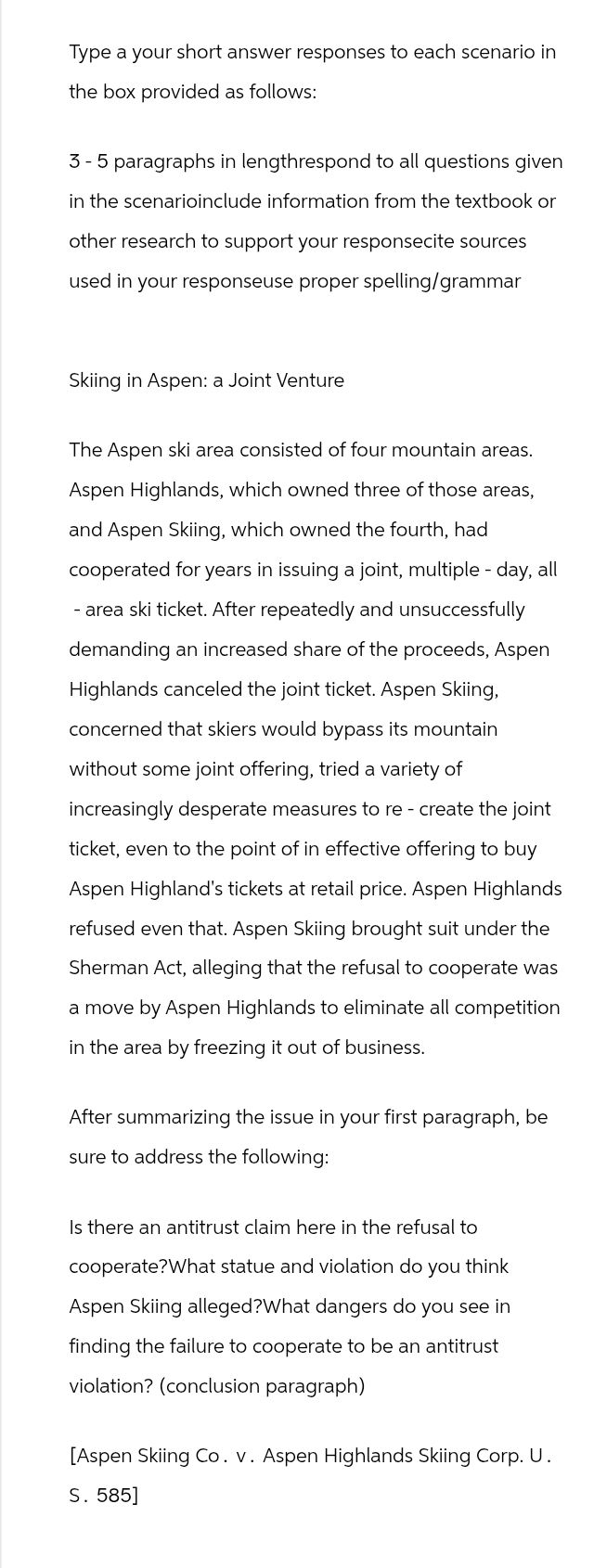 Type a your short answer responses to each scenario in
the box provided as follows:
3 - 5 paragraphs in lengthrespond to all questions given
in the scenarioinclude information from the textbook or
other research to support your responsecite sources
used in your responseuse proper spelling/grammar
Skiing in Aspen: a Joint Venture
The Aspen ski area consisted of four mountain areas.
Aspen Highlands, which owned three of those areas,
and Aspen Skiing, which owned the fourth, had
cooperated for years in issuing a joint, multiple - day, all
- area ski ticket. After repeatedly and unsuccessfully
demanding an increased share of the proceeds, Aspen
Highlands canceled the joint ticket. Aspen Skiing,
concerned that skiers would bypass its mountain
without some joint offering, tried a variety of
increasingly desperate measures to re - create the joint
ticket, even to the point of in effective offering to buy
Aspen Highland's tickets at retail price. Aspen Highlands
refused even that. Aspen Skiing brought suit under the
Sherman Act, alleging that the refusal to cooperate was
a move by Aspen Highlands to eliminate all competition
in the area by freezing it out of business.
After summarizing the issue in your first paragraph, be
sure to address the following:
Is there an antitrust claim here in the refusal to
cooperate?What statue and violation do you think
Aspen Skiing alleged?What dangers do you see in
finding the failure to cooperate to be an antitrust
violation? (conclusion paragraph)
[Aspen Skiing Co. v. Aspen Highlands Skiing Corp. U.
S. 585]
Type a your short answer responses to each scenario in
the box provided as follows:
3 - 5 paragraphs in lengthrespond to all questions given
in the scenarioinclude information from the textbook or
other research to support your responsecite sources
used in your responseuse proper spelling/grammar
Skiing in Aspen: a Joint Venture
The Aspen ski area consisted of four mountain areas.
Aspen Highlands, which owned three of those areas,
and Aspen Skiing, which owned the fourth, had
cooperated for years in issuing a joint, multiple - day, all
- area ski ticket. After repeatedly and unsuccessfully
demanding an increased share of the proceeds, Aspen
Highlands canceled the joint ticket. Aspen Skiing,
concerned that skiers would bypass its mountain
without some joint offering, tried a variety of
increasingly desperate measures to re - create the joint
ticket, even to the point of in effective offering to buy
Aspen Highland's tickets at retail price. Aspen Highlands
refused even that. Aspen Skiing brought suit under the
Sherman Act, alleging that the refusal to cooperate was
a move by Aspen Highlands to eliminate all competition
in the area by freezing it out of business.
After summarizing the issue in your first paragraph, be
sure to address the following:
Is there an antitrust claim here in the refusal to
cooperate?What statue and violation do you think
Aspen Skiing alleged?What dangers do you see in
finding the failure to cooperate to be an antitrust
violation? (conclusion paragraph)
[Aspen Skiing Co. v. Aspen Highlands Skiing Corp. U.
S. 585]
Asked by: Om
Created at: 2026-02-02 04:44:08
Final Answer:
📢 Instructions:
- Ask anything relatd to above question only.
- For new Question goto :