 VIPSolutions
Give step-by-step solution with explanation and final answer: {give me the answer without using bullet-points}321, The state of an ideal gas with C= (S/R is changed from P = 1 bur and V} = 12 m* 10m 12 bar dV = | m by the following mechamscally reversible processes: (@) Bother compression. (6) Adibatic compression followed by cooing of constant presare. (©) Adibatic compression followed by cooing af constant lume. ud) Heating st constant von followed by onlin 5 comntan preva. (e) Cooling at constant pressor followed by esting a constant vole. Caleulae 0. W. AU and AH for each of these processes, ad sketch the paths of al processes on a single PV diagram.
Question:
Give step-by-step solution with explanation and final answer:
{give me the answer without using bullet-points}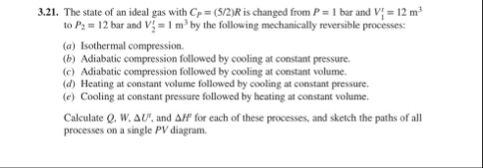 321, The state of an ideal gas with C= (S/R is changed from P = 1 bur and V} = 12 m*
10m 12 bar dV = | m by the following mechamscally reversible processes:
(@) Bother compression.
(6) Adibatic compression followed by cooing of constant presare.
(©) Adibatic compression followed by cooing af constant lume.
ud) Heating st constant von followed by onlin 5 comntan preva.
(e) Cooling at constant pressor followed by esting a constant vole.
Caleulae 0. W. AU and AH for each of these processes, ad sketch the paths of al
processes on a single PV diagram.
321, The state of an ideal gas with C= (S/R is changed from P = 1 bur and V} = 12 m*
10m 12 bar dV = | m by the following mechamscally reversible processes:
(@) Bother compression.
(6) Adibatic compression followed by cooing of constant presare.
(©) Adibatic compression followed by cooing af constant lume.
ud) Heating st constant von followed by onlin 5 comntan preva.
(e) Cooling at constant pressor followed by esting a constant vole.
Caleulae 0. W. AU and AH for each of these processes, ad sketch the paths of al
processes on a single PV diagram.
This is AI generated Response.
Asked by: francis
Created at: 2026-02-02 22:35:17
Asked by: francis
Created at: 2026-02-02 22:35:17
Final Answer:
Rendered
Raw Text
Did you like this answer?
Let's break down the problem step by step.
Given:
- The gas is ideal, with \( C_P = \frac{5}{2} R \).
- Initial state: \( P_1 = 1 \) bar, \( V_1 = 12 \) m³.
- Final state: \( P_2 = 12 \) bar, \( V_2 = 1 \) m³.
- We are to consider four processes and calculate \( Q \) (heat), \( W \) (work), \( \Delta U \) (change in internal energy), and \( \Delta F \) (change in Helmholtz free energy).
Let's denote \( n \) as the number of moles and \( R \) as the gas constant.
First, calculate the number of moles:
From the ideal gas law:
\( P_1 V_1 = nRT_1 \)
\( P_2 V_2 = nRT_2 \)
First, find \( n \) in terms of \( T_1 \) or \( T_2 \):
\( n = \frac{P_1 V_1}{RT_1} = \frac{P_2 V_2}{RT_2} \)
### 1. Isothermal Compression
For isothermal compression:
- \( T_1 = T_2 = T \)
- \( \Delta U = \) (since internal energy for an ideal gas depends only on temperature)
- Work done on the gas:
\( W = nRT \ln \frac{V_2}{V_1} \)
Since \( V_2 < V_1 \), \( W \) will be negative (work done **on** the gas).
- The heat exchanged:
\( Q = W \) (since \( \Delta U = \))
- Helmholtz Free Energy:
\( \Delta F = -nRT \ln \frac{V_2}{V_1} \)
Now, \( nRT = P_1V_1 \) or \( P_2V_2 \) at the same temperature, so:
\( nRT = (1\,\text{bar})(12\,\text{m}^3) = (12\,\text{bar})(1\,\text{m}^3) \)
Convert bar to SI units (1 bar = 100,000 Pa), but since ratios are used, units will cancel in logarithms.
\( W = nRT \ln \frac{1}{12} = nRT \ln(.0833) = -2.4849\, nRT \)
Let \( nRT = P_1V_1 = 12 \) bar·m³
So, \( W = 12 \ln \frac{1}{12} = 12 \times (-2.4849) = -29.819 \) bar·m³
Convert to Joules: \( 1\,\text{bar}\cdot \text{m}^3 = 10^5\,\text{J} \)
So, \( W = -2,981,900\,\text{J} \)
\( Q = W \)
\( \Delta U = \)
\( \Delta F = -W \) (since isothermal)
### 2. Adiabatic Compression, Then Cooling at Constant Pressure
**Step 1:** Adiabatic Compression:
- No heat exchange: \( Q_1 = \)
- Use adiabatic relation: \( P_1 V_1^{\gamma} = P_a V_a^{\gamma} \), where \( \gamma = C_P/C_V = (5/2)R/[(5/2)R - R] = 5/3 \)
- Find intermediate state (\( V_a \), \( P_a \)) such that final volume \( V_2 = 1\,\text{m}^3 \), final pressure \( P_2 = 12\,\text{bar} \).
But since the process ends at \( P_2, V_2 \), the adiabatic ends at the volume where further cooling at constant pressure brings us to the final state.
For adiabatic:
\( P_1 V_1^{\gamma} = P_x V_x^{\gamma} \),
Let \( V_x \) be the volume after adiabatic compression, where pressure is \( P_2 \).
\( P_1 V_1^{\gamma} = P_2 V_x^{\gamma} \)
\( V_x = V_1 \left(\frac{P_1}{P_2}\right)^{1/\gamma} = 12 \left(\frac{1}{12}\right)^{3/5} \)
\( \frac{1}{12}^{.6} \approx .164 \)
\( V_x = 12 \times .164 = 1.97\,\text{m}^3 \)
So, after adiabatic compression:
\( P = 12\,\text{bar}, V = 1.97\,\text{m}^3 \)
**Step 2:** Cooling at constant pressure to \( V_2 = 1\,\text{m}^3 \)
At constant pressure, cooling from \( V_x \) to \( V_2 \).
Calculate \( \Delta U \):
Since \( \Delta U = nC_V \Delta T \), and \( T = \frac{PV}{nR} \),
\( \Delta U = nC_V (T_2 - T_1) \), but need to find \( T_1 \) and \( T_2 \):
- \( T_1 = \frac{P_1 V_1}{nR} \)
- \( T_2 = \frac{P_2 V_2}{nR} \)
Let \( nR = P_1V_1/T_1 = 1 \times 12 / T_1 \)
But for ratios, just use the proportionality:
\( \frac{T_2}{T_1} = \frac{P_2 V_2}{P_1 V_1} = \frac{12 \times 1}{1 \times 12} = 1 \)
So \( T_2 = T_1 \), but that's not possible, let's check at each step:
After adiabatic, \( T_x = \frac{P_2 V_x}{nR} \)
Initial, \( T_1 = \frac{P_1 V_1}{nR} \)
\( \Delta U = nC_V (T_2 - T_1) \)
\( \Delta U = nC_V \left(\frac{P_2 V_2 - P_1 V_1}{nR}\right) \)
\( C_V = C_P - R = \frac{5}{2}R - R = \frac{3}{2}R \)
\( \Delta U = \frac{3}{2}(P_2 V_2 - P_1 V_1) \)
Plugging in:
\( P_1 V_1 = 12 \), \( P_2 V_2 = 12 \), so \( \Delta U = \frac{3}{2}(12 - 12) = \)
**But this suggests \( \Delta U = \) for all paths, which is only true for isothermal.**
Let me clarify for the adiabatic step.
For adiabatic step:
\( T_x = T_1 \left(\frac{V_1}{V_x}\right)^{\gamma-1} \)
\( T_1 = \frac{P_1 V_1}{nR} \)
\( T_x = T_1 \left(\frac{12}{1.97}\right)^{2/3} \)
Calculate \( \frac{12}{1.97} \approx 6.09 \), \( 6.09^{2/3} \approx 3.3 \)
So \( T_x = 3.3 T_1 \)
Now, at constant pressure, volume decreases from \( V_x = 1.97 \) to \( V_2 = 1 \),
So \( T_2 = T_x \frac{V_2}{V_x} = 3.3 T_1 \times \frac{1}{1.97} = 1.675 T_1 \)
So overall,
\( \Delta U = nC_V (T_2 - T_1) = nC_V (1.675 T_1 - T_1) = nC_V (.675 T_1) \)
Recall \( nRT_1 = P_1 V_1 = 12 \); \( C_V = 3/2 R \)
\( n = \frac{P_1 V_1}{RT_1} \)
Thus,
\( \Delta U = \frac{P_1 V_1}{RT_1} \cdot \frac{3}{2} R \cdot .675 T_1 = 12 \cdot \frac{3}{2} \cdot .675 = 12 \cdot 1.0125 = 12.15 \) bar·m³
Convert to Joules: \( 12.15 \times 10^5 = 1,215,000 \) J
Work done:
- **Adiabatic step:**
\( W_1 = \frac{P_2 V_x - P_1 V_1}{1 - \gamma} \)
\( \gamma = 5/3 \), \( 1 - \gamma = -2/3 \)
\( W_1 = \frac{12 \times 1.97 - 1 \times 12}{-2/3} = \frac{23.64 - 12}{-2/3} = \frac{11.64}{-2/3} = -17.46 \) bar·m³
- **Isobaric cooling:**
\( W_2 = P_2 (V_2 - V_x) = 12 (1 - 1.97) = 12 \times (-.97) = -11.64 \) bar·m³
Total work: \( W = W_1 + W_2 = -17.46 - 11.64 = -29.1 \) bar·m³ = -2,910,000 J
Heat exchanged: \( Q = \Delta U - W = 1,215,000 - (-2,910,000) = 4,125,000 \) J
Helmholtz free energy: \( \Delta F = \Delta U - T \Delta S \)
Change in entropy: \( \Delta S = nR \ln \frac{V_2}{V_1} + nC_V \ln \frac{T_2}{T_1} \)
\( \frac{V_2}{V_1} = \frac{1}{12} \), \( \frac{T_2}{T_1} = 1.675 \)
\( n = \frac{12}{RT_1} \)
So \( \Delta S = \frac{12}{T_1} \ln \frac{1}{12} + \frac{12}{T_1} \times \frac{3}{2} \ln 1.675 \)
But since the final and initial states are the same, \( \Delta F \) will be the same for all processes between the same initial and final states.
### 3. Adiabatic Compression then Cooling at Constant Volume
Similar steps, except now after adiabatic compression, cool at constant volume.
Adiabatic compression: \( P_1 V_1^{\gamma} = P_x V_2^{\gamma} \) (since final volume must be \( V_2 \))
\( P_x = P_1 (V_1/V_2)^{\gamma} = 1 \times (12/1)^{5/3} \approx 1 \times 55.3 = 55.3 \) bar
So after adiabatic compression, \( V_2 = 1 \) m³, \( P_x = 55.3 \) bar
Now, cool at constant volume \( V_2 \) from \( P_x = 55.3 \) bar to \( P_2 = 12 \) bar.
At constant volume:
- No work is done: \( W_2 = \)
- \( \Delta U_2 = nC_V (T_2 - T_x) \)
Where \( T_x = \frac{P_x V_2}{nR} \), \( T_2 = \frac{P_2 V_2}{nR} \)
\( \Delta U_2 = nC_V \left( \frac{P_2 - P_x}{nR} V_2 \right) = C_V (P_2 - P_x) V_2 / R \)
Plugging in values:
\( C_V = 3/2 R \), \( V_2 = 1 \), \( P_x = 55.3 \), \( P_2 = 12 \)
\( \Delta U_2 = \frac{3}{2} (12 - 55.3) = \frac{3}{2} \times (-43.3) = -64.95 \) bar·m³
Adiabatic work:
\( W_1 = \frac{P_x V_2 - P_1 V_1}{1 - \gamma} = \frac{55.3 \times 1 - 1 \times 12}{-2/3} = \frac{43.3}{-2/3} = -64
📢 Instructions:
- Ask anything relatd to above question only.
- For new Question goto :