 VIPSolutions
Give step-by-step solution with explanation and final answer:Camphor can be reduced from either the top face or the bottom face of the ring. An exo attack occurs from the top face. An endo attack occurs from the bottom face. H4C. CHy H3C, CH exo attack N N HC, CHs SHs 7 TN 5 o SH oy CHy oy H- 3 ~ + 4 endo attack 4 OH 4 H z 1 3 mp 206-208 °C mp 214°C Based on this information, Compound 1 is formed by an Enter answer | attack of H-, and Compound 3 is formed by Enter answer attack of H.
Question:
Give step-by-step solution with explanation and final answer: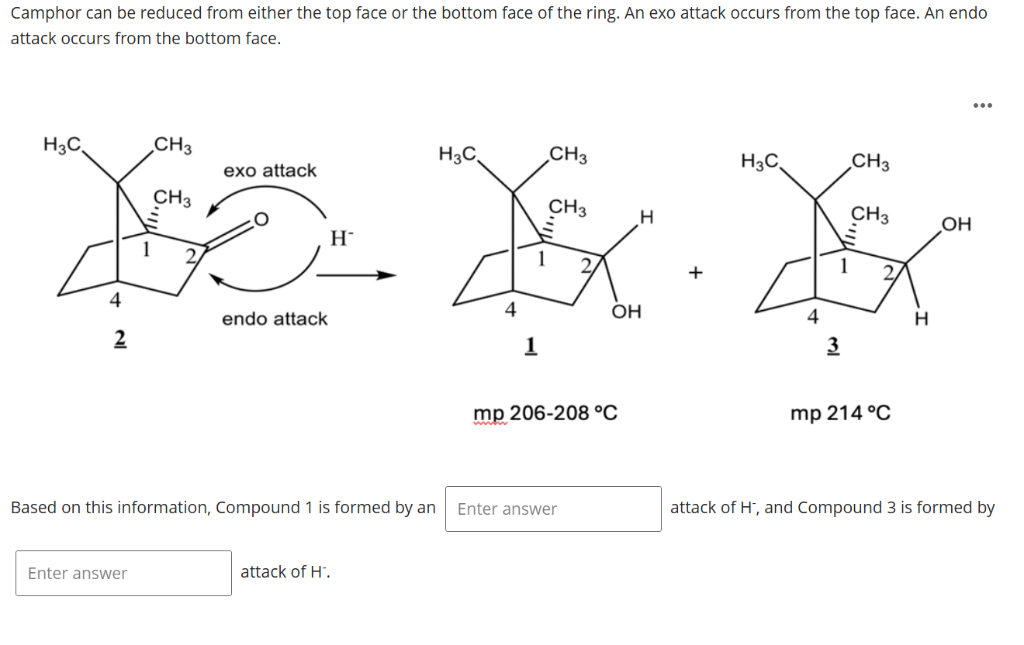 Camphor can be reduced from either the top face or the bottom face of the ring. An exo attack occurs from the top face. An endo
attack occurs from the bottom face.
H4C. CHy
H3C, CH
exo attack N N HC, CHs
SHs 7 TN
5 o SH oy CHy oy
H- 3
~ +
4
endo attack 4 OH 4 H
z 1 3
mp 206-208 °C mp 214°C
Based on this information, Compound 1 is formed by an Enter answer | attack of H-, and Compound 3 is formed by
Enter answer attack of H.
Camphor can be reduced from either the top face or the bottom face of the ring. An exo attack occurs from the top face. An endo
attack occurs from the bottom face.
H4C. CHy
H3C, CH
exo attack N N HC, CHs
SHs 7 TN
5 o SH oy CHy oy
H- 3
~ +
4
endo attack 4 OH 4 H
z 1 3
mp 206-208 °C mp 214°C
Based on this information, Compound 1 is formed by an Enter answer | attack of H-, and Compound 3 is formed by
Enter answer attack of H.
This is AI generated Response.
Asked by: Rahul
Created at: 2026-02-03 03:36:56
Asked by: Rahul
Created at: 2026-02-03 03:36:56
Final Answer:
Rendered
Raw Text
Did you like this answer?
Let's analyze the problem step-by-step:
### Step 1: Understand the Terminology
- **Exo attack:** H⁻ attacks from the **top face** of the ring.
- **Endo attack:** H⁻ attacks from the **bottom face** of the ring.
### Step 2: Analyze the Products Formed
- **Compound 1**: The OH group is on carbon 2 (axial), and the new hydrogen (from reduction) is on carbon 1 (equatorial).
- **Compound 3**: The OH group is on carbon 2 (equatorial), and the new hydrogen is on carbon 1 (axial).
### Step 3: Assign Attack Faces
- If H⁻ attacks from the **exo (top) face**, it will add from above, putting the hydrogen above the ring (axial position on carbon 1).
- If H⁻ attacks from the **endo (bottom) face**, it will add from below, putting the hydrogen below the ring (equatorial position on carbon 1).
### Step 4: Relate to the Products
- In **Compound 1**, the hydrogen is **equatorial** at C-1 (which is below the ring), so it comes from an **endo attack** (bottom face).
- In **Compound 3**, the hydrogen is **axial** at C-1 (which is above the ring), so it comes from an **exo attack** (top face).
### Step 5: Fill in the Answers
- **Compound 1:** Formed by **endo** attack of H⁻.
- **Compound 3:** Formed by **exo** attack of H⁻.
---
## **Final Answer**
> Based on this information, Compound 1 is formed by an **endo** attack of H⁻, and Compound 3 is formed by an **exo** attack of H⁻.
---
**Summary Table:**
| Compound | Attack Type | Face | H Position (C-1) |
|----------|-------------|-------------|------------------|
| 1 | Endo | Bottom | Equatorial |
| 3 | Exo | Top | Axial |
📢 Instructions:
- Ask anything relatd to above question only.
- For new Question goto :