 VIPSolutions
Give step-by-step solution with explanation and final answer: (give me the answer without using bullet points)Chemical Technology The separation of a binary mixture into its constituent components of desired purity is frequently Eaidansai achieved through the process of fractional distillation in a rectification column. This operation relies heavily on the trestonto mein a-cetificatioms for the difference in volatility between the components, which governs the distribution of species between the vapor and liquid phases. Of L The design and optimization of such a column necessitate a thorough understanding of the a equilibrium relationships, the operating lines, and the overall efficiency of the contacting stages. D Considering a continuous distillation column operating at steady state with a total condenser and a partial reboiler, the composition profile across the column is established through a series of stage-wise equilibrium and mass balance calculations. The performance of the column is critically E dependent on the extent to which equilibrium is approached on each tray, which is quantified by the stage efficiency. A The equilibrium relationship for a binary mixture can be characterized by the relative volatility. V i Obtain the expression for the vapor-phase mole fraction of the more volatile component in terms of its liquid-phase mole fraction and the relative volatility. Py Reboiler ii Reduce the derived expression for the special case where the relative volatility is unity, and comment on the implications for separation. B The overall efficiency of the column is a measure of its actual performance compared to an ideal theoretical performance. i Establish the relationship between the number of actual trays required and the number of theoretical stages determined from equilibrium and operating line analysis, defining the overall column efficiency. ii Develop the equation for the Murphree vapor-phase tray efficiency, relating the actual change in vapor composition across a tray to the change that would occur if the vapor leaving the tray were in equilibrium with the liquid on the tray.
Question:
Give step-by-step solution with explanation and final answer:
(give me the answer without using bullet points)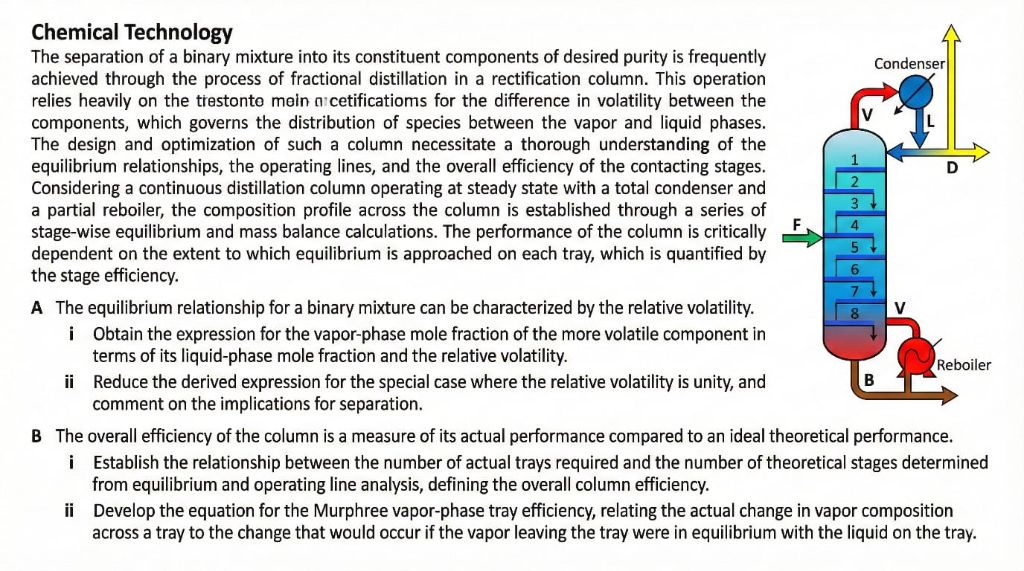 Chemical Technology
The separation of a binary mixture into its constituent components of desired purity is frequently Eaidansai
achieved through the process of fractional distillation in a rectification column. This operation
relies heavily on the trestonto mein a-cetificatioms for the difference in volatility between the
components, which governs the distribution of species between the vapor and liquid phases. Of L
The design and optimization of such a column necessitate a thorough understanding of the a
equilibrium relationships, the operating lines, and the overall efficiency of the contacting stages. D
Considering a continuous distillation column operating at steady state with a total condenser and
a partial reboiler, the composition profile across the column is established through a series of
stage-wise equilibrium and mass balance calculations. The performance of the column is critically E
dependent on the extent to which equilibrium is approached on each tray, which is quantified by
the stage efficiency.
A The equilibrium relationship for a binary mixture can be characterized by the relative volatility. V
i Obtain the expression for the vapor-phase mole fraction of the more volatile component in
terms of its liquid-phase mole fraction and the relative volatility. Py Reboiler
ii Reduce the derived expression for the special case where the relative volatility is unity, and
comment on the implications for separation.
B The overall efficiency of the column is a measure of its actual performance compared to an ideal theoretical performance.
i Establish the relationship between the number of actual trays required and the number of theoretical stages determined
from equilibrium and operating line analysis, defining the overall column efficiency.
ii Develop the equation for the Murphree vapor-phase tray efficiency, relating the actual change in vapor composition
across a tray to the change that would occur if the vapor leaving the tray were in equilibrium with the liquid on the tray.
Chemical Technology
The separation of a binary mixture into its constituent components of desired purity is frequently Eaidansai
achieved through the process of fractional distillation in a rectification column. This operation
relies heavily on the trestonto mein a-cetificatioms for the difference in volatility between the
components, which governs the distribution of species between the vapor and liquid phases. Of L
The design and optimization of such a column necessitate a thorough understanding of the a
equilibrium relationships, the operating lines, and the overall efficiency of the contacting stages. D
Considering a continuous distillation column operating at steady state with a total condenser and
a partial reboiler, the composition profile across the column is established through a series of
stage-wise equilibrium and mass balance calculations. The performance of the column is critically E
dependent on the extent to which equilibrium is approached on each tray, which is quantified by
the stage efficiency.
A The equilibrium relationship for a binary mixture can be characterized by the relative volatility. V
i Obtain the expression for the vapor-phase mole fraction of the more volatile component in
terms of its liquid-phase mole fraction and the relative volatility. Py Reboiler
ii Reduce the derived expression for the special case where the relative volatility is unity, and
comment on the implications for separation.
B The overall efficiency of the column is a measure of its actual performance compared to an ideal theoretical performance.
i Establish the relationship between the number of actual trays required and the number of theoretical stages determined
from equilibrium and operating line analysis, defining the overall column efficiency.
ii Develop the equation for the Murphree vapor-phase tray efficiency, relating the actual change in vapor composition
across a tray to the change that would occur if the vapor leaving the tray were in equilibrium with the liquid on the tray.
Asked by: Francis
Created at: 2026-02-06 08:02:36
Final Answer:
📢 Instructions:
- Ask anything relatd to above question only.
- For new Question goto :