 VIPSolutions
Give step-by-step solution with explanation and final answer: {Give me the answer without using bullet points}1. (25 points) Consider the following gas-phase reaction for methane combustion: CH: (@)+20:(8) —> CO:(2)+2H:0() ‘The reaction rate is given by: r= k * Css with k = 1 min at 600 °C. ‘This reaction is carried out in a continuous-flow reactor that is operated isobarically (1 atm) and. isothermally (600 °C). The inlet composition is 1 mol % CH in synthetic air (20% Oz, 80% Na), and the inlet volumetric flow rate is 50 dm? min”. (@) Assume the reaction is carried out in a tubular plug flow reactor (PFR), of length L and radius R. @ Sketch the total volumetric flow rate as a function of non-dimensional reactor length (21L, which goes from 0 to 1). Explain your answer, and how this information allows you to simplify your expression for the CHs conversion. (i) Derive the design equation for the PFR using methane for the mole balance. (iii) Calculate the PFR volume required to achieve 70% conversion of CHi. (iv) Sketch the CFs concentration as a function of the radius of the PFR, at the reactor exit, assuming the conditions for part (ii). (b) Assume the reaction is carried out in a continuous stirred tank reactor (CSTR). @ Calculate the CSTR volume required to achieve 70% conversion of CHs. (i) Explain why the PFR and CSTR volumes required to achieve 70% conversion of CH are different. (iii) How would your answer to part (i) change if the reaction rate instead were: @ r=k (no dependence on CH concentration) (6) r=k* Cow? (imverse squared dependence on CH concentration)
Question:
Give step-by-step solution with explanation and final answer:
{Give me the answer without using bullet points}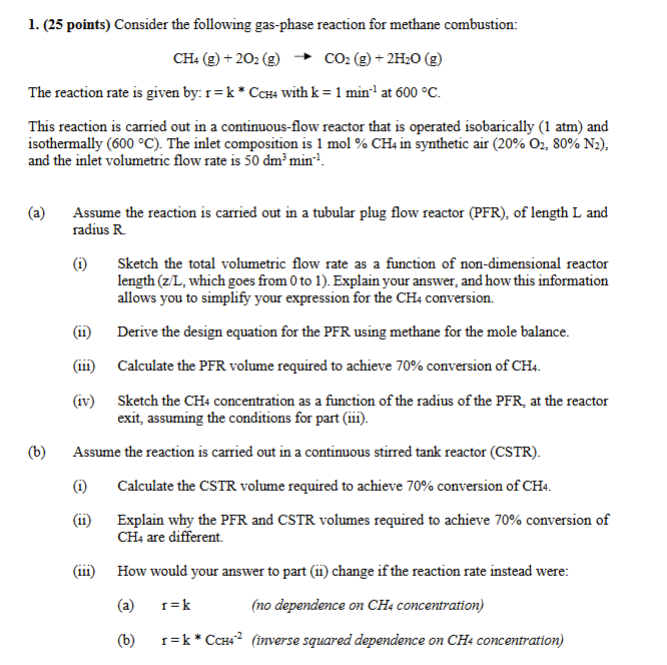 1. (25 points) Consider the following gas-phase reaction for methane combustion:
CH: (@)+20:(8) —> CO:(2)+2H:0()
‘The reaction rate is given by: r= k * Css with k = 1 min at 600 °C.
‘This reaction is carried out in a continuous-flow reactor that is operated isobarically (1 atm) and.
isothermally (600 °C). The inlet composition is 1 mol % CH in synthetic air (20% Oz, 80% Na),
and the inlet volumetric flow rate is 50 dm? min”.
(@) Assume the reaction is carried out in a tubular plug flow reactor (PFR), of length L and
radius R.
@ Sketch the total volumetric flow rate as a function of non-dimensional reactor
length (21L, which goes from 0 to 1). Explain your answer, and how this information
allows you to simplify your expression for the CHs conversion.
(i) Derive the design equation for the PFR using methane for the mole balance.
(iii) Calculate the PFR volume required to achieve 70% conversion of CHi.
(iv) Sketch the CFs concentration as a function of the radius of the PFR, at the reactor
exit, assuming the conditions for part (ii).
(b) Assume the reaction is carried out in a continuous stirred tank reactor (CSTR).
@ Calculate the CSTR volume required to achieve 70% conversion of CHs.
(i) Explain why the PFR and CSTR volumes required to achieve 70% conversion of
CH are different.
(iii) How would your answer to part (i) change if the reaction rate instead were:
@ r=k (no dependence on CH concentration)
(6) r=k* Cow? (imverse squared dependence on CH concentration)
1. (25 points) Consider the following gas-phase reaction for methane combustion:
CH: (@)+20:(8) —> CO:(2)+2H:0()
‘The reaction rate is given by: r= k * Css with k = 1 min at 600 °C.
‘This reaction is carried out in a continuous-flow reactor that is operated isobarically (1 atm) and.
isothermally (600 °C). The inlet composition is 1 mol % CH in synthetic air (20% Oz, 80% Na),
and the inlet volumetric flow rate is 50 dm? min”.
(@) Assume the reaction is carried out in a tubular plug flow reactor (PFR), of length L and
radius R.
@ Sketch the total volumetric flow rate as a function of non-dimensional reactor
length (21L, which goes from 0 to 1). Explain your answer, and how this information
allows you to simplify your expression for the CHs conversion.
(i) Derive the design equation for the PFR using methane for the mole balance.
(iii) Calculate the PFR volume required to achieve 70% conversion of CHi.
(iv) Sketch the CFs concentration as a function of the radius of the PFR, at the reactor
exit, assuming the conditions for part (ii).
(b) Assume the reaction is carried out in a continuous stirred tank reactor (CSTR).
@ Calculate the CSTR volume required to achieve 70% conversion of CHs.
(i) Explain why the PFR and CSTR volumes required to achieve 70% conversion of
CH are different.
(iii) How would your answer to part (i) change if the reaction rate instead were:
@ r=k (no dependence on CH concentration)
(6) r=k* Cow? (imverse squared dependence on CH concentration)
Asked by: Francis
Created at: 2026-02-06 09:01:20
Final Answer:
📢 Instructions:
- Ask anything relatd to above question only.
- For new Question goto :