 VIPSolutions
Give step-by-step solution with explanation and final answer: {give me the answer with out using bullet points}3.25 points) As a chemical process engineer at a specialty chemical production plant, you are tasked with designing 2 new isothermal. liquid-phase process to form an industrial-grade solvent, B, from a new starting feedstock, A. A—3B —ry = kG k=1210 2 mol 2 min" The new feedstock is available as pure A at a concentration (Css) of 10 M, and can be delivered to the process at a steady-state volumetric flow rate (vs) of 5 L/min You are given two reactors of equal volume (cach is 100 L), where one is a CSTR and one is 2 PER, and can decide between the following three configurations for the reactor network: () Reactors in series: CSTR followed by a PEFR. (i) Reactors in series: PER followed by a CSTR. (ii) Reactors in parallel with half of the feed going fo cach reactor. (2) Calculate the exit conversion of A for each of the three configurations. (b) Explain which reactor configuration will give the highest overall conversion, and the differences in conversion between configurations (i) 2nd (i). One moming, you arrive at work and find out that the motor for the impeller of the CSTR has ‘burnt out due to 2 voltage spike. Instead of perfectly well-mixed, the hydrodynamics inside of the CSTR can now be modeled as perfectly plug-flow. (©) Calculate the new overall conversion of A in each of the three configurations (9), i), (ii). @) Reactors in series: PFR followed by a PFR (i) Reactors in parallel with half of the feed going fo cach reactor. (d) Explain why the overall conversion increased, decreased, or remained constant in cach of the configurations in part (c) compared with part (a). (Jn other words, for each case, what happens to the conversion when the CSTR behaves like a PFR, and wiy?) (¢) Explain why the overall conversion increased, decreased, or remained constant between the PFRs arranged in series (c i) or in parallel (c ii).
Question:
Give step-by-step solution with explanation and final answer:
{give me the answer with out using bullet points}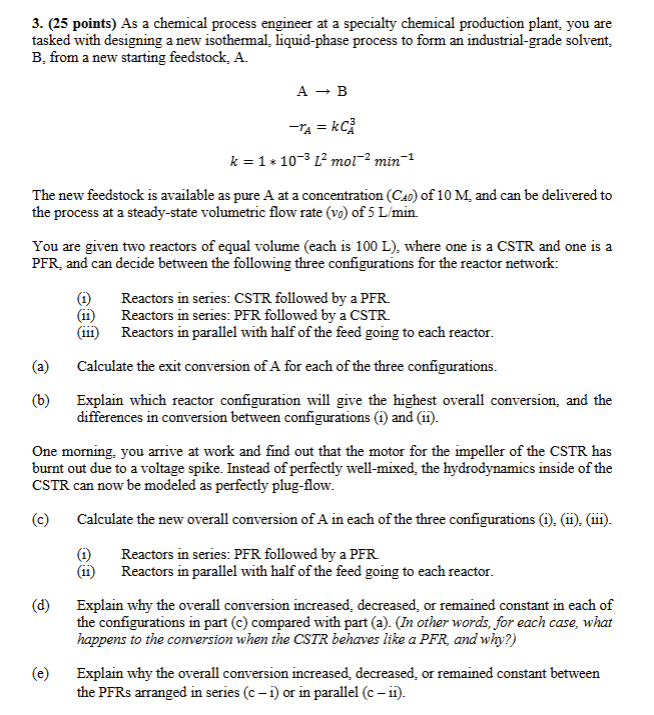 3.25 points) As a chemical process engineer at a specialty chemical production plant, you are
tasked with designing 2 new isothermal. liquid-phase process to form an industrial-grade solvent,
B, from a new starting feedstock, A.
A—3B
—ry = kG
k=1210 2 mol 2 min"
The new feedstock is available as pure A at a concentration (Css) of 10 M, and can be delivered to
the process at a steady-state volumetric flow rate (vs) of 5 L/min
You are given two reactors of equal volume (cach is 100 L), where one is a CSTR and one is 2
PER, and can decide between the following three configurations for the reactor network:
() Reactors in series: CSTR followed by a PEFR.
(i) Reactors in series: PER followed by a CSTR.
(ii) Reactors in parallel with half of the feed going fo cach reactor.
(2) Calculate the exit conversion of A for each of the three configurations.
(b) Explain which reactor configuration will give the highest overall conversion, and the
differences in conversion between configurations (i) 2nd (i).
One moming, you arrive at work and find out that the motor for the impeller of the CSTR has
‘burnt out due to 2 voltage spike. Instead of perfectly well-mixed, the hydrodynamics inside of the
CSTR can now be modeled as perfectly plug-flow.
(©) Calculate the new overall conversion of A in each of the three configurations (9), i), (ii).
@) Reactors in series: PFR followed by a PFR
(i) Reactors in parallel with half of the feed going fo cach reactor.
(d) Explain why the overall conversion increased, decreased, or remained constant in cach of
the configurations in part (c) compared with part (a). (Jn other words, for each case, what
happens to the conversion when the CSTR behaves like a PFR, and wiy?)
(¢) Explain why the overall conversion increased, decreased, or remained constant between
the PFRs arranged in series (c i) or in parallel (c ii).
3.25 points) As a chemical process engineer at a specialty chemical production plant, you are
tasked with designing 2 new isothermal. liquid-phase process to form an industrial-grade solvent,
B, from a new starting feedstock, A.
A—3B
—ry = kG
k=1210 2 mol 2 min"
The new feedstock is available as pure A at a concentration (Css) of 10 M, and can be delivered to
the process at a steady-state volumetric flow rate (vs) of 5 L/min
You are given two reactors of equal volume (cach is 100 L), where one is a CSTR and one is 2
PER, and can decide between the following three configurations for the reactor network:
() Reactors in series: CSTR followed by a PEFR.
(i) Reactors in series: PER followed by a CSTR.
(ii) Reactors in parallel with half of the feed going fo cach reactor.
(2) Calculate the exit conversion of A for each of the three configurations.
(b) Explain which reactor configuration will give the highest overall conversion, and the
differences in conversion between configurations (i) 2nd (i).
One moming, you arrive at work and find out that the motor for the impeller of the CSTR has
‘burnt out due to 2 voltage spike. Instead of perfectly well-mixed, the hydrodynamics inside of the
CSTR can now be modeled as perfectly plug-flow.
(©) Calculate the new overall conversion of A in each of the three configurations (9), i), (ii).
@) Reactors in series: PFR followed by a PFR
(i) Reactors in parallel with half of the feed going fo cach reactor.
(d) Explain why the overall conversion increased, decreased, or remained constant in cach of
the configurations in part (c) compared with part (a). (Jn other words, for each case, what
happens to the conversion when the CSTR behaves like a PFR, and wiy?)
(¢) Explain why the overall conversion increased, decreased, or remained constant between
the PFRs arranged in series (c i) or in parallel (c ii).
Asked by: Francis
Created at: 2026-02-06 11:03:47
Final Answer:
📢 Instructions:
- Ask anything relatd to above question only.
- For new Question goto :