Give step-by-step solution with explanation and final answer:A packed-bed catalytic reactor is employed for the irreversible, first-order, gas-phase reaction A - B. The feed enters the
reactor with a molar flow rate of Fy = 50 mol/min and an initial concentration of C4o = 0.2 mol/L at a temperature of
450 K and a pressure of 15 atm. The reactor contains W = 150 kg of catalyst, and the bulk density of the catalyst bed is
pp = 1200 kg/m?3. The specific reaction rate constant at 450 K is determined to be k = 0.85 L/(kg.,.‘min). The catalyst is
subject to deactivation due to coking, which follows a first-order decay law with respect to the catalyst activity, a, such that
—da/dt = kya. The deactivation rate constant, kg, is temperature-dependent and is given by the Arrhenius equation with
a pre-exponential factor k49 = 0.12 min~* and an activation energy of Eq = 50.2 kJ/mol. The universal gas = 50.2 kJ/mol.
The universal gas constant is R = 8.314 J/(mol-K). The reactor operates isothermally at 450 K. You are required to
analyze the reactor performance by calculating the exit conversion of species A after the reactor has been in
operation for t = 60 minutes. Additionally, you must determine the time required for the catalyst activity to decay to
50% of its initial value. The calculations must account for the coupled effects of the chemical reaction, the catalyst
deactivation over time, and the resulting impact on the overall reaction rate along to the reactor length. Assume ideal
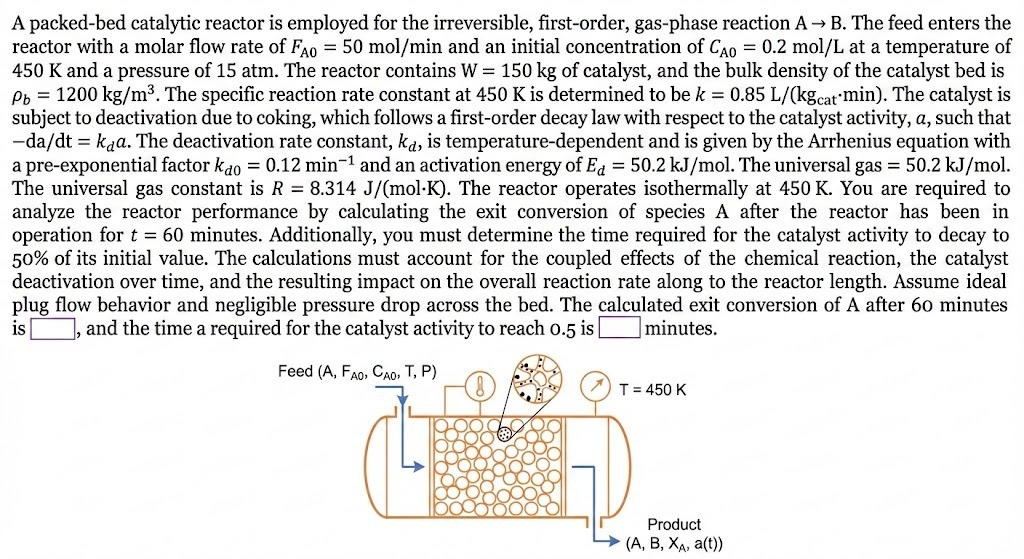
plug flow behavior and negligible pressure drop across the bed. The calculated exit conversion of A after 60 minutes
is], and the time a required for the catalyst activity to reach 0.5is[__| minutes.
Poo)
Feed (A, Fag, Cao, T, P) .
fp ® £5 7) 1=450K
RRR
Oi 'e terse
PaSasieves
BERR
19.090) J]
BAa685
Product
(A, B, Xa, a(t))
Question:
Give step-by-step solution with explanation and final answer:A packed-bed catalytic reactor is employed for the irreversible, first-order, gas-phase reaction A - B. The feed enters the
reactor with a molar flow rate of Fy = 50 mol/min and an initial concentration of C4o = 0.2 mol/L at a temperature of
450 K and a pressure of 15 atm. The reactor contains W = 150 kg of catalyst, and the bulk density of the catalyst bed is
pp = 1200 kg/m?3. The specific reaction rate constant at 450 K is determined to be k = 0.85 L/(kg.,.‘min). The catalyst is
subject to deactivation due to coking, which follows a first-order decay law with respect to the catalyst activity, a, such that
—da/dt = kya. The deactivation rate constant, kg, is temperature-dependent and is given by the Arrhenius equation with
a pre-exponential factor k49 = 0.12 min~* and an activation energy of Eq = 50.2 kJ/mol. The universal gas = 50.2 kJ/mol.
The universal gas constant is R = 8.314 J/(mol-K). The reactor operates isothermally at 450 K. You are required to
analyze the reactor performance by calculating the exit conversion of species A after the reactor has been in
operation for t = 60 minutes. Additionally, you must determine the time required for the catalyst activity to decay to
50% of its initial value. The calculations must account for the coupled effects of the chemical reaction, the catalyst
deactivation over time, and the resulting impact on the overall reaction rate along to the reactor length. Assume ideal
plug flow behavior and negligible pressure drop across the bed. The calculated exit conversion of A after 60 minutes
is], and the time a required for the catalyst activity to reach 0.5is[__| minutes.
Poo)
Feed (A, Fag, Cao, T, P) .
fp ® £5 7) 1=450K
RRR
Oi 'e terse
PaSasieves
BERR
19.090) J]
BAa685
Product
(A, B, Xa, a(t))
This is AI generated Response.
Asked by: venky
Created at: 2026-02-07 22:03:45
Final Answer:
RenderedRaw Text
Did you like this answer?
Let's solve the problem step by step:
---
## **1. List Given Data**
- **Molar flow rate:** \( F_{A} = 50 \) mol/min
- **Initial concentration:** \( C_{A} = .2 \) mol/L
- **Temperature:** \( T = 450 \) K
- **Pressure:** \( P = 15 \) atm (not needed for this calculation)
- **Catalyst weight:** \( W = 150 \) kg
- **Bulk density:** \( \rho_b = 120 \) kg/m³
- **Rate constant at 450 K:** \( k = .85 \) L/(kg·min)
- **Catalyst deactivation:** \( -\dfrac{da}{dt} = k_d a \)
- **Arrhenius for \( k_d \):**
\( k_{d} = .12 \) min⁻¹
\( E_d = 50.2 \) kJ/mol = 50200 J/mol
- **Gas constant:** \( R = 8.314 \) J/(mol·K)
- **Time for conversion calculation:** \( t = 60 \) min
---
## **2. Calculate Deactivation Rate Constant \( k_d \) at 450 K**
\[
k_d = k_{d} \exp\left(-\frac{E_d}{RT}\right)
\]
\[
k_d = .12 \exp\left(-\frac{50200}{8.314 \times 450}\right)
\]
Calculate the exponent:
\[
\frac{50200}{8.314 \times 450} = \frac{50200}{3741.3} \approx 13.42
\]
So,
\[
k_d = .12 \exp(-13.42)
\]
\[
\exp(-13.42) \approx 1.48 \times 10^{-6}
\]
\[
k_d = .12 \times 1.48 \times 10^{-6} \approx 1.78 \times 10^{-7} \text{ min}^{-1}
\]
---
## **3. Catalyst Activity Decay**
\[
-\frac{da}{dt} = k_d a \implies \frac{da}{a} = -k_d dt
\]
Integrate from \( a_ = 1 \) to \( a \) and \( t = \) to \( t \):
\[
\ln a = -k_d t \implies a = \exp(-k_d t)
\]
---
## **4. Plug Flow Reactor Conversion with Deactivation**
**For a PFR with first-order, irreversible reaction and deactivation:**
The rate at any time:
\[
-r_A = k a C_A
\]
The mole balance (in terms of catalyst weight, \( W \)):
\[
\frac{dF_A}{dW} = -r_A = -k a C_A
\]
For a differential catalyst slice (but since \( a \) is only a function of time, it's OK to treat as a batch decay for the activity):
For the whole reactor, integrate over \( W \):
\[
F_{A} X = \int_^W k a(t) C_A dW
\]
Since it's PFR and \( a \) is uniform throughout the reactor at a given time, use the design equation:
\[
W = \frac{F_{A}}{k a} \ln\left(\frac{C_{A}}{C_A}\right)
\]
Or, in terms of conversion \( X \) (since \( C_A = C_{A}(1-X) \)):
\[
W = \frac{F_{A}}{k a} \ln\left(\frac{1}{1-X}\right)
\]
But due to deactivation with time, after time \( t \), \( a = \exp(-k_d t) \).
---
### **At \( t = 60 \) min:**
\[
a(60) = \exp(-k_d \times 60)
\]
\[
a(60) = \exp(-1.78 \times 10^{-7} \times 60) \approx \exp(-1.07 \times 10^{-5}) \approx .999989
\]
So **deactivation is negligible** over 60 min (since \( k_d \) is extremely small).
---
### **Calculate Conversion:**
\[
W = \frac{F_{A}}{k a} \ln\left(\frac{1}{1-X}\right)
\]
Solve for \( X \):
\[
\ln\left(\frac{1}{1-X}\right) = \frac{W k a}{F_{A}}
\]
\[
1-X = \exp\left(-\frac{W k a}{F_{A}}\right)
\]
\[
X = 1 - \exp\left(-\frac{W k a}{F_{A}}\right)
\]
Plug in values:
- \( W = 150 \) kg
- \( k = .85 \) L/(kg·min)
- \( a \approx .999989 \)
- \( F_{A} = 50 \) mol/min
Calculate \( W k a / F_{A} \):
\[
\frac{150 \times .85 \times .999989}{50} \approx \frac{127.498}{50} = 2.55
\]
\[
X = 1 - \exp(-2.55) = 1 - .078 = .922
\]
---
## **5. Time to Reach \( a = .5 \) (50% Activity)**
\[
a = \exp(-k_d t)
\]
\[
.5 = \exp(-k_d t)
\]
\[
\ln(.5) = -k_d t
\]
\[
t = -\frac{\ln(.5)}{k_d} = \frac{.6931}{1.78 \times 10^{-7}}
\]
\[
t = 3.89 \times 10^6 \text{ min}
\]
Convert to years for reference:
\[
\frac{3.89 \times 10^6}{60 \times 24 \times 365} \approx 7.4 \text{ years}
\]
---
## **6. **Final Answers in Boxes**
- **Calculated exit conversion after 60 minutes:**
**.92**
- **Time for catalyst activity to decay to .5:**
**3.9 × 10⁶ min**
---
### **Summary Table**
| Quantity | Value |
|------------------------------------------------|-------------------|
| Exit Conversion after 60 min | .92 |
| Time for activity to reach .5 | 3.9 × 10⁶ min |
---
#### **Boxed Answers:**
> The calculated exit conversion of A after 60 minutes is **.92**, and the time required for the catalyst activity to reach .5 is **3.9 × 10⁶ min**.
---
If you need detailed step-by-step calculations or clarifications on any step, let me know!
VIPSolutions focuses on clear, step‑by‑step explanations so you can learn quickly. Whether you need an AI‑generated walkthrough or a short hint to get unstuck, each solution is organized for fast reading and easy review later.
Search similar questions, compare approaches, and bookmark the best answers for revision. Our goal is simple: quick, reliable study help that feels natural—not noisy.
 VIPSolutions
 A packed-bed catalytic reactor is employed for the irreversible, first-order, gas-phase reaction A - B. The feed enters the
reactor with a molar flow rate of Fy = 50 mol/min and an initial concentration of C4o = 0.2 mol/L at a temperature of
450 K and a pressure of 15 atm. The reactor contains W = 150 kg of catalyst, and the bulk density of the catalyst bed is
pp = 1200 kg/m?3. The specific reaction rate constant at 450 K is determined to be k = 0.85 L/(kg.,.‘min). The catalyst is
subject to deactivation due to coking, which follows a first-order decay law with respect to the catalyst activity, a, such that
—da/dt = kya. The deactivation rate constant, kg, is temperature-dependent and is given by the Arrhenius equation with
a pre-exponential factor k49 = 0.12 min~* and an activation energy of Eq = 50.2 kJ/mol. The universal gas = 50.2 kJ/mol.
The universal gas constant is R = 8.314 J/(mol-K). The reactor operates isothermally at 450 K. You are required to
analyze the reactor performance by calculating the exit conversion of species A after the reactor has been in
operation for t = 60 minutes. Additionally, you must determine the time required for the catalyst activity to decay to
50% of its initial value. The calculations must account for the coupled effects of the chemical reaction, the catalyst
deactivation over time, and the resulting impact on the overall reaction rate along to the reactor length. Assume ideal
plug flow behavior and negligible pressure drop across the bed. The calculated exit conversion of A after 60 minutes
is], and the time a required for the catalyst activity to reach 0.5is[__| minutes.
Poo)
Feed (A, Fag, Cao, T, P) .
fp ® £5 7) 1=450K
RRR
Oi 'e terse
PaSasieves
BERR
19.090) J]
BAa685
Product
(A, B, Xa, a(t))
A packed-bed catalytic reactor is employed for the irreversible, first-order, gas-phase reaction A - B. The feed enters the
reactor with a molar flow rate of Fy = 50 mol/min and an initial concentration of C4o = 0.2 mol/L at a temperature of
450 K and a pressure of 15 atm. The reactor contains W = 150 kg of catalyst, and the bulk density of the catalyst bed is
pp = 1200 kg/m?3. The specific reaction rate constant at 450 K is determined to be k = 0.85 L/(kg.,.‘min). The catalyst is
subject to deactivation due to coking, which follows a first-order decay law with respect to the catalyst activity, a, such that
—da/dt = kya. The deactivation rate constant, kg, is temperature-dependent and is given by the Arrhenius equation with
a pre-exponential factor k49 = 0.12 min~* and an activation energy of Eq = 50.2 kJ/mol. The universal gas = 50.2 kJ/mol.
The universal gas constant is R = 8.314 J/(mol-K). The reactor operates isothermally at 450 K. You are required to
analyze the reactor performance by calculating the exit conversion of species A after the reactor has been in
operation for t = 60 minutes. Additionally, you must determine the time required for the catalyst activity to decay to
50% of its initial value. The calculations must account for the coupled effects of the chemical reaction, the catalyst
deactivation over time, and the resulting impact on the overall reaction rate along to the reactor length. Assume ideal
plug flow behavior and negligible pressure drop across the bed. The calculated exit conversion of A after 60 minutes
is], and the time a required for the catalyst activity to reach 0.5is[__| minutes.
Poo)
Feed (A, Fag, Cao, T, P) .
fp ® £5 7) 1=450K
RRR
Oi 'e terse
PaSasieves
BERR
19.090) J]
BAa685
Product
(A, B, Xa, a(t))